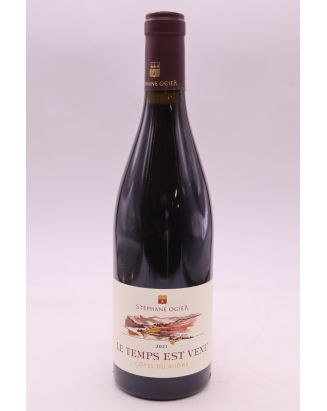
Stéphane Ogier Côtes du Rhône Le Temps est Venu 2021
Personalise your experience
Change your country, language and currency here whenever you wish.
|
|
|
Must-See Châteaux |
|
|
|
|
|
|
|
|
The Ogier family, originally from Cote Rotie, has been based in Ampuis for more than six generations, but until 1982, Domaine Stephane Ogier sold its grapes. In 1983, Domaine Michel et Stéphane Ogier decided to begin producing its Cote Rotie wines under its own label, just as the Cote Rotie appellation was enjoying a resurgence. After six vintages, Michel Ogier decided to stop selling grapes to négociants altogether and vinify all his cuvées himself. Domaine Ogier expanded with several parcels outside the Côte Rôtie AOC, and in 1997, Stéphane Ogier joined the estate to help his father. Under his leadership, Domaine Stephane Ogier gradually grew to a total of 18 hectares.
The Ogier family has been rooted in Ampuis for seven generations, but its history as an independent winemaking family is more recent. Michel Ogier began by buying vineyards and selling his harvest, starting with plots at the Lancement and Côte Rozier sites. Until 1982, all the grapes went to wine merchants, with Guigal and Chapoutier his two largest customers. At the time, the family actually earned more from fruit growing than from vines.
Recognizing the exceptional quality of his grapes, Michel Ogier began making and bottling wine at the estate in 1983. By 1987, the entire harvest was bottled and sold under the family label. La Belle Hélène was born in 1995, initially as an experiment, and named after Michel’s wife. The decisive turning point came in 1997: after studying viticulture and enology in Beaune and completing formative internships with leading Burgundian winemakers and abroad, Stéphane Ogier joined his father. Impressed by the central role of terroir in Burgundian wine culture and drawn to the finesse of Pinot Noir, he applied that perspective to Syrah and Viognier. The cellars were completely renovated in 2003; new plots were acquired in Condrieu from 2007, then in Saint-Joseph, Seyssuel and as far south as Cairanne and the Plan de Dieu. A state-of-the-art winery was built in Ampuis in 2014, making it possible to vinify around fifteen different cuvées, and the estate was renamed Domaine Stéphane Ogier in 2015.
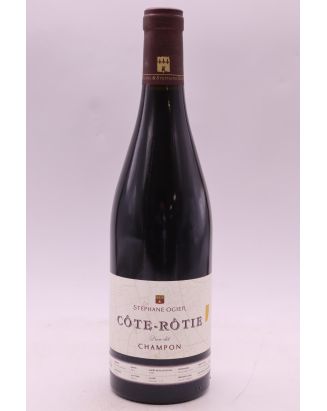
Côte-Rôtie remains the heart of the estate, with plots across the appellation’s most famous named sites: Lancement, Côte Rozier, La Viallière, But de Mont, Champon, Le Besset and La Côte Blonde. The hillside’s dual identity shapes the entire range. The Côte Blonde, with gneiss and light-colored granite mixed with sand, brings finesse, fragrance and elegance. The Côte Brune, with iron-rich schist and clay, lends power, density and longevity.
Through successive acquisitions, Stéphane Ogier has considerably broadened this range of terroirs. Five hectares in Condrieu give Viognier terraces of decomposed granite. Vineyards in Saint-Joseph add to the holdings on the right bank. At Seyssuel, on the Rhône’s left bank, he replanted an ancient vineyard on Paleozoic-era schist that yields Syrah wines of striking minerality. Farther south, Grenache and Syrah plots in Cairanne and the Plan de Dieu supply the house’s Côtes du Rhône wines. True to his Burgundian convictions, the winemaker closely oversees soil management, sometimes using horses to plow the steepest terraces, and rejects heavy mechanization on the hillsides. The grapes are harvested by hand, plot by plot, at optimal ripeness.
The estate’s philosophy is summed up in a remark by its owner: Côte-Rôtie has no grands crus, but he has his own. Each named site is therefore vinified separately to preserve its identity, with varying proportions of destemmed grapes and whole bunches depending on the plot and vintage. La Belle Hélène, for example, is vinified entirely as whole bunches, while Lancement is fully destemmed, accounting for their strikingly different profiles.
Fermentation takes place in temperature-controlled tanks at the modern Ampuis winery, with gentle extraction that favors infusion. The wines are aged in Burgundy-style barrels between one and six years old, with a deliberately restrained proportion of new oak: only La Belle Hélène, aged for twenty-four months, shows perceptible oak in its youth. The estate also uses demi-muids to refine certain cuvées. The result is wines of remarkable precision, combining the intensity of Rhône Syrah with distinctly Burgundian elegance and definition. These bottles can be appealing when young, but the finest often need ten years in the cellar to show their full potential.
Côte-Rôtie La Belle Hélène: the pinnacle of the estate’s range and one of the northern Rhône’s rare gems, with only about 2,200 bottles produced. It comes from a rigorous selection of the estate’s oldest Syrah vines at the Côte Rozier site in the Côte Brune, where the vines are sixty-five to eighty years old. Vinified with 100% whole bunches and aged for twenty-four months in barrel, it offers a deep purple color; aromas of black cherry, espresso, cedar, smoky earth, graphite and toasted spices; and a full, hedonistic palate with ripe, velvety tannins. Power, concentration, generosity and length: a wine built for decades to come.
Côte-Rôtie Lancement: the estate’s historic, collectible single-parcel cuvée, from one of the Côte Blonde’s most famous named sites and vines around forty years old. Fully destemmed, it is the most Burgundian of the house’s cuvées: a focused, delicate impression on the nose, remarkable precision on the palate, a savory character and an exceptionally persistent finish. Black fruit compote, licorice, spice and an abundance of mineral notes.
Côte-Rôtie La Côte Blonde: the great wine of the Côte Blonde, often cited by critics as one of the finest Côte-Rôtie wines made today. It includes about 5% co-fermented Viognier, which lends its characteristic aromatic lift. Round and subtly chocolatey, with a hint of coffee on the finish and aromas that will develop beautifully with age.
Côte-Rôtie La Viallière: bottled separately since the 2015 vintage, this single-parcel cuvée stands out for its elegance and freshness. More graceful than its predecessors, it emphasizes definition and fine texture, with red fruit, violet and a pronounced mineral backbone.
Côte-Rôtie Réserve du Domaine: the house’s original cuvée, a selective blend from around ten named sites across the appellation. It brings together the best of the hillside’s two slopes—the power of the Côte Brune and the fragrance of the Côte Blonde—in a dense, distinctive wine with substantial aging potential.
Côte-Rôtie Mon Village: the estate’s village cuvée and its entry point to Côte-Rôtie. Both rich and delicate, it perfectly illustrates the marriage of power and finesse the winemaker seeks. Black fruit, pepper and olive meet already softened tannins: a pleasure to drink young, yet capable of ten years in the cellar.
Côte-Rôtie Embruns: one of Stéphane Ogier’s more recent creations, born of his continual work with individual plots across the appellation. Another interpretation of the hillside, produced in limited quantities.
Condrieu La Combe de Malleval: the estate’s benchmark white, a Viognier distinguished by subtle depth and consistency from vintage to vintage. Apricot, white flowers and stone fruit meet a silky texture and a freshness that keeps it from feeling heavy. Ideal with fish, shellfish, langoustines or pike quenelles.
Condrieu: the appellation’s classic cuvée, made from the five hectares acquired beginning in 2007. It offers an immediately appealing expression of Viognier, balancing richness and vibrancy, and regularly earns critical praise.
Condrieu, grande cuvée parcellaire: the estate’s most ambitious white selection, a tribute to Jacques Vernay, one of the figures who saved the appellation. Long aging and profound depth for a Viognier built to age, produced in very small quantities.
Saint-Joseph Le Passage Rouge: pure Syrah from the appellation’s granite hillsides, in a precise, mineral style. Black fruit, pepper and smoky notes, with fine tannins and freshness on the finish. One of the area’s finest Saint-Joseph wines.
Saint-Joseph Le Passage Blanc: the white version of this cuvée, a blend of Marsanne and Roussanne that is both generous and vibrant, with white fruit and a salinity that gives it length.
L’Âme Sœur, Syrah de Seyssuel: from the Paleozoic-era schist of Seyssuel, an ancient vineyard replanted on the Rhône’s left bank. Recognized for its exceptional purity and elegance, it shows striking minerality and a firm structure, with the capacity to age for ten to fifteen years. A cuvée that can hold its own alongside the great neighboring appellations.
La Rosine: the cuvée that first established the estate’s reputation, made entirely from Syrah on the plateau just above Côte-Rôtie, from vines adjoining those of the appellation, and aged in the same barrels as the great wines. It combines the freshness of a Saint-Joseph with the elegance of a Côte-Rôtie, carried by vibrant fruit. Exceptional pleasure for the price; serve around 16 degrees with grilled meats or roast partridge with cherries.
Viognier de Rosine: the white counterpart to La Rosine, a honeyed Viognier scented with apricot, with a perfectly integrated touch of oak, a silky texture and a persistent finish. The best introduction to the house’s white-wine style.
Côtes du Rhône Le Temps est Venu Rouge: a blend of Grenache and Syrah from the terroirs of Cairanne and the Plan de Dieu, this Côtes du Rhône has a clear, bright ruby color. Blackcurrant, black cherry and violet on the nose lead to a medium-bodied, rich and generous palate, with great freshness and a long finish of black fruit, red flowers and spice. Perfect with grilled beef or lamb, or rabbit with prunes.
Côtes du Rhône Le Temps est Venu Blanc: the white expression of this southern cuvée, elegant and inviting, with white fruit, a floral hint and welcome freshness in this sun-drenched climate.
La Syrah d’Ogier: a Vin de France conceived as the estate’s entry-level wine, vibrant and immediately appealing, bringing the house’s expertise to every table.
Le Blanc d’Ogier: the white counterpart in this approachable range, fresh and aromatic, to serve well chilled as an aperitif or with Mediterranean cuisine.
COLLECTION NEAR PARIS & VAT REFUND FOR TOURISTS
Free collection in our warehouse near central Paris (92)