Personalise your experience
Change your country, language and currency here whenever you wish.
|
|
|
Must-See Châteaux |
|
|
|
|
|
|
|
|
Grand Cru in Sauternes
Château de Fargues is an unclassified cru as the château did not exist at the time of the 1855 classification: the vineyard was created in the late 1930s by Bertrand de Lur-Saluces and produced its first vintage in 1943 (bottled in 47). Now managed by Alexandre de Lur-Saluces, the château was built in 1306 and has always belonged to the family since 1472. Located next to Château Rieussec, 45km from Bordeaux, the 17-hectare vineyard is cultivated using sustainable farming methods on a soil of clayey gravel ridges. The vines, 35 years old, are divided between two grape varieties: 80% Sémillon and 20% Sauvignon...
The history begins in the 13th century, when the brothers Guilhem and Gaillard de Fargues divided the lordship between them. In 1310, Pope Clement V granted the title of cardinal to his nephew Raymond-Guilhem de Fargues and ordered the construction of fortresses that would form part of the Clementine châteaux: that of Fargues, whose imposing silhouette still stands at the end of an avenue of stone pines, bears witness to this. The family died out without an heir, the fief was confiscated by the King of England and then entrusted to Pierre de La Motte at the end of the 14th century.
In 1472, the marriage of Isabeau de Montferrand, Viscountess of Uza and Baroness of Fargues, to Pierre de Lur brought the estate into the family that still holds it today. The union of Jean de Lur with Catherine-Charlotte, heiress to the Marquis de Saluces, in 1586, gave rise to the Lur Saluces lineage. In 1785, Louis Amédée de Lur Saluces married Françoise-Joséphine de Sauvage d'Yquem, who brought as her dowry a certain Château d'Yquem, situated four kilometers away. A key figure, she decided the move to harvesting in successive passes and had a cellar built at Yquem in 1826, a genuine innovation for the time. Fargues, long devoted to mixed farming and the production of red wine for the family's personal consumption, could therefore not feature in the 1855 classification. Everything changed in 1922: upon his father's death, Bertrand de Lur Saluces, who would also play a role in the birth of the appellation d'origine contrôlée system, had the red vines uprooted and progressively replanted the parcels with Sémillon and Sauvignon Blanc. The first Sauternes vintage was produced in 1943 and bottled in 1947. Alexandre de Lur Saluces succeeded him, directed Yquem until 2004 and then concentrated all his efforts on Fargues, expanding the vineyard from 9.5 hectares in 1968 to 12.25 in 1990, 15 in 2003, and nearly 28 today. He had a modern vat room and cellar built around an old barn that housed dairy cows until 1980, and in 2009 undertook the partial restoration of the fortress. His son Philippe joined him in 2014 and has managed the property since his passing in 2023.
The estate forms a mixed-farming complex of approximately 180 hectares, situated in one of the five communes of the Sauternes appellation area, of which only 28 hectares are dedicated to the vine. The vineyard is divided into some thirty distinct parcels, on hillsides that reach up to 74 meters, a considerable altitude for the region. The soils combine sands, clays and gravels — a mosaic that accounts for the finesse and aromatic precision of the wines.
The grape variety mix is composed of 80% Sémillon, which provides the richness, roundness and structural amplitude, and 20% Sauvignon Blanc, cultivated for its aromatic character and great freshness. Planting density reaches 6,600 vines per hectare and the average vine age is around thirty-five years. The expansion of the vineyard proceeds slowly and cautiously, with parcels acquired from neighbors being systematically uprooted and replanted, so as never to introduce too many young vines into the blend. The vineyard is managed without any synthetic chemical products. It is here, in autumn, that all the magic of the appellation takes place: the morning mists born from the meeting of the cold waters of the Ciron with the Garonne, followed by sunny afternoons, allow the development of Botrytis cinerea, the noble rot, which causes the grapes to lose their volume in exchange for flavors of candied fruit and floral aromas.
Fargues applies exactly the same principles that built Yquem's reputation under the same family. The harvests are manual, carried out in successive passes sometimes spread over several weeks, with each pass selecting only the berries that have reached the ideal stage of concentration. The sorting is uncompromising and the yields reflect this: around 8 hectoliters per hectare, resulting in a production limited to just a few tens of thousands of bottles, sometimes fewer than twenty thousand.
The musts ferment in barrels, with a deliberately limited proportion of new wood, around one third, so that the woody notes never dominate the expression of fruit and botrytis. Aging then continues for two to three years in casks, an exceptionally long period that allows the wine to settle naturally, without fining or filtration. The final blend is assembled in stainless steel vats where the wine rests for several more months before bottling. Philippe de Lur Saluces advocates a pursuit of clarity and even austerity, favoring precision and vitality over polished unctuousness. The estate completed the construction of new cellars in time for the 2021 harvest. Finally, one principle has always been inviolable: when a vintage does not reach the required standard, the wine is simply not released, as was the case in 1972, 1974, 1992 or 2012.
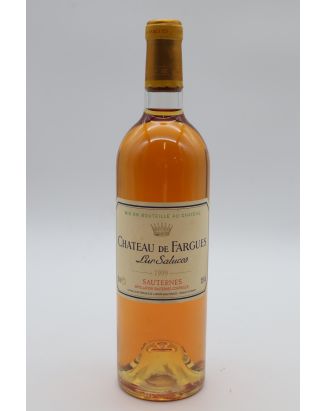
Château de Fargues (Sauternes AOC): the estate's sole wine, and one of the great singularities of the appellation. The estate produces neither a second wine nor a dry white, concentrating all its efforts on a single bottle — a radical choice that allows no margin for error, since there is no fallback cuvée to accommodate rejected lots. The blend is based on 80% Sémillon and 20% Sauvignon Blanc, sourced from botrytized berries harvested berry by berry and aged for two to three years in barrels.
The color evolves from brilliant golden yellow in youth to deep amber after several decades. The nose, often restrained at first — a sign of youth — then opens up to acacia, broom, candied lemon and apricot, followed by a richer botrytized bouquet with nuances of toasted bread, candied ginger, beeswax and soft spices. On the palate, the wine reveals itself to be round, full and remarkably balanced: richness asserts itself without heaviness, the sweetness reinforces the impression of elegance, and flavors of candied fruit and quince jelly precede a toasted, lightly spiced finish. The signature of Fargues may lie in this delicious aroma of bitter orange that it unfolds as it ages, combined with an acidity that keeps the whole ensemble surprisingly fresh. Power and elegance find a perfect balance here.
Among the most memorable years are 1943, 1947, 1959, 1975, 1988, 1989, 1990, 1996, 1997, 2001, 2005, 2009, 2011, 2015, 2016 and 2017. At the table, it pairs magnificently with pan-fried foie gras, a Roquefort or Bleu d'Auvergne, poultry with morel mushrooms, spiced Asian cuisine, or simply a dessert with stone fruits. It is served chilled, at around 9 to 11 degrees, and benefits from decanting for the youngest vintages.
COLLECTION NEAR PARIS & VAT REFUND FOR TOURISTS
Free collection in our warehouse near central Paris (92)