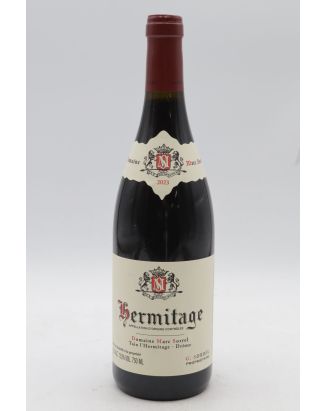
Marc Sorrel Hermitage 2023
Personalise your experience
Change your country, language and currency here whenever you wish.
|
|
|
Must-See Châteaux |
|
|
|
|
|
|
|
|
The highly regarded Domaine Marc Sorrel was founded in 1928 by Marc’s grandfather after he purchased two vineyard plots on the Hermitage hill in the Rhône: Les Rocoules (for white wine) and Le Méal. At the time, people said that working such plots cost more than it brought in. Marc Sorrel took over management of the estate in 1982, greatly raising its profile through opportunities to buy other plots in the best locations on the Hermitage hill: Les Greffieux and Les Bessards. His son Guillaume is now in charge of winemaking and the future of Domaine Marc Sorrel.
The Sorrel family has tended the hallowed slopes of Hermitage since at least 1893. The estate was officially established in 1928 by Félix Sorrel, a notary in Tain-l’Hermitage, who acquired a few acres on the hillside that year, notably in Les Rocoules and Le Méal. In the Sorrel family, the notary profession passed from father to son, and these vines reportedly cost more than they brought in. Yet pride in being a winegrower outweighed the calculations of men of law.
The wine was sold in bulk until the 1970s, when Henri Sorrel, Félix’s son, began bottling it under the family name. In 1982, Marc Sorrel took over the family holdings, leaving a career in the chemical and pharmaceutical industry. Over nearly 40 years, this quiet, meticulous winegrower built a formidable reputation. His father had occasionally used the name Gréal on his labels, but it was Marc who established the two cuvées that would etch the estate’s name in wine lovers’ memories: Hermitage Blanc Les Rocoules and Hermitage Rouge Le Gréal. In 1991, he made another masterstroke by acquiring nearly two hectares in Larnage, within the Crozes-Hermitage appellation. Since the 2019 vintage, his son Guillaume, trained in viticulture and enology, has run the house.
On the Hermitage hill, the estate has a collection of plots to rival those of the greatest producers. Le Méal, at the heart of the appellation, contributes around 0.80 hectares for red wine and 0.20 for white, on large limestone pebbles and brown, sandy-stony soils at the bottom of the slope. Warm and generous, this is where the appellation’s most velvety, fragrant wines are born, from old vines planted in 1927, 1928, and 1945. Les Rocoules, with its convex shape and all-day sunshine, offers 0.60 hectares of white grape varieties on limestone soils rich in iron oxides, over decomposing granite, with vines planted in 1928, then in the 1930s and 1950s.
Just below, Les Greffieux lies on earthier, sandy limestone soils, with younger vines that bring fragrance to the blends. Clos des Plantiers, a family-owned monopole at the foot of the hill, adds richer clay-limestone soils. A small plot in Les Bessards, on pure granite, completes the picture. In Larnage, a few miles to the north, two hectares lie on the famed white kaolin soils, a pale clay that retains moisture and gives the wines texture, freshness, and salinity. Syrah occupies the plots for red wine, Marsanne and Roussanne those for white, with many vines more than 60 years old. The vineyards are managed according to organic farming principles, with extremely low yields, sometimes as little as 15 hectoliters per hectare.
The approach is traditional and noninterventionist. For the whites, the grapes are pressed directly, followed by 48 hours of settling to separate the juice from suspended solids. This is where the house wines begin to develop their distinctive aromatic character. Alcoholic and malolactic fermentation then take place in barrels over six to eight months, with the wines resting on fine lees for part of that time.
For reds and whites alike, from Crozes-Hermitage to Hermitage, aging lasts 18 to 20 months. A long but necessary time. The house follows one absolute rule: never use new barrels. The barrels are generally three to four years old, so they do not leave their mark on the wine and the terroir can speak for itself. It is a mark of the winegrower’s respect for the exceptional soils he cultivates. This choice explains the clarity and depth of Sorrel’s wines, which combine impressive density with mineral precision and rare elegance, and often need 10 or 20 years in the cellar to reveal their full potential.
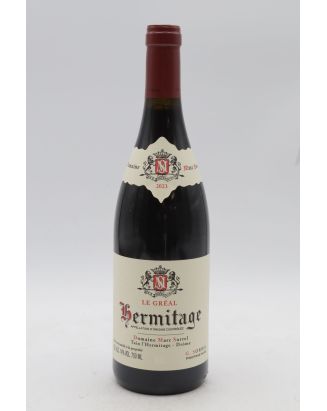
Hermitage Rouge Le Gréal: the estate’s flagship cuvée, its name a contraction of the two vineyard sites that make it up, Les Greffieux and Le Méal. Most of the grapes come from the oldest vines in Le Méal, planted mainly in 1927 and 1928, which naturally bring extraordinary complexity and density, while Les Greffieux adds fragrance. A small proportion of Marsanne softens and balances the blend. Regularly awarded 98 points by La Revue du vin de France, it is one of the few cuvées from the hill that captures both the structure and elegance of Hermitage. It should not be opened before it is 20 years old.
Hermitage Rouge: the so-called classic cuvée, blending fruit from plots in Les Plantiers, Les Greffieux, and Les Bessards. Less imposing than Le Gréal but made in the same mold, it offers a dense, spicy, profound Syrah with firm tannins and a pronounced mineral backbone, as well as excellent aging potential. Produced in very small quantities, it is the best introduction to the house’s red wine style.
Hermitage Blanc Les Rocoules: arguably the appellation’s greatest terroir for white wine, where Sorrel owns 0.60 hectares planted beginning in 1928. The vines are 95% Marsanne, and Guillaume Sorrel includes up to 15% Roussanne in the final blend to enhance its balance and fragrance. Possessed of elemental power, this wine captivates with the generous purity of its fruit, its floral and spicy charm, its extraordinary depth, and its energy. Mineral and honeyed, with phenomenal persistence, it unfolds serenely, always evolving. Give it 20 years.
Hermitage Blanc: the classic white cuvée, made entirely from Marsanne grown in Les Greffieux, below Le Méal, on vines around 30 years old. It illustrates the remarkable balance between richness and mineral precision that Hermitage’s terroirs give the wine. White fruit, honey, flowers, and sweet spices come together in a wine that is dense yet crystalline and multifaceted, supported by deliberately restrained barrel aging.
Crozes-Hermitage Blanc: born of Larnage’s white kaolin soils, it blends around 90% Marsanne and 10% Roussanne from 60-year-old vines, with exceptionally low yields of 15 hectoliters per hectare and only three barrels produced in some vintages. Powerful aromas of ripe fruit (pear, greengage plum, roasted pineapple), a generous texture from the kaolin, which brings freshness and flavor, and a long, saline finish. One of the best values in the entire Northern Rhône.
Crozes-Hermitage Rouge: sourced from the same two hectares in Larnage and vinified exactly like the Hermitage wines, it combines power and delicacy in a way rarely seen in the Rhône Valley. Black fruit, pepper, and kaolin-derived minerality, with tannins fine enough to rival many wines from the neighboring hill, at a far more accessible price.
COLLECTION NEAR PARIS & VAT REFUND FOR TOURISTS
Free collection in our warehouse near central Paris (92)