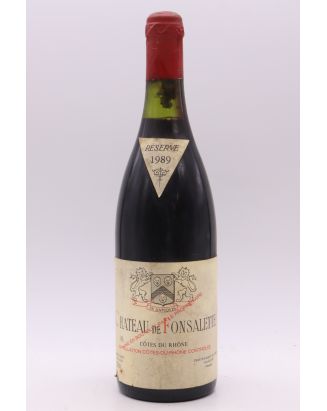
Fonsalette 1989 -5% DISCOUNT !
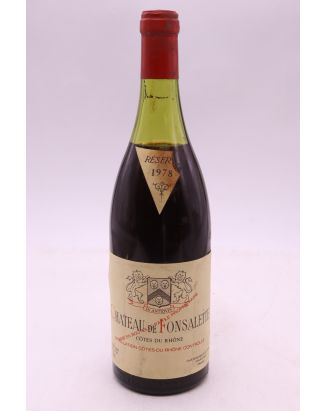
Fonsalette 1978 - PROMO -15%!
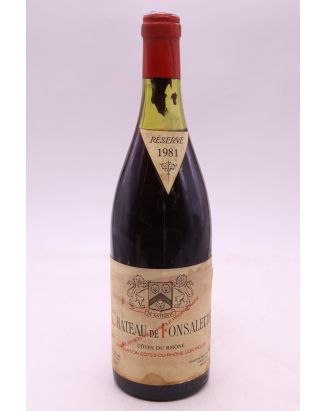
Fonsalette 1981 - PROMO -10%!
Personalise your experience
Change your country, language and currency here whenever you wish.
|
|
|
Must-See Châteaux |
|
|
|
|
|
|
|
|
One of Emmanuel Reynaud's stars
Owned by the Reynaud family since 1945, Château de Fonsalette covers around ten hectares of vines, woodland and olive trees. It was taken over by Emmanuel in 1997 following the sudden death of his uncle Jacques, who had previously managed the estate. Grenache, cinsault, syrah as well as clairette and marsanne are cultivated here. From these varieties, wines are produced under the Côtes-du-Rhône appellation — both white and red — which are not without echoing the finesse of their elder siblings from Château Rayas (also owned by the Reynaud family). Although sourced from different terroirs and blends, they are vinified in the same place by the same team.
The history of the estate is intertwined with that of the Reynaud dynasty, one of the most fascinating in the Rhône Valley. It all began in 1880 when Albert Reynaud, a notary from the environs of Avignon, acquired a property at the lieu-dit Rayas in Châteauneuf-du-Pape. His son Louis continued the venture and expanded the family estate: after Château des Tours in Sarrians in 1935, he purchased Château de Fonsalette in 1945, drawn to this isolated site in the Massif d'Uchaux, then far removed from the most frequented wine routes.
In 1978, Jacques Reynaud succeeded his father and managed Rayas and Fonsalette together, imposing an unmistakable signature built on patience, discretion and an absolute refusal to follow trends. His sudden passing in 1997 marked a turning point: his nephew Emmanuel Reynaud, already established at Château des Tours since 1987, took over the reins of both properties. A discreet winemaker, averse to publicity, he has since perpetuated a viticulture of extreme rigour, today supported by his son Benoît. The grapes from Fonsalette continue to be vinified in the historic cellars of Rayas, in Châteauneuf-du-Pape, which explains the striking kinship between the wines of the two estates.
The estate extends over a vast property of approximately 120 hectares, of which only around ten hectares are planted with vines. The remainder is occupied by oak and pine woodland, olive trees and garrigue, a forested setting that preserves remarkable biodiversity and plays a decisive thermal role. The plots present themselves as sheltered clearings, ventilated by the mistral and cooled at night by the surrounding wooded mass. This microclimate accounts for the aromatic freshness and restrained alcohol levels of wines that are nonetheless born in the Southern Rhône.
The terroir combines sands, gravelly soils and some rounded pebbles, over a clay-limestone subsoil that provides structure and depth. This sand, a cousin of that found at Rayas, gives the wines their silky texture and an almost floral elegance that sets them apart. The red grape varieties consist of grenache (approximately 50%), cinsault (approximately 35%) and syrah (approximately 15%), while the white blend brings together grenache blanc, clairette and marsanne. The vines, often old, are managed in an ecological manner, without herbicides, with deliberately very low yields and rigorously sorted manual harvests.
The winemaking here follows a philosophy of deliberate non-intervention, passed down from generation to generation. The grapes, harvested at full ripeness, are partially destemmed depending on the vintage, with a proportion of whole clusters adding tension and aromatic depth. Fermentations begin spontaneously using only indigenous yeasts, without the addition of commercial yeasts or any correction, in concrete vats and old enamelled tanks. Macerations are long but gentle, without heavy extraction, so as to preserve the fruit, the finesse of the tannins and the precision of the terroir.
Ageing then takes place in the cool cellars of Rayas, in old large barrels, demi-muids and used Burgundy barrels, generally for twelve to eighteen months. No new oak is used: the wood must never mask the expression of the terroir. The wines are neither fined nor filtered, and bottling takes place late, when the winemaker judges the wine to be ready. This artisanal approach, combined with very limited volumes, yields cuvées of rare purity, capable of evolving over several decades in the cellar.
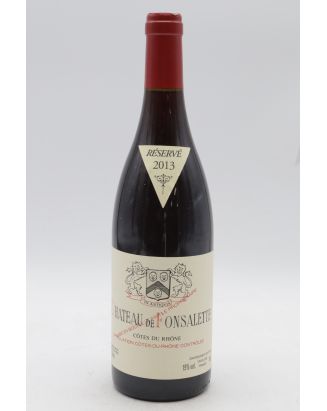
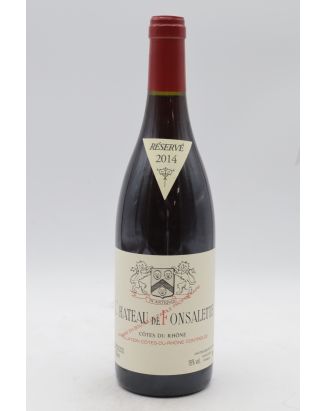
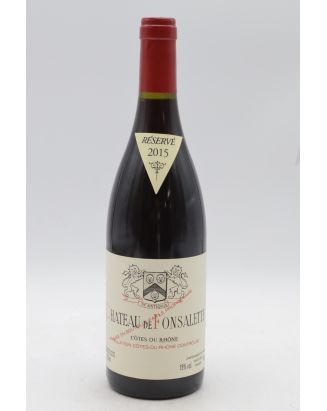
Château de Fonsalette Rouge (Réservé): the estate's flagship cuvée, a blend of approximately 50% grenache, 35% cinsault and 15% syrah from the old vines surrounding the château. The colour, often of moderate intensity, heralds an enchanting nose of wild strawberry, cherry, garrigue, black tea and gentle spices. The palate favours delicacy over power: silky texture, fine tannins, fresh acidity and a saline finish of remarkable length. Regularly compared to Rayas, this exceptional Côtes du Rhône can be kept for twenty to thirty years and pairs beautifully with duck with figs, feathered game or aged cheeses.
Château de Fonsalette Cuvée Syrah: a true rarity from the Southern Rhône, this wine is produced from the blending of two plots of syrah on the estate — a bold choice in a region dominated by grenache. Aged in old barrels, this cuvée develops aromas of violet, black pepper, olive and dark fruits, with an aromatic intensity and a precision reminiscent of the finest northern syrahs. Its structure is tighter and deeper, its freshness intact, and its ageing potential readily reaches twenty-five years. Produced in very small volumes, it ranks among the most coveted bottles from the estate.
Château de Fonsalette Blanc: crafted from approximately 80% grenache blanc complemented by clairette and marsanne, this confidential white is one of the best-kept secrets of the Rhône Valley. Its golden colour precedes a bouquet of ripe white fruits, fennel, honey, almond and dried flowers, lifted by a smoky note with age. The palate, broad and rich, is sustained by an acidity and a noble bitterness that give it a surprisingly saline length. Unlike most whites from the South, it improves over ten to twenty years and pairs magnificently with cream-sauced poultry, rockfish and aged goat's cheeses.
COLLECTION NEAR PARIS & VAT REFUND FOR TOURISTS
Free collection in our warehouse near central Paris (92)