
|
|
|
Must-See Châteaux |
|
|
|
|
|
|
|
|
Located in Lucq-de-Béarn, in the western part of the Jurançon appellation, Domaine Lajibe is today one of the most discreet and sought-after addresses in the South-West vineyard. With only 8 hectares of vines farmed under Demeter-certified biodynamics, this pocket-sized estate produces white wines of great aromatic purity, driven by a tension and a minerality that belong only to the finest Béarn terroirs.
The story of Domaine Lajibe begins far from the rows of vines: in the fencing halls of Paris. Jean-Baptiste Semmartin, a native of the Bigorre, long carried France's colors on the foil piste, reaching the level of the national team. But behind the high-level athlete lay a man from the South-West, deeply attached to his roots and to nature. It was while pacing the floors of Parisian gymnasiums that he realized his true calling lay elsewhere — in the vineyard, in the open air, beneath the Pyrenean sky.
His conversion to winemaking is methodical and rigorous, befitting the fencer he once was. He first trained in Bordeaux at Domaine Grand-Puy-Lacoste, then set off to explore other terroirs: Collioure, then Burgundy, where he spent an extended period with Emmanuel Giboulot, a leading biodynamic winegrower. This Burgundian experience proved decisive: there he refined his sensitivity to soils, natural cycles, and non-interventionist winemaking. He also trained with Domaine Cauhapé, a key figure in the Jurançon appellation.
It was with the invaluable support of the Estoueigt family, owners of Domaine Larroudé in Lucq-de-Béarn, that Jean-Baptiste Semmartin settled permanently in the Béarn. He took over a 2.5-hectare tenant farming arrangement on these family lands, and produced his first vintage in 2017 — an immediate success acclaimed for its energy and crystalline purity. Domaine Lajibe was born. Since then, the domaine has grown steadily to reach 8 hectares, including the recent acquisition of Clos Benguères on the heights of Jurançon. Jean-Baptiste is now joined by his partner Juliana, and together they craft dense and intense white wines imbued with a tension and energy that have earned the domaine its international renown.
In 2021, buoyed by the success of the domaine, Jean-Baptiste also created a négociant structure called Mansengs et Compagnie, allowing him to explore the diversity of manseng grape varieties across other terroirs in the region, particularly in the Gers and around Monein, always within the same rigorous organic standards as those of the domaine.
The vineyard of Domaine Lajibe is concentrated in the commune of Lucq-de-Béarn, at the western extremity of the Jurançon appellation, not far from Pau. This geographical position gives it a unique character within the appellation: here, the soil is composed of a conglomerate of detrital rocks characteristic of the Pyrenean mountain foothills, geological structures that provide the vine with exceptional mineral nourishment.
The climate of this area is strongly shaped by a dual Atlantic and Pyrenean influence. Rainfall is frequent, which makes sunshine all the more precious. Fortunately, all of the domaine's plots benefit from a full south-facing exposure and are sheltered from the prevailing winds, allowing for slow and gradual ripening that promotes aromatic concentration while preserving natural acidity — the true backbone of Lajibe's wines. The Foehn, this warm wind from the Mediterranean sweeping across the Pyrenean hinterland, also plays a key role in the passerillage of the grapes during late harvests.
Three major plots form the heart of the vineyard and each lend their name to one of the domaine's cuvées: Haure, Carmeret, and Serres-Seques.
The entire vineyard has been managed under Demeter-certified biodynamic farming since 2019. Biodynamics here is not merely a marketing label: it is the natural extension of a philosophy of observing, respecting, and following the rhythms of nature. Biodynamic preparation treatments, double shoot-thinning in spring to limit yields, soil cultivation by animal traction on certain plots — everything works together to produce perfectly healthy grapes at optimal phenolic and aromatic ripeness.
In the cellar, Jean-Baptiste Semmartin applies the same rigor as in the vineyard: no additives, no added sulfites, no filtration. Fermentations start spontaneously thanks to the indigenous yeasts naturally present on the grapes — a practice that demands perfect technical mastery, but which guarantees the most faithful and authentic expression of the terroir in the glass.
The aging of Domaine Lajibe's wines is long and considered. Jean-Baptiste takes advantage of the polyphenols naturally present in Gros Manseng to practice controlled oxidative aging, which imparts remarkable stability to the wines without the use of sulfur. This technique, inspired by the great oxidative wines of the Jura, produces wines that are open and expressive on the palate, while preserving their freshness and energy. A bottle of Domaine Lajibe, once opened, will thus easily remain in perfect condition for two to three days.
The wines are aged in neutral oak barrels or in tanks, depending on the cuvée. The aim is never to mark the wine with wood, but to use the vessel as a tool for natural refinement and stabilization. Bottling is carried out without fining or filtration, thus preserving the full substance and complexity of the wines. This plot-by-plot approach, coupled with yields below 10 hl/ha — among the lowest in the entire Jurançon appellation — guarantees a concentration and aromatic intensity that form the unmistakable signature of the domaine.
The Lajibe style is immediately recognizable: straight, precise, mouth-watering wines that are at once dense and digestible. Far from the stereotypes of South-West white wines that can sometimes be heavy or over-ripe, Lajibe's cuvées shine through their tension, balance, and capacity to age gracefully. They are excellent wines to drink now, but also remarkable candidates for cellaring, capable of evolving serenely for 10 to 15 years for the finest cuvées.
Haure: From a plot of approximately one hectare of century-old vines, it is co-planted according to Béarnais tradition with a blend of Petit Manseng, Gros Manseng, Petit Courbu, and the rare Claverie — a near-extinct Béarnais grape variety that Jean-Baptiste is committed to preserving. This ampelographic diversity gives the cuvée an extraordinary aromatic complexity.
Carmeret: Carmeret is the domaine's character cuvée, the one that best embodies the power and precision of Petit Manseng vinified as a dry wine on the terroir of Lucq-de-Béarn. Sourced from the eponymous plot, this dry white Jurançon immediately captivates with the intensity of its golden yellow color, radiant and crystalline.
Serres-Seques: From the eponymous plot of the "dry ridge," this dry Jurançon is a magnificent paradox: Petit Manseng, a grape variety naturally destined for great sweet wines, vinified here as a dry wine with stunning mastery and precision. Jean-Baptiste pushes ripeness levels quite high on this very steep plot, which is felt in the wine's exceptionally rich aromatic range, while the poor soils and aging preserve remarkable tension and salinity.
Serres-Seques Vendanges Tardives: The only sweet wine of Domaine Lajibe is a work of viticultural goldsmithery. Made from Petit Manseng dried on the vine, the grapes remain on the vine well after the first harvests, concentrating their sugars and aromas thanks to the Foehn — this Jurançon Vendanges Tardives is an exceptional sweet wine, far removed from conventional sugary wines.
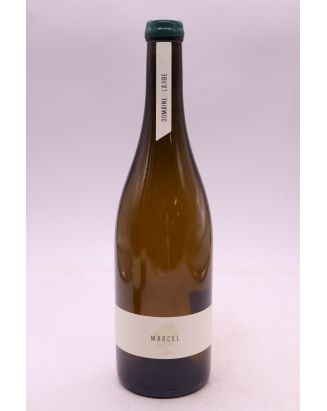
Marcel: The Marcel cuvée is an exploration of high-slope terroirs in the commune of Monein, sourced from a subsoil of pudding stone and limestone. It is a cuvée that perfectly embodies the geographical openness of the domaine without ever betraying its identity. Jean-Baptiste pushes ripeness levels quite high here, resulting in a rich and contrasting aromatic range: sweet apples, candied citrus, cedrat, with a calcareous minerality characteristic of the Monein terroirs.
Campsou Benguères: The Campsou Benguères cuvée is the latest addition to the domaine, sourced from the Clos Benguères recently acquired by Jean-Baptiste on the hillsides of Jurançon. It reflects the dynamic expansion of the domaine and its founder's desire to explore the diversity of the appellation's terroirs. These new plots bring a complementary expression to the range: a dry white wine combining the aromatic complexity characteristic of mansengs with the mineral freshness of the soils in the area.
Mansengs et Compagnie (négociant)
Alongside the domaine, Jean-Baptiste created the négociant structure Mansengs et Compagnie in 2021, with the ambition of exploring the diversity of manseng grape varieties on terroirs outside Lucq-de-Béarn, particularly in the Gers and on the cool soils of Monein. The grapes purchased come exclusively from winegrower partners committed to organic farming. The vinification is carried out at the domaine by Jean-Baptiste himself, with the same strict specifications: indigenous yeasts, no additives, not even sulfur. These cuvées are now largely integrated into the domaine's production. The Mansengs et Compagnie wines, generally blending 1/3 Petit Manseng and 2/3 Gros Manseng from cool terroirs, offer a more accessible alternative to the domaine range, without sacrificing an ounce of energy or minerality.
COLLECTION NEAR PARIS & VAT REFUND FOR TOURISTS
Free collection in our warehouse near central Paris (92)