Personalise your experience
Change your country, language and currency here whenever you wish.
|
|
|
Must-See Châteaux |
|
|
|
|
|
|
|
|
Delicious wines from Savoie!
The domaine des Ardoisières is located in Savoie in Fréterive, between Chambéry and Albertville, and its recent history is quite remarkable. In the 1990s, the mayor of the village of Cevins wanted to revive the vineyard that had once existed and had disappeared following Phylloxera. A passionate winemaker, Michel Grisard, replanted the Cevins hillside in 1997 (it took 5 years to obtain the first harvest), and Brice Omont, an agricultural engineer, joined him in 2002. Now at the head of the domaine des Ardoisières, Brice Omont has a vineyard of 16 ha divided into 2 distinct parts: the Cevins hillside and the St Pierre de Soucy hillside.
The story of Domaine des Ardoisières began in 1997 with a bold undertaking: reviving an abandoned vineyard on the forgotten slopes of Cevins in the Tarentaise Valley. Led by Denis Perroux, the village’s visionary mayor, and Michel Grisard, an accomplished biodynamic winegrower from Prieuré Saint-Christophe, the project brought together the local community and associations to restore 420 fragmented plots lost to phylloxera and the decline of farming in the 20th century. The first planting, in May 1998, covered 20 ares of Altesse. Herculean work followed: clearing stumps, building terraces and restoring dry-stone walls. The first substantial harvest came in October 2002, yielding 22 hectoliters and marking the revival of a 2,000-year-old site documented since Roman times, when Columella and Pliny were already praising "Vitis Allobrogica".
In January 2003, Brice Omont, a young agronomist from Champagne with a passion for natural wines, met Michel Grisard and joined the team, formally becoming a partner in March 2005. Despite a chaotic start—a devastating drought in 2003, rejected bank applications and meager yields—a group of 12 passionate investors, including restaurateurs and wine lovers, saved the estate in 2004 with funding and moral support. Inaugurated in June 2003 by Agriculture Minister Hervé Gaymard, the site expanded in 2008–2009 through the lease of organic plots in Saint-Pierre-de-Soucy, providing more stable production. Brice Omont became majority managing partner in 2010, refocusing on pragmatic biodynamics. Since 2018, the purchase of organic grapes from neighboring growers, including for the Silica wines, and the lease of Louis Magnin’s vineyards in Arbin, bringing the total to 24 hectares, have strengthened resilience in a changing climate. Today, this emblematic estate brings Savoie wines to all corners of the world and is celebrated by Michelin-starred restaurants, proving that patience and instinct can triumph on dizzyingly steep slopes.
Domaine des Ardoisières owes its distinctive character to two complementary terroirs, shaped by millennia of glaciation and winegrowing history, where each plot expresses a unique mineral identity. The south-facing Cevins slope, a glacial barrier at 400–500 meters in elevation, is dominated by terraces of metamorphic mica schist. Its poor, shallow, silty-sandy soils lie on slopes as steep as 70%. Planted at 8,000 vines per hectare and trained as bush vines on stakes along the contours to combat erosion, these vines defy gravity. Acrobatic manual work, carefully managed ground cover and sheep-manure amendments keep yields low at 25 hl/ha. Varieties are interplanted: Altesse, Roussanne, Mondeuse Blanche, Malvoisie and Jacquère for the whites; Persan and Mondeuse Noire for the reds. Part of a Savoie winegrowing landscape that once covered 20,000 hectares, compared with 3,000 today, this site produces wines of saline tension and crystalline depth.
By contrast, the slopes of Saint-Pierre-de-Soucy on the left bank of the Isère offer sedimentary soils: Jurassic schistous marl and clay-limestone soils on moderately to steeply sloping ground with western and southern exposures. Less extreme, these sites allow a density of 5,000 trellised vines per hectare, pruned in single Guyot or Royat cordon, with more generous yields of 40 hl/ha. White varieties are Jacquère, Chardonnay and Mondeuse Blanche; red varieties are Gamay, Mondeuse Noire and Persan. Together with 1.5 hectares in Laissaud and scree soils in Saint-Jean-de-la-Porte, these certified organic and biodynamically farmed plots, treated with minimal copper and biodynamic preparations, capture Alpine freshness. Their wines once rivaled those of Graves or Chablis. Together, these 16–24 hectares, tended by hand by 15 employees, embody a rare Alpine terroir rich in schist and fractured limestone, where the vines express raw energy and persistent minerality, ideal for distinctive, age-worthy wines.
At Domaine des Ardoisières, winemaking is a minimalist art, guided by profound respect for the grapes and terroir to preserve the aromatic purity developed in the vineyard. Grapes are hand-harvested and sorted according to each variety’s ripeness, then delivered in 30 kg crates and vinified as whole clusters without destemming to maximize each plot’s expression. For the whites, gentle, slow pressing precedes light cold settling (14–15°C), followed by spontaneous alcoholic fermentation with indigenous yeasts—strains distinctive to each soil—that encourage terroir complexity. Malolactic fermentation is not systematic and occurs naturally. Aging lasts nine to 18 months in stainless steel or concrete tanks or used barrels from Burgundy or Bordeaux, with moderate lees stirring for the barrel-aged cuvées.
The reds undergo two to three weeks of maceration in open tanks, with gentle punch-downs and initial pump-overs to extract fine tannins and lively fruit, before the wine is drawn off and the grapes pressed. Malolactic fermentation takes place in barrels, followed by the same aging period of nine to 18 months, without routine racking. There is no fining or heavy filtration; minimal sulfur is added only at bottling, with premium corks used to support optimal aging (10–15 years for the top cuvées). Pragmatic in the face of unpredictable weather, this biodynamic approach seeks to preserve in the cellar the quality achieved in the vineyard: taut, saline wines of remarkable length, where schist-derived minerality meets balsamic and spicy notes.
The wines of Domaine des Ardoisières form a balanced range of white and red IGP Allobroges wines, with each blend or single-variety wine revealing the diversity of Savoie’s terroirs.
White Clay: From the west-facing slopes of Saint-Pierre-de-Soucy, on schistous marl and clay, this blend of Jacquère (40%), Chardonnay (40%) and Mondeuse Blanche (20%) produces a pure, precise and easy-drinking wine. Guyot- and cordon-trained vines yield 40 hl/ha. Whole-cluster vinification with indigenous yeasts and nine months in tank bring citrus and pine-resin notes, with firm acidity lending the palate tension and salinity. Excellent young and ideal with seafood.
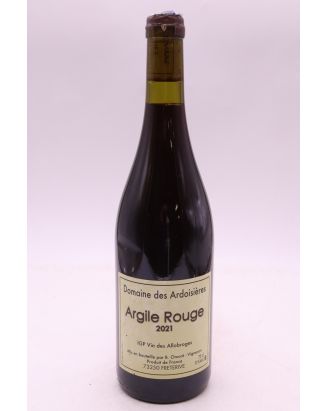
Red Clay: From the same terroir, enriched with clay-limestone scree at Saint-Jean-de-la-Porte, this generous red blends Gamay (65%), Mondeuse Noire (25%) and Persan (10%). Yields are 40 hl/ha; whole-cluster vinification is followed by nine months in tank. Expect lively fruit, silky tannins and balsamic freshness, with blueberry and pepper aromas. A distinctive, approachable wine for grilled meats.
White Schist: A gem from the south-southeast-facing slope of Cevins (60% gradient, silty mica schist), this blend of Jacquère (40%), Roussanne (30%), Malvoisie (20%) and Mondeuse Blanche (10%) yields 30 hl/ha from bush-trained vines and exudes crystalline purity. Aged 12 months in barrels, it reveals mineral precision, finely etched acidity and a saline finish reminiscent of great Rieslings grown on schist. Remarkably long on the palate.
White Quartz: A prestigious wine made from 100% Altesse grown in Cevins (20 hl/ha, south-southeast exposure) on poor, schistous soils. Whole-cluster vinification with indigenous yeasts is followed by 18 months in barrels. Notes of quince, mirabelle plum, walnut and wisteria lead to a structured, intense and balanced palate with lingering saline finesse. An emblematic age-worthy wine, taut and complex.
Red Amethyst: The signature blend from Cevins (25 hl/ha, 60% south-facing slope) combines Persan (60%) and Mondeuse Noire (40%) grown on mica schist. Vinified as whole clusters and aged 18 months in barrels, it offers aromas of blueberry, pepper and spice. The palate is powerful yet fine, generous and structured. A deep, elegant red rooted in its Alpine terroir.
White Silica: Made from organically grown Jacquère sourced from neighboring growers in Apremont, described as a century-old variety (50–60-year-old vines), on limestone scree, for a lively, mineral expression. Minimal-intervention whole-cluster vinification with indigenous yeasts brings taut freshness and pure fruit.
Red Silica: Made from 100% organic Mondeuse Noire sourced nearby, vinified as whole clusters and aged in a combination of concrete tanks, stainless steel tanks and neutral barrels. It offers a fruity structure, fine tannins and spicy notes: an approachable, vibrant red despite the challenges of unpredictable weather.
From easy-drinking Clay to spicy Amethyst, each bottle promises a unique sensory experience, combining mineral tension with subtle richness. Ready to discover these natural treasures? Explore our selection and buy wine at the best price. Discover the wines of Domaine des Ardoisières, as well as other Savoie estates such as Belluard, Blard & Fils, Dupasquier and Gilles Berlioz. Browse our wider selection of bottles, magnums and older vintages. With Vins et Millésimes, buying wine online has never been easier! Always 100% in stock, with fast shipping and the best prices!
COLLECTION NEAR PARIS & VAT REFUND FOR TOURISTS
Free collection in our warehouse near central Paris (92)