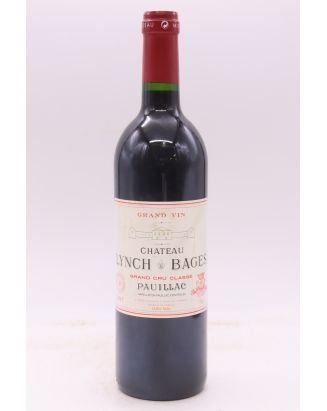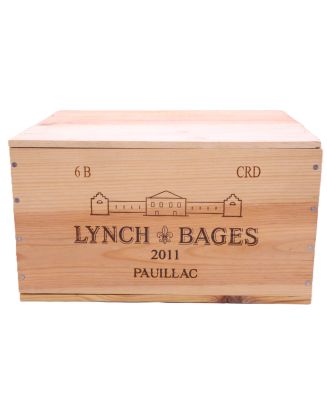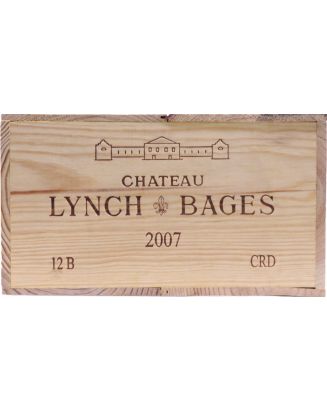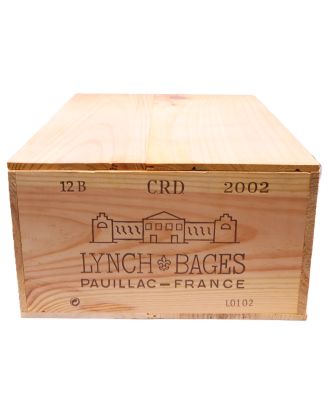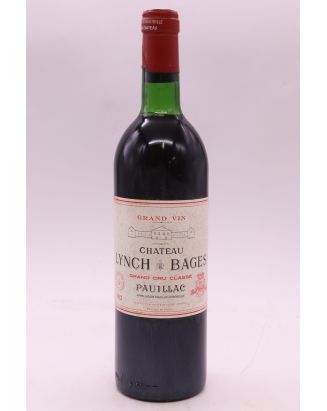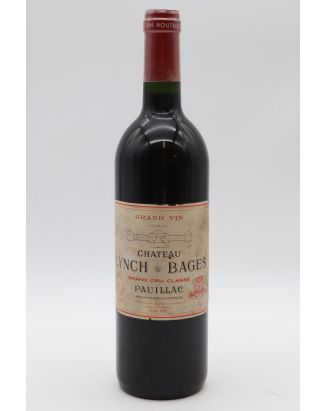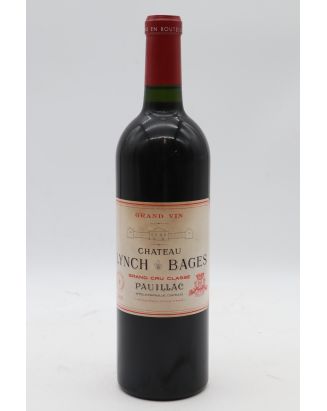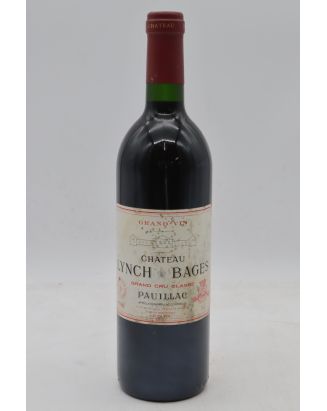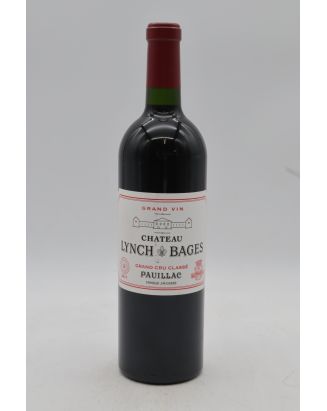
Château Lynch-Bages is an iconic wine estate located in Pauillac, in the Médoc, classified as a 5th Grand Cru Classé in 1855. Despite this ranking, it is often compared in quality to 2nd Crus Classés, earning it a reputation well beyond its official classification. The estate spans approximately 100 hectares planted primarily with Cabernet Sauvignon, the king grape of the Médoc that gives the wine its tannic structure, aromatic depth and extraordinary aging potential. Under the stewardship of the Cazes family since the 1930s, and today with Jean-Charles Cazes, Lynch-Bages has successfully combined Bordeaux tradition with a constant pursuit of excellence, establishing itself as an essential reference for lovers of great Bordeaux wines.
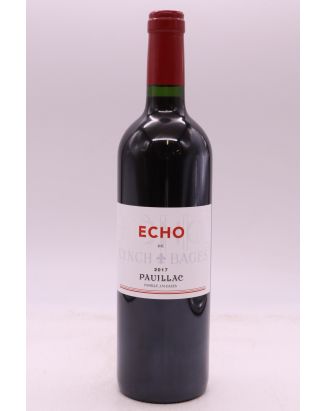
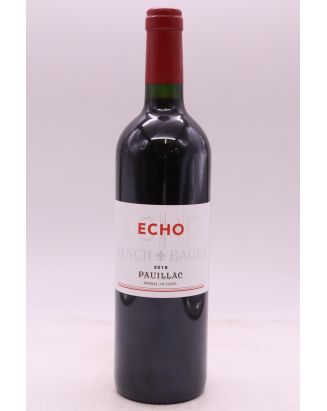
Echo de Lynch-Bages, formerly known as Haut-Bages Averous, is the estate's second wine. It is crafted from the château's youngest vines as well as blends not selected for the Fine Wine. While Echo shares the aromatic DNA of Lynch-Bages — that expressive dark fruit and characteristic Médoc structure — it presents a softer texture, less concentrated tannins, and a faster maturity, ideal for drinking between five and ten years after the vintage. It is an excellent entry point for discovering the estate's style at a more accessible price, while offering a level of quality far superior to the average Bordeaux wines in its price range.
Château Lynch-Bages is a wine designed for long cellaring, provided that optimal storage conditions are maintained. It is recommended to store bottles at a stable temperature between 12 and 14°C, away from light, vibrations, and odours. A humidity level of around 70% helps keep the corks in good condition. Depending on the vintage, the Fine Wine can be kept without difficulty for between 20 and 40 years, or even longer for great years such as 1961 or 2005. Enthusiasts wishing to enjoy its full aromatic complexity and silky tannins would do well to wait at least 8 to 12 years after the vintage before opening their bottle.
Château Lynch-Bages rouge stands out for its generous and expressive aromatic profile, rare among the great Pauillacs. On the nose, it reveals intense notes of blackcurrant, blackberry and black cherry, accompanied by nuances of cedar, tobacco, graphite and soft spices. On the palate, the texture is ample, the tannins dense yet silky, and the finish long and persistent. Its blend is predominantly Cabernet Sauvignon, complemented by Merlot, Cabernet Franc and Petit Verdot. This style, both powerful and approachable in its youth, yet fully revealed after ten to twenty years of ageing, largely explains the loyalty of its admirers around the world.
Among the most sought-after historic vintages of Château Lynch-Bages, several stand out for their exceptional quality. The 1961 is unanimously hailed as one of the greatest wines of the century, with an extraordinary concentration and complexity. The 1982 embodies the generosity and roundness of a sun-drenched vintage that helped reveal Bordeaux to the world. The 1985, 1988 and 1989 are also absolute benchmarks, combining freshness and maturity with rare elegance. More recently, the 2000, 2005 and 2009 vintages rank among the estate's finest achievements, offering remarkable density and considerable aging potential for the decades to come.
To fully express its aromatic potential, Château Lynch-Bages rouge should be served between 16 and 18°C. A temperature that is too high tends to exacerbate the alcohol and flatten the aromas, while serving it too cool would close up the tannins and mask the complexity of the wine. For bottles stored in a cellar at 12–14°C, it is advisable to take the bottle out approximately one hour before serving. Decanting is strongly recommended, especially for young vintages or great years such as 1995, 2000 or 2005: passing the wine through a decanter for one to two hours allows it to oxygenate, soften the tannins and release the full aromatic palette of the Cabernet Sauvignon, from notes of dark fruit to more tertiary nuances of leather, truffle and blonde tobacco.
The earliest mentions of the land of "Batges" date back to the 16th century. Located at the gates of Pauillac, this land has welcomed generations of winegrowers over the centuries.
In the early 17th century, Jean Déjean, a royal notary, and his brother Pey, a wine merchant, settled in the village of Bages and began acquiring the surrounding lands. The next generation, represented by Pierre Déjean and his son Bernard, completed the assembly of the Domaine de Bages, which was sold in 1728 to the knight Pierre Drouillard, treasurer-general of Guyenne.
In the 18th and 19th centuries, the Lynch family brought a new dimension to the estate. John Lynch, originally from Galway, took refuge in Bordeaux in 1691. His son Thomas acquired the Domaine de Bages on 9 June 1750 through his marriage to the daughter of Pierre Drouillard. Their son, the knight Michel Lynch, understood the importance of terroirs, selected the finest grape varieties, systematically drained the soils and invented new tools for viticulture.
The estate remained in the Lynch family for seventy-five years.
In the 19th century, Bordeaux estate owners adopted new cultivation techniques and winemaking methods advanced rapidly. In 1866, Jérôme Cayrou, the new owner of Lynch-Bages, was advised by Pierre Skawinski, a key figure in this technical revolution thanks to his invention of the "new system" vat house. For the first time, gravity was used to handle the grapes, with the harvest hoisted up to the crusher installed on the upper floor, then poured into the vats.
The family's story, marked by perseverance and simplicity, unlikely encounters and travels, mirrors that of the Médoc. Their attachment to the vineyard, to heritage and to gastronomy is expressed through an art of living with wine, passed down from generation to generation.
Their ancestor, Jean "Lou Janou," left the valleys of the Couserans, near Saint-Girons in Ariège, around 1875 to settle in Pauillac and find work there. Jean-Charles, the first member of the family to be born in Pauillac — first a baker, then a bank employee — acquired a wine-producing estate in the late 1930s. He proved to be a talented winemaker and defined the unique style of Lynch-Bages.
His son André also played a decisive role by regenerating and expanding the vineyard. He was the first to promote the wines internationally. Jean-Michel, an engineer in Paris, joined his father in 1973. The facilities and the Skawinski chai, over a hundred years old, required modernization work that would last fifteen years. The wines of Lynch-Bages gained in consistency and quality.
In 2007, Jean-Charles took over from his father at the head of the family estates and launched the renovation project for Lynch-Bages, in collaboration with architect Chien Chung (Didi) Pei. With the 2020 vintage, he opened a new chapter in the history of the estate.
Château Lynch-Bages shines with a score of 99/100 for the 1989 vintage, and 97/100 for the 2016, 2010, 1990 and 2000 vintages, attesting to its excellence according to Robert Parker.
The vineyard of Château Lynch Bages extends over 100 hectares, situated on the Bages plateau on the left bank.
It is composed of vines averaging 30 to 60 years of age. The vineyard is managed using sustainable practices and consists overall of several red grape varieties: 72% Cabernet Sauvignon, 20% Merlot, 5% Cabernet Franc and 3% Petit Verdot. These grape varieties are typical of Pauillac.
In addition, a small plot is dedicated to white grape varieties, where Sauvignon Blanc, Sémillon and Muscadelle are cultivated. These white varieties yield wines with beautifully expressive fruit aromas.
These vines benefit from a terroir that is both geologically homogeneous and enjoys a relatively mild oceanic climate. It is a gravel plateau with calcareous and sandy soils, naturally well drained thanks to the proximity of the Garonne.
At Château Lynch-Bages, the harvest is carried out by hand, ensuring the quality of the grapes collected. The berries are carefully sorted before being transferred into stainless steel vats for pump-overs. The spectacular gravity-fed vat house is used for the vinifications.
After fermentation, the wines undergo racking, maceration, pressing and malolactic fermentation. The final blend for the vintage is determined by a technical team following numerous tastings.
The Lynch-Bages estate produces approximately 400,000 bottles each year.
The château markets two red Bordeaux blended cuvées, including a grand wine "Le Grand Vin de Lynch Bages" and, since 2008, a new second wine "Echo de Lynch Bages" which replaced the previous second cuvée "Haut Bages Averous," which had existed since 1976. Echo de Lynch Bages is drawn from a selection of plots and the youngest vines of the estate. In addition to these 2 fine wines, the Château has also been producing since 1990 a white wine named "le Blanc de Lynch Bages" (under the Bordeaux Blanc appellation), composed of Sauvignon Blanc, Sémillon and Muscadelle.
The qualities of Château Lynch Bages are unanimously recognized internationally, and while its official ranking is only that of a fifth classified growth of 1855, this Bordeaux château is part of the elite wines of the Pauillac appellation. Its characteristics make it a deep and powerful wine with notes of blackcurrant, earth, leather and tobacco, and its aging potential is 10 to 25 years of cellaring or more. In its greatest vintages (2015, 2010, 2009, 2005, 2000, 1996, 1990, 1989, 1982), Château Lynch Bages produces very fine bottles that are often found among the highest scores awarded during en primeur tastings. The second wine "Echo de Lynch Bages" is more approachable, and the "Blanc de Lynch Bages" is a lively and expressive wine in its youth that can be cellared for a few years.
Mature Lynch Bages wines will pair wonderfully with a rib of beef, a seven-hour leg of lamb or game!
Discover our 1er Grands Crus Classés and Crus Classés de Bordeaux on our website — hundreds of references to explore. Find the other 5th Grands Crus Classés de Pauillac: Château d'Armailhac, Camensac, Cantemerle, Clerc Milon, Croizet Bages, Grand Puy Ducasse, Haut Batailley, Pontet Canet and many more!
COLLECTION NEAR PARIS & VAT REFUND FOR TOURISTS
Free collection in our warehouse near central Paris (92)