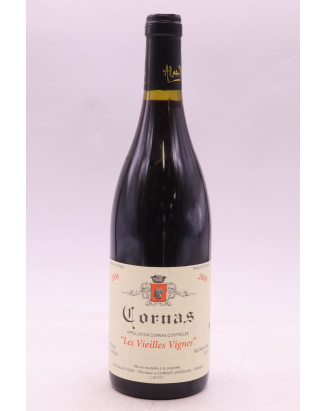
Alain Voge Cornas Les Vieilles Vignes 2022 Magnum
Personalise your experience
Change your country, language and currency here whenever you wish.
|
|
|
Must-See Châteaux |
|
|
|
|
|
|
|
|
Domaine Voge is based in Cornas and is one of the appellation’s renowned estates. It was founded by Henri Voge, Alain’s grandfather. After Alain’s father died prematurely, Alain took over in 1965 and developed estate bottling; until then, the wines had been sold to négociants. The estate has an impressive collection of vineyards, mostly on hillsides, covering 13 hectares: 7 hectares of red grapes (100% Syrah) in Cornas, 1 hectare in Saint-Joseph and 5 hectares of white grapes (100% Marsanne) in the Saint-Péray AOC. The estate began converting to biodynamic farming in 2006 and completed the process in 2013.
The family story begins around 1900, when the Voges ran a small mixed farm in Cornas, growing grapes and fruit trees and operating a nursery. The turning point came in 1962: Alain Voge took the reins of the property, gradually gave up the other crops and made the bold bet of focusing on two then-overlooked appellations, Cornas and Saint-Péray. He stopped selling his harvest to négociants, bottled his own wines and personally presented them to the region’s finest restaurants. In 1970, he created Les Vieilles Vignes, the estate’s oldest cuvée, then in 1984 made the first barrel-aged Saint-Péray raised on its lees, a pioneering step in the appellation.
A committed winegrower, Alain Voge began defending the Cornas vineyards against urban development as early as 1972, replanting abandoned hillsides and helping these wines gain recognition far beyond the region. In 2004, he entrusted management to Albéric Mazoyer, a renowned Ardèche-born enologist, who began converting the vineyards first to organic and then to biodynamic farming (the Saint-Péray whites from 2006 and all the vines from 2013, with the wines certified beginning with the 2016 vintage). Lionel Fraisse, from a longstanding Saint-Péray winegrowing family, joined the team in 2012 and took over its leadership in 2018. Alain Voge died in September 2020 at the age of 81, leaving behind a leading estate and a team faithful to what the house calls its enlightened classicism.
The vineyards cover around twelve hectares, almost entirely planted on steep south- and southeast-facing hillsides: nearly eight hectares of Syrah in the Cornas AOC, four to five hectares of Marsanne in the Saint-Péray AOC, one hectare of Saint-Joseph and a plot of Côtes du Rhône. The bedrock is the same throughout: ancient, highly weathered granite that local winegrowers call gores. This well-draining subsoil, mixed with silica, clay and occasional limestone seams, forces the vines to send their roots deep and gives the estate’s wines their distinctive saline minerality.
The plots rise from around 130 meters at the foot of the hillsides to 400 meters on the heights of Cornas, where cool nights preserve acidity and aromatic finesse. The historic named sites (Chaillot, Mazard, Combe, La Côte, Hongrie, Saint-Pierre) are farmed separately on terraces supported by the famous chaillés, dry-stone walls maintained by hand. Many of the vines are over sixty years old, and some Marsanne vines reach eighty. Plowing, soil cultivation, careful pruning, training on individual stakes on the steepest slopes and biodynamic preparations are all part of an entirely manual approach to viticulture—demanding work that yields ripe, balanced grapes.
The winemaking philosophy comes down to one idea: intervene as little as possible to let the terroir speak. Grapes are harvested by hand and carefully sorted in the vineyard and cellar. For the reds, destemming is partial (often with some whole clusters retained, depending on the cuvée and vintage); fermentation begins with indigenous yeasts alone in small stainless-steel tanks dedicated to individual plots; and maceration continues for several weeks, with gentle punch-downs and pump-overs. Extraction remains measured, with the aim of achieving fine tannins rather than showy power.
Aging lasts fourteen to twenty-four months, depending on the cuvée, in a combination of barrels and 600-liter casks. The proportion of new oak has deliberately been reduced over the years (to around 20% for the top cuvées). The Saint-Péray wines are vinified in tanks or barrels according to their style, then aged for an extended period on fine lees, with or without stirring, to gain body and complexity without masking the freshness of the Marsanne. The wines are bottled with minimal handling and limited sulfites to preserve the energy and aging potential that characterize the estate’s wines.
Cornas Les Chailles: a blend of plots at the foot of the hillsides across several named sites, this cuvée takes its name from the dry-stone walls that shape the landscape. Aged mainly in previously used barrels, it offers juicy dark fruit, floral, peppery and lightly smoky notes, and fine tannins. It is an ideal introduction to the estate’s wines, approachable young yet capable of aging for around ten years.
Cornas Les Vieilles Vignes: created in 1970, this is the house’s signature cuvée. It comes from roughly sixty-year-old Syrah vines planted in the heart of the appellation, at the Chaillot, Mazard and Combe sites, rooted in granitic gores. After a long maceration and eighteen to twenty months of barrel aging, the wine reveals aromas of sour cherry, blackcurrant, violet, leather and spice, supported by a firm tannic structure and a long finish. A Northern Rhône classic built to age for fifteen to twenty years.
Cornas Les Vieilles Fontaines: created by Alain Voge in 1988, this rare cuvée comes from the estate’s oldest Syrah vines on a particularly prized granite terroir. It is produced only in exceptional vintages, in very small quantities. Its concentration, depth, velvety tannins and saline finish make it the fullest expression of Cornas’s character at Voge.
Cornas Chapelle Saint-Pierre: sourced from the Saint-Pierre site, planted at an elevation of nearly 400 meters, this single-site cuvée is vinified and aged separately. Its focused, fresh and airy profile contrasts with the appellation’s traditional sun-ripened power. Rare and produced in limited quantities, it is bottled only when the vintage is judged to have achieved perfect balance.
Saint-Péray Harmonie: a blend of several biodynamically farmed Marsanne plots, this cuvée seeks to express the grape faithfully rather than make a show of it. Vinified with restraint and aged on fine lees, it combines crisp white fruit (pear and vineyard peach), notes of almond and white flowers, and a palate given tension by its granite minerality. An excellent food wine to open with river fish or poultry in cream sauce.
Saint-Péray Ongrie: created in 1984 under the name Cuvée Boisée, later called Terres Boisées and renamed Ongrie beginning with the 2015 vintage in reference to the Hongrie site, it reflects Alain Voge’s pioneering role in oak aging in Saint-Péray. Fermented and aged on its lees in barrels, it develops a richer, more vinous character, with candied yellow fruit, toasted hazelnut and honey, without ever losing its freshness. It benefits from three to five years of aging.
Saint-Péray Fleur de Crussol: the estate’s most ambitious white cuvée, conceived by Alain Voge with Lyon sommelier Daniel Denis. It comes from an eighty-year-old Marsanne plot at La Côte, planted by an ancestor of the Fraisse family and overlooking Hongrie and the Château de Crussol. Aging, now divided between barrels and 600-liter casks with a reduced proportion of new oak, produces a remarkably dense white wine with a silky texture and an exceptionally long, saline finish. A fine white wine for aging, capable of developing for ten years or more.
Saint-Péray Les Bulles d’Alain: a tribute to Saint-Péray’s historic sparkling-wine tradition, this wine is made by the traditional method from biodynamically grown Marsanne on granite soils. The grapes are harvested early, in early September, to preserve the liveliness essential for the second fermentation. Fine bubbles and a chalky, airy palate with notes of apple and brioche make this a distinctive aperitif, far removed from standardized sparkling wines.
Saint-Joseph Les Côtes: from a small plot of Syrah trained on individual stakes on a very steep granite hillside, this limited-production cuvée combines concentration with precision. Ripe red fruit, sweet spices and smoky notes meet a generous mouthfeel. It can be enjoyed after three or four years and evolves beautifully for a good ten years.
Côtes du Rhône Les Peyrouses: a Syrah cuvée from terroirs neighboring Cornas, aged for around twelve months in previously used barrels to preserve the fruit’s freshness. The nose combines blackberry, black cherry, pepper and licorice; the palate is juicy, round and supple, with smooth tannins. It is the estate’s easy-drinking wine, best discovered in its first three to four years alongside everyday dishes.
COLLECTION NEAR PARIS & VAT REFUND FOR TOURISTS
Free collection in our warehouse near central Paris (92)