Personalise your experience
Change your country, language and currency here whenever you wish.
|
|
|
Must-See Châteaux |
|
|
|
|
|
|
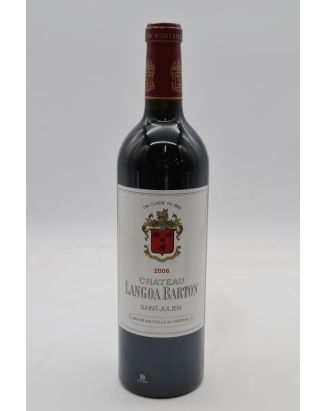
Château Langoa-Barton is a Third Grand Cru Classé of Saint-Julien, in the Médoc, on the left bank of the Bordeaux vineyard. A property of the Barton family, of Irish origin, since 1821, it has the distinction of being one of the few classified growths never to have left the same family since the 1855 classification. Predominantly cabernet sauvignon, this fine wine captivates with its elegance, its finesse and its remarkable value for money.
The Barton family's Bordeaux story begins in 1722, when Thomas Barton left Ireland to settle in Bordeaux and develop a flourishing wine trade. His grandson, Hugh Barton, co-founded with Daniel Guestier the celebrated négociant house Barton et Guestier, still in operation today. In 1821, Hugh Barton acquired Château Langoa, then in 1826 a portion of the Léoville estate, giving birth to Château Léoville-Barton. As early as 1855, Château Langoa-Barton was classified as a Troisième Grand Cru.
From generation to generation, the Barton family has never sold their property — a unique distinction among the classified growths of 1855. After the recovery work led by Ronald Barton in the aftermath of the Second World War, Anthony Barton took the helm of the estate in 1983 and built its reputation on wines of outstanding quality offered at fair prices. Today, his daughter Lilian Barton-Sartorius runs the family properties with her two children, Mélanie and Damien, who represent the tenth generation. The Château Langoa, an elegant 18th-century chartreuse, houses the cellars of both Barton crus in Saint-Julien.
The vineyard of Château Langoa-Barton extends over approximately twenty hectares at the heart of the Saint-Julien appellation, not far from Châteaux Ducru-Beaucaillou and Beychevelle. It rests on a classic Médoc terroir of fine gravel over a clay subsoil, ideal for cabernet sauvignon. Oriented towards the Gironde estuary, the vines enjoy a privileged exposure that encourages the perfect ripening of the grapes.
The grape variety blend gives pride of place to cabernet sauvignon (approximately 70%), complemented by merlot and cabernet franc, with occasionally a touch of petit verdot. Planted at a density of approximately 9,000 vines per hectare, the vines, averaging thirty-five years of age, are trained using traditional viticulture, without chemical fertilisers or herbicides. Château Langoa-Barton shares the same expertise as the neighbouring Château Léoville-Barton: only the terroir distinguishes the two crus.
After manual harvesting and rigorous berry selection, the vinification of Château Langoa-Barton is carried out parcel by parcel in large temperature-controlled wooden vats, faithful to the estate's tradition. Alcoholic fermentation lasts seven to ten days, followed by gentle extraction through pump-overs and a maceration of approximately three weeks, in order to preserve the elegance that is the hallmark of the estate.
The wines are then aged for sixteen to twenty months in French oak barrels, of which 50 to 60% are new. The blends are assembled with the contribution of oenologists Jacques and Eric Boissenot, leading references in the Médoc. The result is a harmonious and silky Saint-Julien, favouring finesse over power, with a fine structure and superb ageing potential.
Château Langoa-Barton (Saint-Julien, Troisième Grand Cru Classé, red) is the estate's Fine Wine, dominated by cabernet sauvignon complemented by merlot and cabernet franc. It reveals a deep colour and a complex nose of red and black fruits (raspberry, cherry, blackberry), enhanced by spices and subtle oak. The palate, balanced and silky, combines an elegant tannic structure with a beautiful expression of fruit, all carried by a freshness that is quintessentially Saint-Julien in character. A true wine for ageing, it can develop for more than fifteen years and pairs ideally with lamb, red meats, game birds and mature cheeses.
Lady Langoa is the second wine, shared by Châteaux Langoa-Barton and Léoville-Barton, assembling parcels from both estates. Dominated by cabernet sauvignon, complemented by merlot, petit verdot and cabernet franc, it offers a more immediate and approachable expression of the Barton style. Supple, fruity and elegant, it represents an ideal introduction to the family's great Saint-Julien crus.
COLLECTION NEAR PARIS & VAT REFUND FOR TOURISTS
Free collection in our warehouse near central Paris (92)