Personalise your experience
Change your country, language and currency here whenever you wish.
|
|
|
Must-See Châteaux |
|
|
|
|
|
|
|
|
Located in Cerè, above Negrar in the heart of Valpolicella Classica, Domaine Giuseppe Quintarelli is one of Italy’s most legendary wine producers. Across some twelve hectares in the hills north of Verona, the family continues to follow the methods of Bepi Quintarelli, considered the father of modern Amarone. Extended drying of grapes on racks, spontaneous fermentations, seven to ten years of aging in large Slavonian oak casks, handwritten labels and sealing wax: everything here speaks to patience and a refusal to follow trends.
The story begins in the early 20th century, when Silvio Quintarelli and his brothers farmed vines as sharecroppers in Figari, in the municipality of Marano di Valpolicella. After World War I, he left the area for the Negrar Valley and, in 1924, founded his own estate in Cerè, at the heart of the Valpolicella Classica zone, with the help of his wife and sons. The wines, already of good quality, began making their way to the United States, but the property remained small and low-profile.
Everything changed in the early 1950s, when Giuseppe Quintarelli, born in 1927 and known as Bepi, took the reins. For six decades, he worked tirelessly to improve the quality of his wines, expanded the vineyard and introduced new grape varieties: Corvina, Nebbiolo, Croatina, Cabernet Franc and Cabernet Sauvignon, Sangiovese, Garganega, Trebbiano Toscano, Sauvignon Blanc, Chardonnay and Saorin. Success came in the 1960s and 1970s, and Amarone, introduced to a wider audience, became a worldwide phenomenon. A quiet, modest man who let his work speak for itself, Bepi inspired a generation of Italian winemakers, including his devoted apprentice Romano Dal Forno. He died in January 2012 at the age of 84. The estate remains in the family, run by his daughter Fiorenza, son-in-law Giampaolo and grandsons Francesco and Lorenzo, who faithfully continue his methods.
The property covers approximately twelve hectares across the hills of Negrar, north of Verona, in the historic Valpolicella Classica area, with parcels climbing to nearly 500 meters above sea level. This higher-altitude coolness is crucial: it brings the acidity and tension that balance the natural power of wines made from dried grapes. The limestone soils of the Lessini Mountains’ foothills, combined with varied exposures, allow the grapes to ripen slowly and fully.
The vines are trained on traditional Veronese pergolas, with deliberately low yields. Corvina and Corvinone form the backbone of the red grape plantings, complemented by Rondinella and the varieties introduced by Giuseppe Quintarelli: Cabernet Sauvignon, Cabernet Franc, Nebbiolo, Croatina and Sangiovese. For the whites, Garganega and Trebbiano Toscano grow alongside Sauvignon Blanc, Chardonnay and the exceptionally rare Saorin. Each parcel is harvested by hand, with an extremely strict selection of clusters for drying: only the healthiest and best-aerated can withstand several months of the process.
The estate’s signature begins with appassimento, the drying of grapes after harvest. Three methods are used here: hanging the clusters, placing them in small wooden crates, or laying them on racks. After several months of drying, which concentrates sugars and aromas while developing an inimitable complexity, the grapes are pressed and fermented very slowly using only native yeasts, in keeping with time-honored practices.
Then comes aging, the other pillar of the house style: in large Slavonian oak casks, never assertive new oak, for at least seven years for the Amarone Classico, up to ten for the Riserva and around six for the Recioto. Only Alzero is different, spending five years in French oak. The Valpolicella and Ca’ del Merlo undergo a ripasso on Amarone lees, which gives them structure and depth. Amarone is declared only in vintages deemed worthy of it; in other years, the harvest becomes Rosso del Bepi, vinified in exactly the same way, or is simply not released as a red wine.
Bianco Secco: the house’s all-too-often overlooked white, a field blend dominated by Garganega and Trebbiano Toscano, with touches of Sauvignon Blanc, Chardonnay and Saorin. White fruit, fresh almond, dried herbs and pronounced salinity come together in a wine of surprising focus, far removed from the region’s more forgettable whites. A little marvel of freshness.
Amabile del Cerè: the estate’s white passito, made from white grapes dried for an extended period and then aged for many years. Exceptionally rare and sought after, it offers aromas of candied quince, dried apricot, honey and nuts, lifted by vibrant acidity that keeps it from feeling heavy. A collector’s bottle.
Primofiore: an introduction to the world of Quintarelli, blending Corvina and Corvinone with Cabernet Franc and Cabernet Sauvignon and vinified from fresh grapes without drying. Lively red fruit, gentle spice and fine tannins make for an elegant, easy-drinking red that already bears the house’s stylistic signature.
Rosso Ca’ del Merlo: a single-parcel cuvée bringing together Corvina, Corvinone and Rondinella with Cabernet Sauvignon, Cabernet Franc, Nebbiolo, Croatina and Sangiovese. Half the grapes are pressed immediately after harvest and the other half dried for two months. The wine then undergoes a ripasso on Amarone lees before spending seven years in Slavonian oak casks. Fresh and preserved red fruit, cocoa, tar and spice make this a complex, profound wine built for long aging.
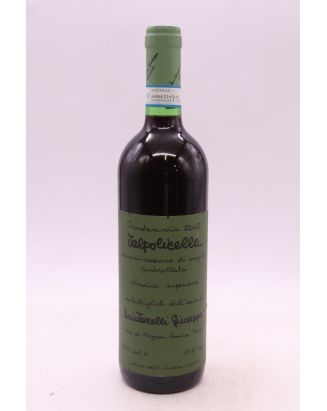
Valpolicella Classico Superiore: far from the usual light Valpolicella, Quintarelli’s version is made with roughly half the grapes dried for two months, then aged for seven years in Slavonian oak after a ripasso on Amarone lees. The result is a red of remarkable density and finesse, with notes of black cherry, spice and dried flowers, rivaling many Amarones from other producers.
Rosso del Bepi: a direct tribute to the master, produced only in vintages when grape quality does not allow an Amarone to be declared. Made using exactly the same drying and aging methods, it offers a striking taste of the house style at a more accessible price, with fabulous aromatic richness and considerable aging potential.
Amarone della Valpolicella Classico: the estate’s undisputed flagship and a benchmark for the entire appellation. Made from approximately 55% Corvina and Corvinone, 30% Rondinella, and 15% Cabernet Sauvignon, Nebbiolo, Croatina and Sangiovese, it comes from grapes dried for several months and then aged for at least seven years in large oak casks. Brandied cherry, fig, leather, cocoa, tobacco and spice unfold across a powerful yet breathtakingly refined palate, with an unforgettable finish.
Amarone della Valpolicella Classico Riserva: produced only in exceptional vintages and in tiny quantities, sometimes under the Selezione designation or as a special release, it spends a full decade aging in Slavonian oak. Of extraordinary concentration and complexity, it combines power with masterful balance and ranks among the world’s most sought-after Italian wines.
Alzero: the estate’s Bordeaux-style cuvée, created in the early 1980s. It blends approximately 40% Cabernet Franc, 40% Cabernet Sauvignon and 20% Merlot, with the grapes dried before vinification. The house’s only wine aged in French oak, for five years, it offers an exceptionally velvety texture and notes of blackcurrant, graphite, tobacco and spice. An absolute rarity, produced in just a few thousand bottles.
Recioto della Valpolicella Classico: Valpolicella’s fine sweet red wine and the historical predecessor of Amarone, made from the same dried grapes but with fermentation stopped to retain sugar. After around six years in oak casks, it offers a nectar of candied black cherry, chocolate, plum and spice, with remarkable elegance and freshness. Superb with a chocolate dessert or blue cheese.
COLLECTION NEAR PARIS & VAT REFUND FOR TOURISTS
Free collection in our warehouse near central Paris (92)