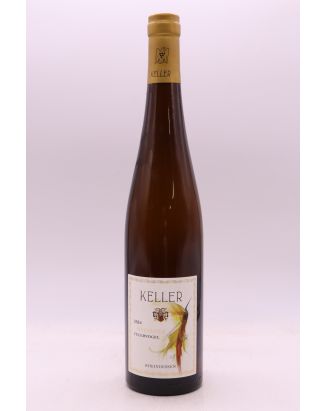
Keller Silvaner Feuervogel Trocken 2024
Personalise your experience
Change your country, language and currency here whenever you wish.
|
|
|
Must-See Châteaux |
|
|
|
|
|
|
In the vast panorama of German wines, Weingut Keller holds an absolutely singular place. Located in the Rheinhessen region, in Flörsheim-Dalsheim, this family wine estate founded in 1789 is today led by Klaus-Peter Keller, the eleventh generation of winegrowers. Where others settle for excellence, Keller aims for absolute perfection: dry rieslings ranking among the greatest white wines in the world, and Spätburgunder capable of rivaling the finest Burgundy pinot noirs.
The history of Domaine Keller dates back to 1789, when Johann Leonhard Keller, who had emigrated from Switzerland due to the turmoil of the French Revolution, settled in Dalsheim. He then acquired four hectares of the "Oberer Hubacker" plot, a historic vineyard that had belonged to the local abbey. This founding gesture is far more than a simple land transaction: it marks the beginning of a winemaking adventure that would last more than two centuries.
For nearly two hundred years, the estate built a solid reputation thanks to its sweet and fruity wines. The property has always enjoyed great prestige, particularly for its liquoreux and moelleux wines of great nobility. It is the eleventh generation that brings about a decisive transformation. Before joining the family estate, Klaus-Peter went to train in Burgundy, where he carried out internships with renowned winemakers, including Domaine Rousseau. Armed with this Burgundian experience and a winemaking qualification from Geisenheim, he took over the helm with his wife Julia in 2001.
The name of the iconic G-Max cuvée carries the memory of this family history: the "G" pays homage to Georg, Klaus-Peter's great-grandfather, the first family member to commercialise wine in bottles as early as 1921 and the true founder of Weingut Keller as we know it today, while "Max" honours Maximilian, Klaus-Peter's eldest son. Today, their son Felix also works alongside his parents, thus ensuring the continuity of an exceptional family legacy. The Gault Millau crowned the estate "Winzer des Jahrzehnts" — Winemaker of the Decade — a distinction that alone sums up the estate's meteoric rise to the summit of world viticulture.
Domaine Keller owns 21 hectares of vines in the Wonnegau sub-district of Rheinhessen, of which 70% are planted with Riesling. Approximately 70% of this area is classified as Grosse Lage, the German equivalent of Grands Crus, within the VDP classification. The emblematic vineyards include the Hubacker in Dalsheim, and the Kirchspiel, the Morstein and the Abtserde in Westhofen.
Each terroir has its own signature and contributes to the diversity of the portfolio:
Hubacker (Dalsheim). This historic four-hectare plot is planted almost exclusively with Riesling, on yellow limestone soils, with a south-east exposure that encourages late ripening and great concentration. The average yield is maintained at 45 hl/ha over several years. In 2000, a six-metre limestone tower was erected there to underline the importance of this founding cru.
Morstein (Westhofen). This Nierstein vineyard is one of the largest Grosse Lagen in Rheinhessen. Its heavy clays resting on a limestone subsoil give rise to the most powerful and most mineral Rieslings in the Keller range.
Kirchspiel (Westhofen). An east-facing, cooler cru that yields Rieslings of remarkable precision and tension. Julia Keller, whose family owned many prestigious plots in Westhofen, brings to the estate an intimate knowledge of these terroirs.
Abtserde / Abts E®.de (Westhofen). This sector, mentioned in documents dating from 1284, harbours a secret: it has the highest active limestone content of all of Westhofen, comparable to that of Grand Cru Les Clos in Chablis, which lends its wines additional precision and freshness.
The vineyards rest on soils rich in limestone, which contribute to the distinctive character and quality of the wines. Throughout the growing season, meticulous work is carried out in each plot according to its specific pedological characteristics. Pruning, leaf removal and shoot positioning are carried out entirely by hand. The canopy height is adjusted according to the water-holding capacity of each vineyard in order to optimise late ripening.
The winemaking philosophy of Weingut Keller rests on a fundamental principle: allowing the terroir to express itself without constraint. In the cellar, a non-invasive principle is applied with as few interventions as possible — as much as necessary, as little as possible — in order to preserve the natural potential of the grapes. The musts ferment spontaneously at low temperature thanks to the vineyard's indigenous yeasts. Fermentation lasts at least eight to ten weeks, and up to six months for sweet wines.
The fermentation and ageing of the wines take place in large French oak barrels. The wines then mature in bottle for at least six months before being released to the market. Depending on the style sought, certain cuvées are aged in stainless steel tanks to preserve their aromatic purity, while the Grosse Gewächse benefit from a period in large traditional wooden barrels.
Particular attention is paid to obtaining healthy and physiologically ripe grapes through selective manual harvesting. During the harvest, often later than that of neighbouring estates, a rigorous sorting is carried out both in the vineyard and in the cellar, eliminating any imperfect berry. This extreme rigour at every stage, from vine to bottling, explains the exceptional concentration, purity and minerality that characterise all of the estate's cuvées.
Riesling G-Max
The G-Max Riesling is produced in minute quantities from the finest GG plots selected by Klaus-Peter. Initially intended for his personal consumption, this wine is today one of the most sought-after and most acclaimed Rieslings in the world. The 2001 vintage marks the first vintage of this now cult cuvée. Only 1,500 bottles are produced per vintage, making it one of the most expensive dry Rieslings in the world. Today, almost the entire production is sold in the "Kellerkiste", a case comprising five bottles of Riesling GG and one bottle of G-Max. Wines at this level are distinguished by their extreme concentration, energy and brilliance, and require long cellaring to reveal their full complexity.
Riesling GG Hubacker (Dalsheim)
This Riesling GG comes from the four hectares of vines that the Keller family has owned since 1789, planted on yellow limestone soils with a south-east exposure. The 40-year-old Riesling vines ripen later than all other Grosses Gewächs at the estate. The Hubacker is one of the richest Riesling GGs from Keller. Jancis Robinson regularly describes it as the "Montrachet of Germany", underlining the richness of its bouquet, its power and its delicate finish.
Riesling GG Kirchspiel (Westhofen)
Sourced from an east-facing cru with cooler temperatures than Morstein, this Riesling GG is distinguished by its tension, precision and cutting minerality. The Von Der Fels cuvée, often described as the "baby G-Max", is a blend of young vines from the GG plots, sourced 60% from the Hubacker and 40% from the Kirchspiel, planted on limestone soils. It constitutes an ideal introduction to the world of the estate's great crus.
Riesling GG Morstein (Westhofen)
The Morstein is generally the most powerful GG in the Keller range. Aromatic without being exuberant, rich, deep and enveloping, it combines power and finesse with a mineral and persistent finish. It is one of the most important and most sought-after cuvées of the estate. It is reserved exclusively for sale in the estate's mixed twelve-bottle case.
Riesling GG Abts E® / Abtserde (Westhofen)
The name Abtserde, meaning "Abbot's Land", is that of an ancient lieu-dit mentioned in documents from 1284. Klaus-Peter Keller acquired this plot in 2006. It has the highest active limestone content of all the vineyards in Westhofen, lending the wines additional precision and freshness comparable to Grand Cru Les Clos de Chablis. It is the cru that requires the most time for all its elements to integrate harmoniously.
Riesling GG Bürgel (Nierstein)
This Riesling GG comes from a 0.3-hectare plot acquired in 2009. The red schist soils on the steep slopes overlooking the Rhine differ radically from the limestones of Westhofen and Dalsheim, lending this wine a unique personality, darker and more tense.
Riesling RR (Kirchspiel)
The "RR" cuvée is generally sourced from a confidential red-soil plot within the Kirchspiel. This barrel rarely ferments to complete dryness and the Kellers appreciate the wine's natural balance, slightly off-dry (feinherb), of remarkable freshness and drinkability. It is the insiders' bottle, both accessible and profound.
COLLECTION NEAR PARIS & VAT REFUND FOR TOURISTS
Free collection in our warehouse near central Paris (92)