Personalise your experience
Change your country, language and currency here whenever you wish.
|
|
|
Must-See Châteaux |
|
|
|
|
|
|
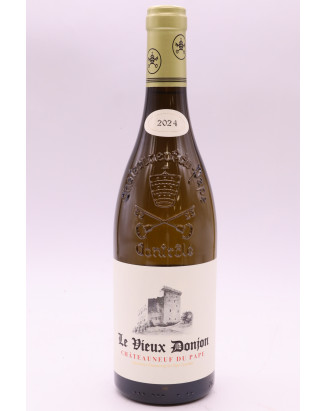
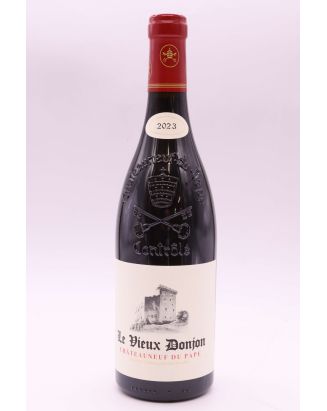
Le Vieux Donjon is one of the most discreet and admirable estates in the Châteauneuf-du-Pape appellation, a confidential gem "curiously far better known abroad than in France", with a large share of its production exported. Founded between the two World Wars by Marcel Michel, the estate gained momentum from 1966 onwards when it began bottling its wines, then under the impetus of Lucien and Marie-José Michel, who joined together in 1979. Today, their daughter Claire Fabre-Michel and her brother François Michel carry on with the same passion and the same media silence a tradition of excellence founded on a simple and radical principle: to produce only two cuvées each year — a Châteauneuf-du-Pape Rouge and a Châteauneuf-du-Pape Blanc — deliberately refusing to create prestige cuvées.
The history of Vieux Donjon dates back to the interwar period, when Marcel Michel began cultivating vines in Châteauneuf-du-Pape. At that time, the estate sold its grape production in bulk and in barrels to négociants. It was not until 1966 that the decision was made to bottle and market the wines under the estate's own label. A first step towards independence and recognition, which would come to full fruition from 1979 onwards, when Lucien Michel and Marie-José united their two family inheritances and their respective vineyards to form Le Vieux Donjon as it exists today. Having each inherited the vineyard and family know-how, they extracted the very best from these terroirs over the course of a few decades to produce wines of a confidential and outstanding quality.
The estate's philosophy was affirmed from the outset: never any compromise on quality, never a multiplication of prestige cuvées to court the press. A single red cuvée, a single white cuvée, crafted with the same rigour for decades. This integrity has earned the estate the status of one of the appellation's great benchmarks abroad, particularly in the United States and Japan, with consistently very high scores from international critics. Lucien Michel passed away, and his children Claire Fabre-Michel (wife of Adrien Fabre of Domaine la Florane and the Domaines de l'Echevin) and François Michel have been at the helm for about ten years, perpetuating the work of previous generations in the same tradition and with the same care both in the vineyard and in the cellar. A special cuvée, entitled "Cuvée Especiale", was produced exceptionally in 1990 and 1998, in tiny quantities of 25 to 100 cases, identified by a gold sticker on the bottle.
The Vieux Donjon vineyard extends over 17 hectares, located at the heart of the Châteauneuf-du-Pape appellation in the Vaucluse. The plots are spread across several types of terroir characteristic of the appellation: galets roulés soils (or "gress"), those imposing alluvial stones that store the heat of the day and release it at night, favouring optimal and consistent ripening of the Grenache, as well as argilo-calcareous and sandy soils in other areas. The vineyard takes its name from the old medieval keep of the village of Châteauneuf-du-Pape, which has dominated the vines for centuries.
The red grape varieties are dominated by Grenache noir (75%), complemented by Mourvèdre (10%), Syrah (10%) and Cinsault (5%), along with a few other indigenous varieties permitted in very small proportions. The great singularity of the vineyard lies in the exceptional age of the old vines: the average age of the vines exceeds 50 years, and many Grenache plots are over 100 years old. These centenarian vines, with their naturally tiny yields, concentrate matter and complexity in every berry, largely explaining the depth and longevity of Vieux Donjon's wines. For whites, the grape varieties include Grenache blanc, Roussanne, Clairette and Bourboulenc.
Winemaking at Vieux Donjon is resolutely traditional, in keeping with the appellation's customs and techniques passed down from generation to generation. Harvests are entirely manual, with strict sorting of the grapes both in the vineyard and in the cellar. Depending on the vintage, the bunches are partially destemmed (approximately 50% of the harvest depending on the year) to preserve the balance between structure, freshness and fruit. Fermentation takes place naturally, without added yeasts for most of the grape varieties (only Mourvèdre may benefit from the addition of selected yeasts depending on the vintage), in traditional concrete vats. The vatting period lasts approximately 25 days, allowing for a gentle and harmonious extraction of tannins, anthocyanins and aromas. Ageing takes place exclusively in old oak foudres for 18 months, with no passage through new barrels, in order to preserve the purity of the fruit and the typicity of the terroir without any woody input.
For the Châteauneuf-du-Pape Blanc, winemaking follows an equally precise approach: malolactic fermentation is not carried out, thus preserving the wine's natural freshness and lively acidity. This decision, rare in the appellation, gives the Vieux Donjon white "a remarkable freshness and a subtle balance between vivacity and roundness", making it one of the most chiselled and energetic whites in Châteauneuf. The wines are neither filtered nor fined before bottling in the greatest years.
Châteauneuf-du-Pape Rouge: The estate's great red cuvée, the only one produced every year, and one of the absolute benchmarks of the appellation. A blend of 75% Grenache (including many century-old vines), 10% Mourvèdre, 10% Syrah, 5% Cinsault and various grape varieties. Approximately 50% destemmed depending on the vintage, fermentation with indigenous yeasts in concrete vats, vatting for 25 days, ageing for 18 months in oak foudres. A red wine of great elegance: aromas of fresh red fruits (cherry, raspberry), a fine and silky tannic structure, a persistent finish blending fruity freshness with spiced notes. A wine for cellaring from 15 to 25 years in the greatest vintages. The 2007 and 2010 vintages have entered the appellation's legend. "Very well known abroad, this cuvée captivates discerning enthusiasts with its consistency and authenticity." Produced in confidential quantities, difficult to find in France.
Châteauneuf-du-Pape Blanc: A white cuvée made from a blend of Grenache blanc, Roussanne, Clairette and Bourboulenc, sourced from the appellation's galets roulés and clay terroirs. Malolactic fermentation is not carried out, preserving the wine's natural freshness. A rich and complex white wine, both sun-drenched and remarkably fresh: aromas of white flowers, citrus, white-fleshed fruits and stony minerality. A chiselled and energetic palate, endowed with a subtle balance between vivacity and roundness. A rare fine-dining white wine, capable of ageing for several years in great cellars. Produced in even more limited quantities than the red.
Châteauneuf-du-Pape Cuvée Especiale (exceptional vintages only): An extremely rare and ultra-confidential cuvée, produced only in exceptional vintages, namely 1990 and 1998 among the known ones. Identified by a gold sticker on the bottle, this cuvée does not exceed 25 to 100 cases in production. A selection of the very finest vats of the vintage, expressing the quintessence of Vieux Donjon in its most concentrated form. A collector's item for enthusiasts of the greatest Châteauneuf-du-Pape wines.
COLLECTION NEAR PARIS & VAT REFUND FOR TOURISTS
Free collection in our warehouse near central Paris (92)