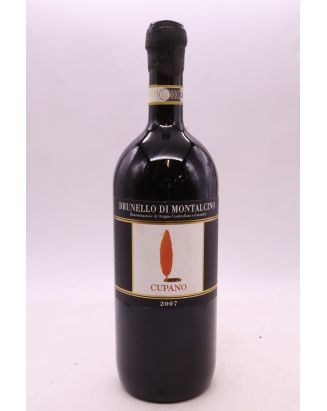
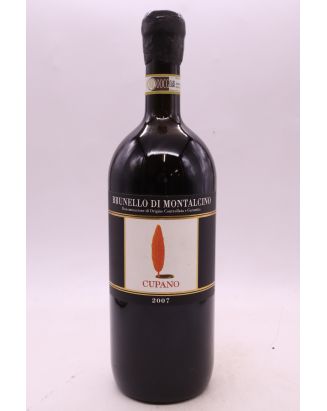
Cupano Brunello di Montalcino 2007 Magnum
Cupano Brunello di Montalcino 2007 Magnum - PROMO -10%!
Personalise your experience
Change your country, language and currency here whenever you wish.
|
|
|
Must-See Châteaux |
|
|
|
|
|
|
|
|
Perched on a stony hillside overlooking the Ombrone river, in the south-western quadrant of Montalcino, Domaine Cupano is one of Tuscany's best-kept secrets. Founded by a couple who came from Paris, Ornella Tondini and Lionel Cousin, it applies a deeply Burgundian approach to sangiovese, inherited from Henri Jayer: few hectares, tiny yields, parcel-by-parcel winemaking, indigenous yeasts and patient ageing in Burgundian oak barrels. The result is Brunello of rare elegance and transparency, capable of ageing for decades without ever losing their freshness.
Ornella Tondini, a journalist for L'Autre Journal, and Lionel Cousin, a filmmaker and cinematographer, were living in Paris with their daughter Orsa when they decided in the 1990s to leave everything behind for Montalcino. They already knew the region well, spending most summers there hosting artists, actors, musicians, and writers. In 1994, they purchased Podere Centine, a livestock farm that had been abandoned for more than forty years, southwest of Montalcino near the medieval village of Camigliano. The soil was completely pristine, never having touched chemical fertilizers, pesticides, or industrial treatments.
They immediately understood the land's value and sought out the best advice. Carlo Ferrini selected the plots, plant material, training system, and vine height. François Bouchet introduced them to biodynamics. Above all, legendary Burgundian winemaker Henri Jayer, alongside journalist Jacky Rigaux, became their mentor, passing on his core beliefs: small acreage, wine is made in the vineyard, zero chemical fertilizers, limited yields, strict table sorting, native yeasts, and malolactic on the lees in French barrels. In 1997, the couple planted 3.4 hectares around the hill, certified organic from year one, and the first commercial vintage was 2000. Lionel Cousin passed away in 2021, leaving the estate in the hands of Ornella and Andrea Polidoro, who joined as a consultant in 2014 before becoming cellar master in 2016, trained by Lionel in every technique of the estate.
The property covers around 35 hectares, of which only 6 are planted to vines, with the rest divided among 2 hectares of olive trees, 18 hectares of woods, and about ten hectares of arable land. This intentional balance preserves a biodiversity rare in such a densely planted appellation. The hill slopes in all directions, allowing plots to face south, east, and west, benefiting from exceptional aeration and sunlight. This relatively warm sector of Montalcino is moderated by breezes from the Mediterranean coast and the nearby presence of the Ombrone River.
The terroir serves as the site's true signature. The riverbed once ran through these lands before tectonic forces linked to nearby Mount Amiata, an ancient volcano, pushed up the hill and left behind its sediments. As a result, the soil consists of sandy clays mixed with rounded pebbles, offering remarkable drainage and high mineral content. Because the area was once submerged by the sea, fossilized seashell fragments are found here, and Lionel Cousin even unearthed the fossilized remains of a whale. This marine minerality imparts to the wines their distinctive elegance and salinity. Sangiovese Grosso accounts for most of the plantings, complemented by small plots of Cabernet Sauvignon and Merlot.
Each parcel is harvested, fermented, and aged separately, akin to a Burgundian climat. Sorting is rigorous, carried out on tables to systematically eliminate underripe or damaged berries. Fermentations start solely with indigenous yeasts in stainless steel vats, with frequent pump-overs and rack-and-returns, though extraction is always kept measured—the goal being infusion and tannin refinement rather than raw power. The estate avoids all oenological additives.
Malolactic fermentation occurs on the lees in Burgundian oak barrels, which are rolled regularly to keep the lees in suspension and nourish the wine. Aging is extensive, taking place in 225-liter barriques and 500-liter tonneaux, with the proportion of new wood reduced over the years to keep the fruit unmasked. The wines are neither fined, filtered, nor clarified, and benefit from patient bottle aging prior to commercial release. Volumes remain tiny, often just a few thousand bottles per cuvée and vintage.
Brunello di Montalcino: the flagship cuvée, made from 100% Sangiovese Grosso from the hill's historic parcels. Following a long fermentation with indigenous yeasts, the wine ages for several years in Burgundian oak barrels before bottle maturation. It stands out with a transparency and elegance that set it apart from heavier Brunellos: violet petals, black tea, crisp cherry, balsamic herbs, exotic spices, and a touch of blood orange frame a silky structure. The tannins are fine and the saline finish lingers endlessly. A fine wine for cellaring, capable of evolving over several decades.
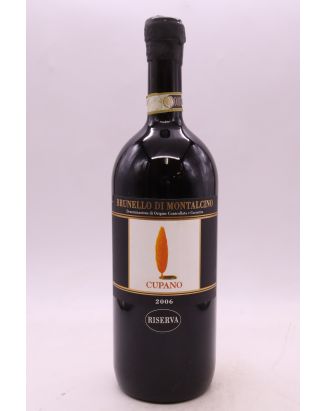
Brunello di Montalcino Riserva: produced only in exceptional vintages and in strictly limited quantities, it comes from a selection of the best barrels and undergoes even longer aging. Deeper and denser than the classic Brunello, it nonetheless retains the same restraint and energy. Ripe black fruits, blond tobacco, licorice, and balsamic notes combine in a wine of staggering complexity, to be opened several hours in advance or cellared for many years.
Rosso di Montalcino: far from a simple second wine, this pure Sangiovese is crafted as a miniature Brunello, also capable of aging. Aged in oak, including a proportion of 500-liter tonneaux, it displays bright red fruits, pipe tobacco, warm earth, cinnamon, wild flowers, and a touch of orange zest and cocoa. Elegant tannins are supported by vibrant acidity, and the mineral finish lingers extensively. A wine of exceptional finesse, ready to drink now or cellar for five to ten years.
Ombrone, Sant'Antimo: the cuvée that pays homage to the river bordering the property, crafted from Cabernet Sauvignon and Merlot planted on the hill in 1997. Vinified with the same single-parcel approach and avoidance of excessive extraction, it offers a darker, more velvety profile of blackcurrant, blackberry, graphite, and sweet spices, with a silky texture reminiscent of fine Bordeaux while retaining the saline imprint of the Montalcino terroir.
Moscadello di Montalcino: a tribute to the commune's oldest specialty, predating Brunello, this sweet wine is crafted from Moscato Bianco grown on the property. Orange blossom, fresh grapes, citrus peel, and light honey create a nose of great delicacy, while the palate, luscious yet perfectly taut, extends into a clean finish. A rarity made in very small quantities, best served chilled as an aperitif, with blue cheeses, or with fruit pastries.
COLLECTION NEAR PARIS & VAT REFUND FOR TOURISTS
Free collection in our warehouse near central Paris (92)