Personalise your experience
Change your country, language and currency here whenever you wish.
|
|
|
Must-See Châteaux |
|
|
|
|
|
|
|
|
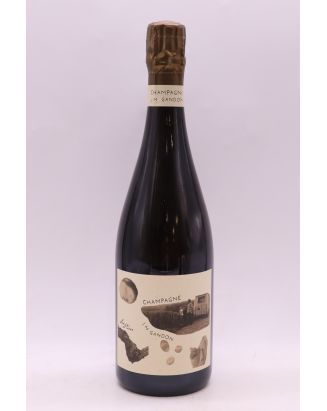
Based in Branscourt, a small village in the Vesle valley west of Reims, JM Gandon is one of the most talked-about names of the new Champagne generation. Victor Gandon made his first vintage there in 2020, picking up the thread of a family history begun by his great-grandparents as farmers and continued by his father Jean-Marie, whose initials give the domaine its name. On soils of Upper Ypresian and Cuisian studded with marine fossils, he works pinot noir and meunier vines from mass selections of the 1970s, planted at very high density. Slow pressings, spontaneous fermentations, barrel ageing on the lees, minimal sulphur, and near-zero dosages.
The story begins with Victor Gandon's great-grandparents, farmers in a Champagne region then dedicated to mixed agriculture, who planted the family's first vines in Branscourt. His father, Jean-Marie Gandon, expanded the estate during the 1960s and 1970s, notably establishing the massal-selection plots that form the cornerstone of the property today. Like many growers in this quiet valley, he sold his entire harvest to the négoce and never vinified his own grapes.
The turning point came in 2020. Victor, trained in enology and also heading agroforestry for a prominent Champagne house, chose to vinify a first parcel on the family estate. These were the first wines ever produced under the domaine's name, and the resulting cuvée, Les Pièces, was created as a tribute to his father and the vines he planted—represented by the JM initials on the label. The inaugural vintage, yielding only 1,350 bottles, immediately caught the eye of discerning wine merchants and importers. Since then, Victor has gradually taken on additional parcels each year for estate vinification, while the remainder of the crop continues to be sold to wine merchants. The project remains in development, making each new vintage an event to watch.
Branscourt is a forgotten growth: the village counts only 39 hectares of vineyards within a landscape of fields and woods where the Vesle Valley creates a corridor marked by morning mists. Located west of Reims, this sector belongs to the Massif de Saint-Thierry area. It features a mosaic of soils: chalk on the hillsides, sandy clays midway up the slopes, and distinct sand veins. The geology dates from the Upper Ypresian and Cuisian stages, featuring sandy-clay soils of the Cuis-la-Motte type that are remarkably rich in marine fossils of Venericardia planicosta and Turritella communis.
The family estate spans between 5 and 6 hectares across some twenty parcels of Pinot Noir, Meunier, and Chardonnay, including several massal-selection plantings established by Jean-Marie in 1968, 1973, and 1974. The core of the project is the L'Aubière parcel, a vineyard of less than half a hectare with an east-west exposure at an altitude of 140 meters, planted at around 10,000 vines per hectare. Meunier occupies the rows closest to the small stream bordering the plot, providing natural protection against the spring frosts common to the valley. Rather than creating numerous micro-cuvées, Victor Gandon seeks to harmonize variations in soil, vine age, rootstock, and exposure, approaching his vineyard as an interconnected mosaic rather than a collection of separate parcels. Soils have been worked mechanically since 2013 without weedkillers or insecticides, while copper use is kept to a strict minimum.
Cellar work directly mirrors vineyard philosophy: precision, restraint, and an aversion to artifice. Harvesting is done by hand, grapes are pressed gently using a pneumatic press, followed by natural settling. Barrels and vats are filled entirely by gravity without pumping.
Fermentations begin spontaneously with native yeasts alone, without inoculation, chaptalization, or must adjustments. Malolactic fermentation occurs naturally. Maturation takes place on full lees in 228- and 400-liter Burgundy barrels—occasionally complemented by stainless steel depending on the vintage—lasting nine to twelve months without racking. The wine is neither fined nor filtered. Secondary fermentation in bottle is kept deliberately restrained, aging on laths lasts two to three years, and dosage is zero or minimal, ranging between brut nature and extra brut. The estate uses no reserve wines: each cuvée is a direct reflection of its harvest year, shaped by the natural freshness of the Vesle Valley and structured around Pinot Noir.
Les Pièces V20: the inaugural champagne crafted by Victor Gandon, sourced from the 2020 vintage and exclusively from the L'Aubière parcel. A blend of roughly 95% Pinot Noir and 5% Meunier from massal-selection vines planted in 1973 and 1974. Spontaneously fermented with native yeasts, aged on lees for about twenty-four months, bottled without fining, filtration, or dosage. Produced in a run of just 1,350 bottles, it stands out for its precision, intensity, and bottle aging potential estimated at around fifteen years. The nose displays ripe red fruits backed by delicate oak nuances, while the palate is taut, expressive, and finishes with lovely salinity.
Les Pièces V21: the estate's second vintage, produced from a cool and demanding season. The blend highlights Pinot Noir complemented by roughly 10% Meunier, aged half in used oak barrels and half in stainless steel tanks. Dosaged extra brut at under three grams per liter and disgorged in spring 2024, it captivates with deep, almost balsamic floral notes, an elegant texture, and quiet power. The complexity and depth of a cool vintage are on full display.
Les Pièces V22: an extra brut White de Noirs from the sunny, dry, and early 2022 season, where ripening accelerated rapidly late in the summer. Grapes were transferred by gravity into 228- and 400-liter barrels, spontaneously fermented with natural malolactic fermentation, and aged for nearly ten months on full lees without fining or filtration, followed by over two years of bottle aging before disgorgement. The nose opens with fresh red fruits and ripe apple, accented by brioche and subtle chalkiness. The palate is vinous, direct, and broad, lifted by fine bubbles and a saline tension that carries the finish.
Subsequent vintages continue this approach, with each new harvest enabling Victor Gandon to take over additional parcels across the family estate.
COLLECTION NEAR PARIS & VAT REFUND FOR TOURISTS
Free collection in our warehouse near central Paris (92)