Personalise your experience
Change your country, language and currency here whenever you wish.
|
|
|
Must-See Châteaux |
|
|
|
|
|
|
|
|
A leading estate in the Pommard appellation
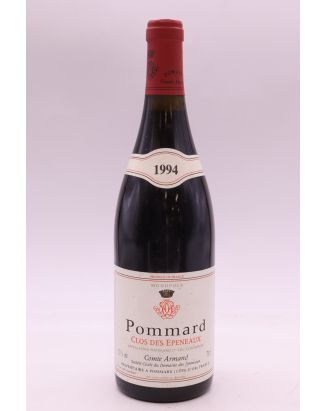
Located in the heart of the village of Pommard, in the Côte de Beaune, Domaine du Comte Armand, also known as Domaine des Épeneaux, holds exclusive ownership of one of Burgundy’s most legendary walled vineyards. Across nine hectares farmed under certified organic and biodynamic practices, it produces powerful, rich wines of remarkable depth, now showing even greater refinement and elegance. The Pommard 1er Cru Clos des Épeneaux, a 5.23-hectare monopole, is one of the Côte de Beaune’s most sought-after cuvées, complemented by excellent wines from Volnay and Auxey-Duresses.
Domaine des Épeneaux takes its name from Clos des Épeneaux, a magnificent five-hectare plot assembled by Nicolas Marey in the late 18th and early 19th centuries. In 1828, the clos and its buildings, located in the center of the village of Pommard and known as the Fief de Rancy, became part of the estate of the Comte Armand family. The property remained centered on this single exceptional plot for more than a century and a half, making it one of the most unusual estates in the Côte d’Or.
The estate did not expand until 1994, first adding vines in Volnay, then plots in the village of Auxey-Duresses. It thus reached its present size of nine hectares. The owning family has always entrusted the management of the estate to talented stewards, a tradition that has contributed greatly to its international reputation. Since the 2014 vintage, Paul Zinetti has overseen the vineyards and winemaking. He has steered the wines toward greater refinement and elegance without abandoning the estate’s hallmark: powerful, rich cuvées with aging potential measured in decades. Today, the entire range is regarded as a benchmark in Burgundy, and Clos des Épeneaux is among the most acclaimed wines of the Pommard appellation.
The jewel of the estate is Clos des Épeneaux, covering 5.23 hectares. It is one of the ten largest monopoles in the Côte de Beaune and Côte de Nuits, across both premiers crus and grands crus. Straddling the Grands Épenots and Petits Épenots climats, it lies on clay-limestone soils particularly favorable to the expression of Pinot Noir. Its vines range from 30 to 80 years old, are planted at a density of 12,000 vines per hectare, and are systematically propagated through massal selection.
The clos is assessed in exceptionally fine detail. It is divided into four units vinified separately according to four main criteria: planting year; bedrock depth, which ranges from 20 to 30 centimeters in the upper section to 60 or 80 centimeters in the lower section; soil structure; and soil texture. Beyond this historic core are plots in Volnay, notably the Les Fremiets premier cru and the Les Condemaines locality, as well as plots in Auxey-Duresses at Les Argillas, one of the most limestone-rich areas in the entire Côte de Beaune, with 30% active limestone. The estate is farmed according to certified organic and biodynamic principles, with particular attention to biodiversity and soil life. Harvesting is, of course, done by hand, and each cuvée is blended according to uncompromising selection standards.
The wines reflect the quality of the fruit from which they are made. On the principle that the berry itself is the fruit, the grapes are 100% destemmed but not crushed, preserving a high proportion of whole berries. Vinification then proceeds in three stages: five to eight days of pre-fermentation maceration at 13 or 14°C, five to ten days of spontaneous alcoholic fermentation, and post-fermentation maceration lasting three to fifteen days, depending on the year.
In most cases, total maceration lasts around four weeks, particularly long compared with traditional Burgundian methods. The estate believes it is more beneficial to give the extracted material time to settle into a stable, harmonious structure. The moon, which largely governs the rhythm of vineyard work, has also played a role in the winery since the 2001 vintage: these four weeks of maceration correspond to a lunar sidereal cycle, a rhythm governing fluids on Earth. The wines are then aged according to this constant 28-day rhythm to preserve, as far as possible, the vibrational state of the water within the grapes at the moment they are picked. Unusual as this approach may be, it yields wines of greater precision and minerality.
Depending on the appellation and the age of the vines, barrel aging lasts 18 to 24 months, with new oak ranging from 0% for the village wines to 30% for the old vines of Clos des Épeneaux; the barrels are lightly toasted. Most wines are neither fined nor filtered, allowing their full qualities to shine through. The estate recommends storage at around 12°C and advises decanting recent vintages, while noting that no decanter can replicate the fullness gained after ten to fifteen years in the cellar.
Pommard 1er Cru “Clos des Épeneaux”: the estate’s legendary cuvée and exclusive monopole, spanning 5.23 hectares across Grands Épenots and Petits Épenots. It comes only from selected plots with vines at least twenty years old; grapes from younger vines are declassified. The clos is divided into four units vinified separately, with the final blend combining the energy of younger vines and the density of older ones. Aging takes about 22 months in oak barrels. The color is brilliant ruby; the remarkably complex nose offers black cherry, raspberry, violet, sweet spices, and undergrowth. Full-bodied and dense on the palate, it has silky yet firm tannins, pronounced underlying minerality, and a remarkably long finish. Highly tannic in its youth, this wine of character and depth comes fully into its own after a decade and can be kept for several decades.
Pommard Village: depending on the vintage, grapes from the youngest vines in Clos des Épeneaux are declassified into this village-level cuvée. It offers a more approachable introduction to the estate’s wines, with Pommard’s characteristic fleshy, spicy character, softer tannins, and more immediately expressive red fruit.
Volnay 1er Cru “Les Fremiets”: a plot of 39 ares and 57 centiares, producing a limited run of approximately 1,800 bottles and aged for 18 months with 25% new barrels. Les Fremiets comprises two plots, one planted in 1950 and the other in 1980. They border the Pommard appellation, accounting for their very similar soil, with a high concentration of iron oxide, while the bedrock remains characteristic of Volnay. The resulting wines are relatively delicate and elegant from the first sip through the mid-palate, in the Volnay style, before quickly gaining structure on the finish, in the manner of Pommard. A fascinating premier cru at the meeting point of two appellations.
Volnay Village: the village-level cuvée from a terroir renowned for its finesse, an ideal complement to Les Fremiets. It charms with aromas of violet, cherry, and raspberry, fine, supple tannins, an elegant structure, and lovely freshness. A delicate Pinot Noir that is approachable younger than the Pommard wines.
Auxey-Duresses 1er Cru: from the well-exposed slopes of this village neighboring Meursault, this premier cru offers a structured, flavorful Pinot Noir with notes of red and black fruit, spices, and a distinct mineral backbone. Its natural freshness and density make it excellent value within the estate’s range, with good aging potential.
Auxey-Duresses Village: a plot of 48 ares and 95 centiares, yielding around 2,250 bottles and aged for 18 months in barrels with 20% new oak. Facing due south on a hillside at Les Argillas, this vineyard, whose vines average 40 years of age, has geology distinctive to the area—one of the most limestone-rich parts of the Côte de Beaune, with 30% active limestone. The wines brim with small berries and are generally enjoyed fairly young, but can also age confidently for up to ten years.
Bourgogne Blanc “Condemaine”: a plot of 17 ares and 30 centiares, yielding only around 1,200 bottles, aged for 12 months in two- to four-year-old barrels, then six months on fine lees in stainless steel tanks. This young vineyard, around twenty years old, lies in the commune of Volnay at Les Condemaines, on more clay-rich soils in an area planted predominantly with Pinot Noir. Introducing muscaté Chardonnay, a small-berried Chardonnay from Mâcon La Roche Vineuse, was a bold but successful choice on these rich, deep soils. Trained using the Cordon de Royat system, it produces a white wine of surprising precision and freshness for a regional appellation.
Bourgogne Aligoté: a modest Burgundy white made with the same exacting standards as the crus. Lively, crystalline, and saline, it offers lemon and green apple with crisp acidity and a focused, easy-drinking palate. An ideal aperitif wine, also perfect with shellfish, seafood, and fresh goat cheese.
COLLECTION NEAR PARIS & VAT REFUND FOR TOURISTS
Free collection in our warehouse near central Paris (92)