Matrot

Wines from Domaine Matrot: buy at the best price

Based in Meursault, Domaine Matrot is a Burgundian family estate whose history dates back to 1835. Today led by the sixth generation, sisters Adèle and Elsa Matrot, it cultivates more than 20 hectares across the finest terroirs of the Côte de Beaune: Meursault, Puligny-Montrachet, Blagny, Volnay, Auxey-Duresses, Monthélie, Saint-Romain and Maranges. The whites, drawn from the premier crus Perrières, Charmes, Blagny, Combettes and Chalumeaux, rank among the absolute benchmarks of Meursault and Puligny, while the reds captivate with their suppleness and elegance. The vineyard has been farmed without chemical fertilizers since the 1970s and under sustainable practices since 2000, with indigenous yeasts, long fermentations and measured aging: everything here serves the purity of the fruit. 

Read more
See more
Filters

Price

€20.00 - €80.00

Volume

Parker WA rating

No choice available on this group

Burghound rating

86 - 96

Revue du Vin de France rating

No choice available on this group

Bettane & Desseauve rating

No choice available on this group

Prices drop

No choice available on this group

Download this list
There are 3 products.
Download this list
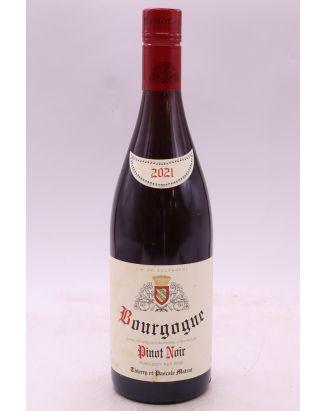
Thierry et Pascale Matrot Bourgogne 2021 Red
1 in stock
128103
Red
75cl
86/100
Add to cart
Burgundy | Bourgogne

Thierry et Pascale Matrot Bourgogne 2021 rouge

€21.00 inc-VAT per bottle
€17.50 ex-VAT
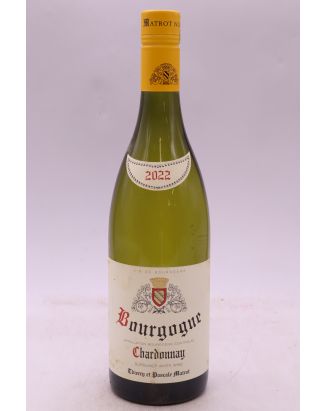
Thierry et Pascale Matrot Bourgogne 2022 White
1 in stock
128104
White
75cl
86/100
Add to cart
Burgundy | Bourgogne

Thierry et Pascale Matrot Bourgogne 2022 blanc

€26.40 inc-VAT per bottle
€22.00 ex-VAT
Thierry et Pascale Matrot Saint Aubin 1er cru Le Charmois 2022
1 in stock
128111
White
75cl
Add to cart
Burgundy | Saint Aubin 1er cru

Thierry et Pascale Matrot Saint Aubin 1er cru Le Charmois 2022

€66.00 inc-VAT per bottle
€55.00 ex-VAT

History of Domaine Matrot

It all begins with Simon Boillot (1835–1924), a winegrower in Meursault and grandfather of Marguerite Amoignon, who cultivated both his own family's vines and those of his wife. Meanwhile, Claude Matrot (1849–1933), a wine merchant like his father, developed a passion for the vine and in 1900 acquired three decisive plots: the Puligny-Montrachet Les Chalumeaux 1er Cru, the Meursault-Blagny 1er Cru and the Blagny La Pièce sous le Bois 1er Cru, all of which still form the heart of the range today.

His son Joseph Matrot (1881–1963) inherited both a talent for trade and a winegrowing expertise. In 1904, he married Marguerite Amoignon, who co-owned an estate in Meursault with her brother Charles. Charles's death during the war of 1914 led the couple to settle in the family home at 12 rue de Martray, which became and remains the headquarters of Domaine Matrot. Their son Pierre Matrot (1923–2004) began working the vines as early as 1937, purchased plots in Meursault, Auxey-Duresses and Monthélie, and modernised the estate. Thierry Matrot, born in 1955, joined the estate in 1976 after studying viticulture and oenology in Beaune, and his father entrusted him with winemaking from 1983 onwards. In January 2000, Thierry and Pascale Matrot created the company bearing their name and further enlarged the vineyard. Their daughters subsequently joined them, Elsa in 2008 and Adèle in 2010, both holding degrees in viticulture, oenology and wine commerce. In 2012, they invested in a plot in Maranges to enrich the range, and have since overseen the running of the estate.

Terroirs and Vines of Domaine Matrot

The heart of the vineyard lies in Meursault, a village on the Côte de Beaune renowned for its great white wines and its supple, elegant reds. The estate holds a remarkable heritage there, notably including the premier crus Les Perrières, celebrated for its taut minerality, Les Charmes, more ample and generous, and Blagny, situated at altitude on cooler soils. In Puligny-Montrachet, the plots of Les Combettes, neighbouring Meursault, and Les Chalumeaux, higher up on the slope, rank among the finest terroirs of the appellation.

The estate also extends into Blagny with the premier cru La Pièce sous le Bois, into Volnay with the red enclave of Santenots, as well as into Auxey-Duresses, Monthélie, Saint-Romain and Maranges. The grape varieties planted are Chardonnay, Pinot Noir and Aligoté. As early as the 1960s, the estate was not immune to the wave of full chemical farming, but the arrival of Thierry in 1976 marked a turning point: chemical fertilisers were abandoned in favour of organic manuring, and integrated pest management was progressively introduced, adapting products and their dosages to each disease. In 2000, the entire vineyard shifted to reasoned viticulture. The soils are ploughed, yields are controlled from pruning and bud removal onwards, and a green harvest is carried out before véraison when necessary.

Vinifications of Domaine Matrot

Only ripe and healthy grapes enter the cellar, with the sanitary condition, yields and maturity monitored with constant rigour before setting the harvest date. The whites are pressed as whole clusters on a pneumatic press. A few days before the harvest, a starter culture is prepared so as to work exclusively with the estate's indigenous yeasts. Fermentations are deliberately long, conducted under temperature control, generally between 18 and 20 degrees for the whites, and may extend over eight to ten weeks in oak barrels.

The estate takes extreme care over the hygiene of its casks and selects the lees that will accompany each wine throughout its ageing. The wines rest in 228-litre oak barrels for eleven to eighteen months, with one-to-five-year-old casks used predominantly for the whites, and only 10 to 20% new barrels for the reds. Bâtonnage is adapted to the vintage, malolactic fermentation is carried through to 100%, and a single racking followed by filtration precedes bottling. This approach, which aims to elevate without distorting, produces wines of great purity that are best waited a few years after bottling. The whites benefit from decanting to release their complexity, while the reds prefer aeration in the glass.

The cuvées of Domaine Matrot

The Bourgogne Aligoté opens the white range with a lively and lemony wine, driven by a frank acidity and a refreshing salinity, ideal as an aperitif. The Bourgogne Chardonnay proves already remarkably charming, with an aromatic intensity and a depth of palate that are impressive for its appellation, featuring white peach, apricot, ripe pear and fresh hazelnut. The Saint-Romain, sourced from a high-altitude village with cooler soils, delivers a straight and mineral Chardonnay, marked by citrus and a chalky finish of fine vivacity.

The Meursault village expresses the full generosity of the terroir, with an ample and flavoursome palate, notes of white fruits, almond and fresh butter, carried by discreet oak. The Meursault-Blagny 1er Cru, planted at altitude on leaner soils, stands out for its tension and minerality, with a vibrant acidity and a saline length that ensures a cellaring potential of fifteen years and more. The Meursault-Charmes 1er Cru embodies the elegance and roundness of the village, built on grilled hazelnut, acacia honey and ripe white fruits, in a silky texture of great harmony. The Meursault-Perrières 1er Cru represents the pinnacle of the estate in Meursault: of striking mineral depth, it combines restrained power, notes of gunflint, candied citrus and an exceptional persistence that fully unfolds after a decade in the cellar.

In Puligny-Montrachet, the Puligny-Montrachet Les Chalumeaux 1er Cru, acquired as early as 1900 by the family, seduces with its nose of candied lemon, popcorn, vanilla and flint, its generous palate and its remarkable freshness. The Puligny-Montrachet Les Combettes 1er Cru, situated on the boundary with Meursault, combines the richness of its neighbour with a Puligny-like verticality, with a nose marked by flint, herbs and lemon zest, and a superb saline length. The Puligny-Montrachet La Quintessence 1er Cru is the estate's most confidential cuvée in Puligny, a very high-level selection that pushes concentration and mineral definition even further. The cuvée L'Effronté completes the white range with an atypical and confidential bottle, off the beaten track, reflecting the freedom that the Matrot sisters allow themselves beyond the classic appellations.

On the red side, the Bourgogne Pinot Noir offers a supple and fruity wine, built on cherry and raspberry, with smooth tannins and immediate drinkability. The Maranges Vieilles Vignes, sourced from the southern end of the Côte de Beaune, brings more substance and a generous dark fruit character, at a particularly attractive quality-to-price ratio. The Auxey-Duresses shows freshness and spice, while the Monthélie, neighbour of Volnay, plays a floral and delicate tune, built on violet and small red berries.

The Meursault Rouge is a sought-after rarity: this Pinot Noir from Meursault, an appellation predominantly dedicated to whites, develops a crunchy red fruit character, a fine texture and a remarkable freshness. The Maranges La Fussière 1er Cru is a full-bodied and rich wine, with firm tannins, marked by dark fruits and liquorice, which benefits greatly from a few years in the cellar. The Volnay Santenots 1er Cru, sourced from the famous red enclave situated in the commune of Meursault, combines finesse and depth, with a nose of blackcurrant, blueberry and undergrowth and an elegant, ample and silky palate. Finally, the Blagny La Pièce sous le Bois 1er Cru, acquired by the family in 1900, is one of the most original reds of the Côte de Beaune: planted at altitude on the boundary of Meursault and Puligny, it yields a taut, wild and mineral Pinot Noir, with firm tannins and a saline length, which requires patience to reveal its full complexity.

WHAT THEY SAY ABOUT US

5 good reasons to buy wines on V&M

...

EXPRESS DELIVERY

In a secure polystyrene packaging

...

INTERNATIONAL SHIPPING

Find out more about VAT-EX sale for outside EU deliveries

...

COLLECTION NEAR PARIS & VAT REFUND FOR TOURISTS

Free collection in our warehouse near central Paris (92)

...