
 Personalise your experience




 Sign in
 Cart
0
Cart
0


How to decant an aged wine? The sommelier's guide

How to decant an aged wine? The sommelier's guide
You have just brought up from your cellar a bottle of Bordeaux from the 1990s or a Burgundy of more than twenty years? Before uncorking it, one crucial step is required: decanting. This sommelier's gesture can make all the difference between a memorable tasting and an irreparably ruined bottle.
Key takeaway:
- Decanting ≠ carafe pouring: decanting serves to separate the sediment from an old wine, whereas carafe pouring aims to oxygenate young wines.
- Delicate and precise movement: pour slowly, without agitation, using a light source to stop as soon as sediment appears.
- To be done at the last moment: the older the wine, the shorter the decanting should be — even immediate for very old vintages.
- Wines concerned: generally the great age-worthy reds (Bordeaux, Burgundy, Rhône) from 15–20 years onward presenting a sediment.
- Mistake to absolutely avoid: excessive oxygenation can "kill" an old wine within minutes — it is better to decant too late than too early.
What is the decanting of an aged wine?
Decanting refers to the action of gently transferring the contents of a bottle of aged wine into a decanter, with the sole purpose of separating the clear wine from its natural sediment. Etymologically, the verb "to decant" comes from the Latin canthus, meaning the rim or edge of a vessel — an image that perfectly illustrates this decisive passage from the neck to the decanter.
This sediment results from a natural phenomenon called phenolic precipitation: over time, tannins and pigments combine to form insoluble particles that fall to the bottom of the bottle. This natural process contributes to softening the tannins, but leaves a residue that, were it to end up in the glass, would impart a very unpleasant bitter and astringent flavor.
Decanting is therefore a separation operation, not an oxygenation one. That is its whole subtlety.
Decanting vs. carafe pouring: a fundamental distinction
These two terms are often confused. Yet they share neither the same objective, nor the same technique, nor the same target.
|
|
Decanting |
Carafe pouring |
|
Objective |
Separate the sediment |
Aerate and oxygenate |
|
Wines concerned |
Old wines (15 years+) |
Young, tannic wines |
|
Contact with air |
Minimal, to be avoided |
Sought-after and prolonged |
|
Decanter shape |
Narrow neck, tapered base |
Wide, flared base |
|
Timing |
At the last moment |
1 to 4 hours before |
|
Movement |
Slow, precise |
May be more lively |
Key takeaway: an old Bordeaux or a great Burgundy is decanted; a 3-year-old Côtes-du-Rhône is poured into a carafe. A very old wine can only withstand a minimal amount of oxygenation: any excess air risks making it lose the delicate balance of its aromas within minutes.
Why should an aged wine be decanted?
1. Eliminate sediment to preserve the tasting pleasure
The sediment present in old bottles is not dangerous, but it is deeply unpleasant on the palate: harsh flavor, grainy texture, bitter aftertaste. By separating the wine from these tannic residues, decanting ensures that every glass is perfectly clear and pure.
2. Release the stifled aromas
After years of slumber in the cellar, a great vintage needs a gentle awakening. The simple act of transferring it into a narrow-necked decanter offers it a minimal oxygenation — just enough for its complex aromas (leather, undergrowth, spices, candied fruit) to express themselves fully.
3. Eliminate any reduction odors
A wine that has long been sealed in its bottle may present a slight reduction (smell of sulfur or mustiness). Decanting allows it to "wake up" gradually and dispel these fleeting notes before serving.
Which wines should be decanted?
Wines that must absolutely be decanted
Decanting primarily concerns old red wines that have developed a visible sediment:
• Great Bordeaux wines (Médoc, Saint-Émilion, Pomerol) from 15 to 20 years of age onward
• Age-worthy Burgundies (Gevrey-Chambertin, Chambolle-Musigny, Pommard) from 15–20 years onward
• Rhône wines (Hermitage, Côte-Rôtie, Châteauneuf-du-Pape) at peak maturity
• Unfiltered wines, regardless of their age, if they present a sediment
Wines not to decant
• Very old wines (30 years and over): decant only if sediment is visible, at the very last moment
• Wines with delicate and volatile aromas: no need to take the risk if the sediment is minimal
• White wines: decanting is rarely beneficial for them
• Champagnes and sparkling wines: decanting would cause them to lose their effervescence
Vins & Millésimes tip: if in doubt, always taste the wine before deciding to decant it. A fragile wine with no notable sediment can very well be served directly from the bottle.
Essential equipment for decanting an aged wine
The decanting carafe: Choose a decanter with a narrow neck and tapered base, which limits the surface area of contact between the wine and the air. Season it beforehand (rinse it with a little wine) so that it is clean and odor-free.
A light source: The traditional technique is that of the candle: its soft flame allows you to see, by transparency through the neck, the gradual arrival of the sediment particles. Alternatively, the light from your phone works very well.
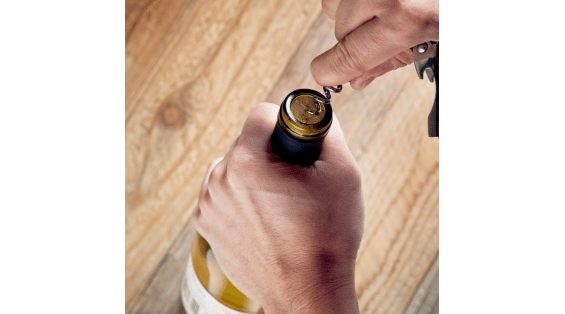
A quality corkscrew: To open the bottle with minimal vibration and without fragmenting the cork. Remove the capsule entirely.
A fine strainer and a funnel (optional): If the sediment is particularly abundant or if fragments of cork are present.
How to decant an aged wine: a step-by-step guide
Step 1: Prepare the bottle (24 to 48 hours before)
Stand the bottle upright in your cellar from the day before, or even 48 hours ahead for very old vintages. This upright position allows the sediment to slowly slide down to the bottom of the bottle. Avoid any sudden movement during these hours of rest.
Step 2: Prepare your space and your decanter
Just before serving, season your decanter with a splash of wine. Place your light source within easy reach, at the level of the neck.
Step 3: Open the bottle gently
Remove the capsule entirely and uncork without shaking the bottle. Wipe the neck with a clean cloth.
Step 4: Pour the wine slowly and precisely
Tilt the bottle gently over the decanter, keeping the neck in front of your light source. Pour the wine in a slow, steady, continuous stream, never interrupting the flow. Do not rotate the bottle on itself.
Step 5: Monitor the arrival of the sediment
Observe the contents of the neck in transparency. As soon as you see the first dark particles approaching the neck, stop pouring immediately. It is normal to lose a few centiliters, or even more depending on the sediment, which will remain in the bottle along with the deposits.
Step 6: Restopper and serve quickly
Once decanting is complete, restopper the decanter without delay. For very old wines, serve immediately — a race against the clock begins as soon as the wine comes into contact with air.
How long should an aged wine be left in a decanter?
• Wine aged 10 to 20 years: decant at the last moment (ideally no more than 15 to 30 minutes before serving)
• Wine aged 20 to 30 years: decant 10 to 15 minutes before, and monitor its evolution in the glass
• Wine aged 30 years and over: decant at the very moment of serving and pour immediately
The tip: taste a small sip at the moment of decanting, then again a few minutes later. You will sense whether the wine is opening up or whether it is already beginning to fade.
Mistakes to absolutely avoid
• Decanting too early: the most common and most irreversible mistake. A fine wine vieux can go out permanently within minutes of excessive exposure to air.
• Shaking or agitating the bottle before decanting: sediments stirred back into suspension do not settle quickly.
• Using a wide-based decanter: reserved for young wines, this shape exposes the wine to too much oxygen.
• Trying to recover every drop: leave the murky bottom in the bottle without regret.
• Not seasoning the decanter: a decanter that smells musty can alter the wine's aromas.


COLLECTION NEAR PARIS & VAT REFUND FOR TOURISTS
Free collection in our warehouse near central Paris (92)