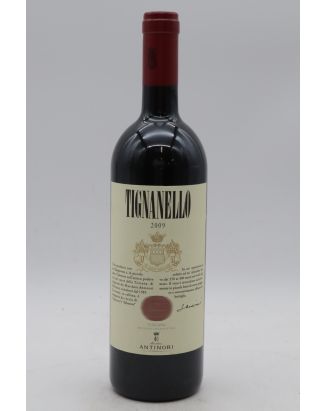
Marchesi Antinori Toscana Tignanello 2009
Personalise your experience
Change your country, language and currency here whenever you wish.
|
|
|
Must-See Châteaux |
|
|
|
|
|
|
|
|
At the heart of the Chianti Classico, between the valleys of the Greve and the Pesa, Tenuta Tignanello is the birthplace of one of the most influential wines in Italian viticultural history. It was here that the Antinori family created, in the early 1970s, a red wine that would upend all the rules: a sangiovese aged in barriques, blended with cabernet and freed from the white grapes that were then mandatory in Chianti. Declassified as a simple table wine, Tignanello paved the way for the Super Tuscan movement and gave birth, on the same hillside, to its younger sibling Solaia. Today, the estate produces only three cuvées, all sourced from this southwest-facing slope between 350 and 400 meters in altitude, on alberese and galestro soils that define their elegance and remarkable aging potential.
The Antinori family has produced wine since 1385, the year Giovanni di Piero Antinori joined the Arte Fiorentina dei Vinattieri, Florence's guild of wine merchants. The Tignanello vineyard entered the family estate in 1900, and it was there that Niccolò Antinori, followed by his son Piero, conducted the boldest experiments in 20th-century Tuscan viticulture. In 1970, with oenologist Giacomo Tachis, a first single-vineyard cuvée was born, named Chianti Classico Riserva Vigneto Tignanello, still containing 20% canaiolo and 5% trebbiano and malvasia, but already aged in small oak barrels.
The 1971 vintage marked a break: the wine deliberately left the Chianti Classico appellation to become a simple Tuscan vino da tavola and took the name Tignanello. In 1975, white grapes were permanently removed from the blend. Since 1982, the current composition has been established. Tignanello was the first sangiovese aged in barriques, the first modern Italian red blended with non-traditional varieties such as cabernet, and one of the first Chianti Classico reds vinified without white grapes. Emboldened by this success, Piero Antinori created Solaia in 1978 on the sunniest part of the same hill. The 1997 vintage of Solaia became the first Italian wine to be named Wine of the Year by Wine Spectator in 2000. Tignanello's label, designed by Silvio Coppola in 1974 for the release of the 1971 vintage, bears the stylised sun, the family coat of arms and its motto Te Duce Proficio, as well as Niccolò Antinori's signature, added by Piero in recognition of his father's trust.
Tenuta Tignanello extends across 319 hectares of land in San Casciano Val di Pesa, in the province of Florence, including around 130 hectares planted with vines and divided into a multitude of small parcels. The estate's two most prized vineyards, Tignanello and Solaia, unfold on the same southwest-facing hill, at elevations of between 350 and 400 metres. The Tignanello vineyard alone occupies a large parcel of around 77 hectares, while Solaia covers nearly 20 hectares in the sunniest part of the slope.
The soils derive from Pliocene marine marls, rich in limestone and schist, with the characteristic presence of alberese (marly limestone) and galestro, the friable schists that have made Chianti Classico famous. This rocky, free-draining foundation forces the vines to root deeply and gives the wines their saline minerality and fine tannic structure. The climate, marked by warm days and cool nights throughout the growing season, preserves the grapes' acidity and aromatic precision. The grape varieties are based on indigenous sangiovese, complemented by varieties considered non-traditional for the area, cabernet sauvignon and cabernet franc, planted here since the 1970s and perfectly acclimatised.
Harvesting is staggered according to grape variety, generally around 20 September for sangiovese and until the first half of October for the cabernets. On arrival at the winery, the grapes are destemmed, gently crushed, then rigorously sorted before fermentation begins.
Each must is vinified separately, in conical or stainless-steel tanks, with alcoholic fermentation lasting around one week. Skin macerations favour very gentle pump-overs and the délestage technique, in order to achieve intense colour extraction while preserving supple, elegant tannins. The wines are run off only after daily tasting. Malolactic fermentation takes place spontaneously in barriques, enhancing aromatic finesse and complexity. Ageing takes place in French oak barrels, with a small proportion of Hungarian oak, mostly new: around 13 to 14 months for Tignanello, 15 to 18 months for Solaia, and one year for the Riserva. The lots are initially aged separately, then blended to complete their evolution in oak. Each wine then benefits from at least twelve months of bottle ageing before release.
Tignanello (Toscana IGT): the cuvée that changed the history of Italian wine. Produced exclusively from the eponymous vineyard, it combines a selection of sangiovese with small proportions of cabernet sauvignon and cabernet franc. Fermentation in conical tanks with careful maceration, malolactic fermentation in barriques, followed by around thirteen months of ageing in mostly new French and Hungarian oak barrels, then twelve months in bottle. The wine has an intense ruby colour and reveals notes of ripe cherry, pomegranate and blood orange, followed by floral hints of hibiscus and violet, then sweet spices, cocoa and pencil lead. The palate is precise and juicy, carried by silky tannins and a long, savoury finish. Tignanello is bottled only in favourable vintages: it was not produced in 1972, 1973, 1974, 1976, 1984, 1992 or 2002.
Solaia (Toscana IGT): born in 1978 on the sunniest part of the Tignanello hill, from which it takes its name. The initial blend consisted of 80% cabernet sauvignon and 20% cabernet franc, repeated in 1979, before sangiovese was introduced at around 20% and the proportions of the two cabernets were adjusted to the current composition, dominated by cabernet sauvignon. Separate alcoholic fermentations in 60-hectolitre conical tanks, malolactic fermentation in barriques, ageing for fifteen to eighteen months in new French oak barrels, followed by extended bottle ageing. The result is a monumental red, both powerful and refined, with aromas of blackcurrant, graphite, cedar and blond tobacco, a dense tannic structure and exceptional longevity. Produced only in the finest years, with production limited to around 55,000 bottles.
Marchese Antinori Chianti Classico Riserva DOCG: a historic label of the house, produced since the 2011 vintage exclusively from grapes from Tenuta Tignanello, making it the finest introduction to the estate's world. It can be seen as the direct heir to the Podere Tignanello Chianti Classico Riserva conceived by Giacomo Tachis and Piero Antinori in 1970. It is composed almost entirely of sangiovese, complemented by a small proportion of additional varieties. Fermentation in stainless-steel tanks, spontaneous malolactic fermentation, then around twelve months in French and Hungarian oak barriques and a further twelve months in bottle. Bright ruby colour, with aromas of black cherry, raspberry and red berries, lifted by violet, ginger, cocoa and cedar. The palate strikes a balance between a silky texture and a savoury finish, with fine, tightly knit tannins that extend the tasting experience at length.
COLLECTION NEAR PARIS & VAT REFUND FOR TOURISTS
Free collection in our warehouse near central Paris (92)