Personalise your experience
Change your country, language and currency here whenever you wish.
|
|
|
Must-See Châteaux |
|
|
|
|
|
|
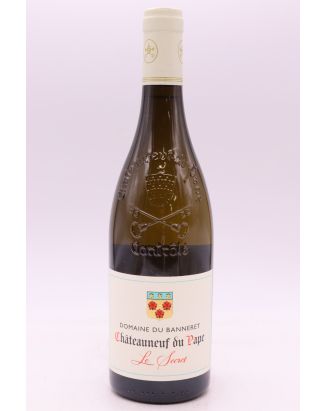
Domaine du Banneret is one of the most discreet and authentic gems of the Châteauneuf-du-Pape appellation, "a hidden little treasure" whose annual production does not exceed 10,000 to 13,000 bottles. A family estate whose origins date back to 1405, when the Bertet family, direct ancestors of the Vidals, already owned their vineyard in the heart of the village, the estate was re-established in 1989 by Jean-Claude Vidal, an architect from a major Toulouse firm who chose to change his life and take over the family parcels. His first steps in the cellar were taken alongside his friend and mentor Henri Bonneau, who allowed him to produce his first cuvées and passed on ancestral winemaking techniques. He also learned from Jacques Reynaud of Château Rayas. Since 2014, his daughter Audrey Vidal has been running the estate, which she joined in 2012. Across just 3 to 5 hectares spread over 7 to 8 parcels around the village, Domaine du Banneret produces a single Châteauneuf-du-Pape red, blending the 13 grape varieties authorised by the appellation, in a tradition of noble classicism and absolute authenticity that has made it a reference for lovers of great southern wines.
The story of Domaine du Banneret is one of fidelity to the land and to one's ancestors. The Bertet family, of whom the Vidals are direct descendants, already owned their own vineyard plots in Châteauneuf-du-Pape as early as 1405, like many other notable families of the time. The Bertet family coat of arms still appears on the estate's labels, a living testament to this six-century heritage. The vine has passed through the generations, until Jean-Claude Vidal, who in 1989 decided to leave everything behind to take over the family vines. A recognised architect at a prominent Toulouse firm, he made this decision after the previous operator was preparing to retire and the question arose of a sale outside the family.
Having no winery of his own at first, Jean-Claude borrowed a simple barrel from an old friend, one Henri Bonneau, whose wines were at the time among the most sought-after in the appellation. Henri Bonneau allowed him to make his first cuvées at his estate, passing on the gestures and philosophy of a Châteauneuf from a bygone era. Jean-Claude also learned from Jacques Reynaud of Château Rayas, another silent genius of the appellation. Supported by the discreet yet highly talented oenologist Serge Mouriesse, the estate gradually built its reputation as "a hidden gem of the appellation, at once unmissable and full of mystery." In 2012, his daughter Audrey Vidal joined the estate, and has been at its helm since 2014.
The vineyard of Domaine du Banneret covers approximately 3 to 5 hectares, spread across 7 to 8 plots around the village of Châteauneuf-du-Pape. The terroirs are varied and complementary, characteristic of the geological diversity of the appellation: soils of rounded galets (quartzites) that store the warmth of the day and release it at night, light sands and deep clays. Among the most remarkable plots, some are located on the Grand Pierre terroir, very close to the vines of the legendary Château Rayas, on the highest parts of the appellation. Other Syrah plots are situated near the Bois de Boursan, and some Mourvèdre plots close to the banks of the Rhône.
The grape variety selection is the estate's great singularity: all 13 grape varieties authorised by the Châteauneuf-du-Pape appellation are present and co-planted together in the same plots, with the exception of Syrah, which is trained on wire. In red: Grenache noir (the majority at 60%), Mourvèdre (10%), Syrah (10%), Muscardin, Vaccarèse, Terret Noir, Cinsault, Picpoul noir, Counoise. In white (incorporated into the red blend): Grenache blanc, Clairette blanche, Clairette rose, Bourboulenc, Roussanne, Picardan. The average age of the vineyard is 70 years, with many old vines of 80 years and more. Yields are parsimonious, at around 22 hl/ha only, less than half of what the appellation permits. When a vine dies, Jean-Claude prefers to replace it through massale selection in order to maintain diversity and typicity.
The winemaking at Domaine du Banneret is resolutely ancestral and makes no concessions to modernity. The harvests are manual and strict, with rigorous sorting of the grapes. All grape varieties are co-fermented together, as whole clusters (un-destemmed), with indigenous yeasts in small concrete tanks. The maceration is long, lasting 3 to 4 weeks, allowing a gentle and progressive extraction of the substance, tannins and aromas from all 13 grape varieties. A few rackings are carried out to maintain freshness. The wine is then aged in old oak foudres for 18 to 24 months. The wines are unfiltered. Bottling is done by gravity in the small cellar carved into the village hillside.
The result of this approach is a Châteauneuf of rare complexity and depth, bearing the imprint of all 13 grape varieties in a unique and inseparable blend. "They produce a Châteauneuf as in days gone by, with the 13 authorised grape varieties of the appellation, red and white, all united in a single red cuvée. A rarity today." Production remains deliberately limited, barely 10,000 bottles per vintage, in order to uphold the absolute standards of quality that define the estate.
Châteauneuf-du-Pape Rouge: The singular, exclusive cuvée, wholly representative of the appellation's finest classicism. A blend of all 13 grape varieties authorised by Châteauneuf-du-Pape, co-planted and co-fermented together: 60% Grenache (including fine plots on the Grand Pierre terroir close to Rayas), 10% Mourvèdre, 10% Syrah, and 20% Muscardin, Vaccarèse, Terret Noir, Cinsault, Picpoul noir, Counoise, Clairette blanche and rose, Bourboulenc, Roussanne, Picardan. Vines averaging 70 to 80 years old, with yields of 22 hl/ha. Manual harvesting of whole clusters, co-fermentation with indigenous yeasts in concrete tanks, long maceration of 3 to 4 weeks, ageing of 18 to 24 months in old oak foudres. A powerful, complex and very long red wine, with aromas of red and black fruits, spices, garrigue and floral notes contributed by the white grape varieties. Broad and structured on the palate, with a firm and noble tannic framework that requires at least 5 to 7 years of cellaring before it opens up. "A great fine wine for cellaring, to be forgotten for at least five years before serving with a leg of lamb or game", Guide Hachette des Vins. Approximately 10,000 bottles per vintage.
COLLECTION NEAR PARIS & VAT REFUND FOR TOURISTS
Free collection in our warehouse near central Paris (92)