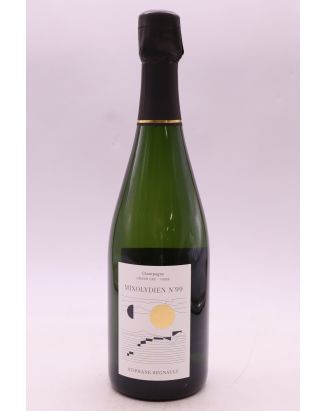
Stéphane Regnault Grand Cru Oger Mixolydien N°99
Personalise your experience
Change your country, language and currency here whenever you wish.
|
|
|
Must-See Châteaux |
|
|
|
|
|
|
At the heart of the Côte des Blancs, on the Grand Cru terroir of Le Mesnil-sur-Oger, Domaine Stéphane Regnault embodies a singular and demanding vision of Champagne. Here, there is no compromise: every bottle is the fruit of rigorous parcel-by-parcel work, certified organic viticulture, and a philosophy that places the chalky terroir above all else. For Stéphane Regnault, a winemaker established at the heart of the Côte des Blancs, the role of the producer is simple: to guide the wine without imposing a direction upon it. The result? Champagnes of rare purity and tension, which have become in just a few years among the most sought-after references for natural wine enthusiasts and grower Champagne lovers.
The story of Domaine Stéphane Regnault is one of a return to roots, as unexpected as it is profound. Stéphane Regnault is indeed an aeronautical engineer turned sommelier, who returned to his home town of Le Mesnil-sur-Oger in 2008 and began studying, tasting, and exchanging ideas with the rising figures of the region, among them Etienne Calsac, Flavien Nowack, and Benoît Tarlant, the latter opening his eyes to the full scope of the viti-vinicultural approach.
From sommelier in London to aeronautical engineer in Paris, Stéphane Regnault's professional journey is rich in diverse experiences. It is this blend of cultures — technical, gastronomic, and artistic — that forges his unique sensibility as a winemaker. Inspired by the support and advice of his peers, Stéphane decided to take over the family estate in 2014. From that point on, he stopped selling his grapes to the cooperative, converted all the vines to certified organic farming, and began exploring biodynamic techniques.
It was only after nearly ten years of experience, reflection, and experimentation that his first cuvée was released in 2018, the fruit of harvests from the family vineyards located in Oger and Le Mesnil-sur-Oger. A late but masterful début, marking the birth of an immediately identifiable style: precise, taut, mineral, rooted in its lieux-dits like nowhere else.
An accomplished jazz saxophonist, Stéphane Regnault infuses his estate with an artistic dimension that goes far beyond the act of vinification alone. Each cuvée bears the name of a musical mode — Lydian, Mixolydian, Dorian, Chromatic — like so many improvised scores on the theme of the Champagne terroir.
The estate today cultivates approximately 4 hectares of old vines aged between 40 and 60 years, spread equally between the villages of Oger and Le Mesnil-sur-Oger, two appellations classified 100% Grand Cru at the heart of the Côte des Blancs. A modest vineyard in terms of surface area, yet one of exceptional terroir richness.
From these two villages, Stéphane has identified three lieux-dits for his single-vineyard cuvées: Chemin de Flavigny in Oger, Le Moulin on the border between Oger and Le Mesnil-sur-Oger, and Les Hautes-Mottes in Le Mesnil. Each of these lieux-dits possesses its own pedological identity, which can be read directly in the glass.
Le Chemin de Flavigny features a full south-facing exposure, a 7% slope, a very light topsoil with natural grass cover, an intermediate horizon with a modest chalk content, and a subsoil of slightly fractured compact chalk. This terroir produces expressive, fruity wines with vibrant energy.
Le Moulin reveals a full east-facing exposure, a gentle 2% slope, a well-structured topsoil with grass cover, a chalk-rich intermediate horizon of considerable depth, and a subsoil of silky, fractured chalk. This is the plot of complexity and silk.
Les Hautes-Mottes is distinguished by a south-facing exposure in a gentle hollow, a very fine, well-structured, open and crumbly topsoil with a clover-based grass cover. Hautes-Mottes means "high mounds" and refers to the unusual veins of chalk that extend into the plain beyond the railway, to the south of Le Mesnil. Half of the vineyard there was planted in the 1950s, the other half in the 1980s.
Stéphane first transitioned the estate towards sustainable viticulture (HVE & VDC certifications), then towards organic farming from the 2020 harvest onwards. In the same spirit, he allowed himself to be influenced by biodynamics, using horn manure (500P), silica (501), valerian (507), as well as herbal teas and plant decoctions (nettle, horsetail, comfrey, yarrow…). These practices help reduce the use of copper and sulphur while strengthening respect for the soil and living ecosystems.
Stéphane Regnault's vinification philosophy rests on a cardinal principle: allowing each plot to express itself in its full authenticity, without unnecessary interference. His idea of vinification is the simplest possible: a beautiful, expressive grape speaks for itself. He does, however, use barrels — for the image, the history, the sensations, the diversity, and the work they represent. The relationship between the wood and the grape juice must create a true complementarity: neither too much nor too little.
All fermentations during the harvest are spontaneous: each plot has its own biodiversity, its own flora. Since the natural yeasts present on the grape skins differ from one plot to another, the aim is to avoid interfering with the identity of each lieu-dit.
The ageing is long and attentive. Stéphane does not rack before June, unless a tasting necessity arises. Long months of work on the lees allow the wine to build and acquire complexity. With regard to SO2, he uses it only just after pressing and very sparingly during ageing, preferring bâtonnage — the stirring of the lees back into suspension — to protect the wine from oxidation.
Stéphane favours a gentle pressing using a membrane press, vinifies the press juices separately, and exposes the juice to oxygen to develop its resilience. All wines are moved by gravity alone. Sulphur levels are very low — just 2 grams at pressing and a similar dose at disgorgement.
One of the estate's most remarkable technical signatures is the use of the perpetual reserve (solera). Each year, Stéphane uses a portion of his soleras to carry out his blending and tops up the deficit with wine from the current year sourced from the same plot. This is the origin of the cuvée numbering system: each number corresponds to the sum of the blending years that enter into the composition of the wine. Thus, the Lydien no. 45 is the result of the 2014 + 2015 + 2016 vintages (14 + 15 + 16 = 45). A numerical language as elegant as it is transparent.
Chromatique
The Chromatique cuvée is the estate's blended cuvée. Its name is borrowed from the chromatic scale in music, which uses absolutely every available note. Sourced from the estate's three lieux-dits, it is aged partly in oak and partly in stainless steel tanks, with a significant proportion of perpetual reserves. This cuvée draws on the vines from the Le Mesnil-sur-Oger terroir, predominantly on the very chalky lower slopes, and the vines from the Oger terroir with its richer soils. The vinification is non-interventionist, with a first spontaneous fermentation and no additions whatsoever. Extra brut dosage (2 g/l), predominantly 100% chardonnay.
Lydien
Le Lydien is Regnault's most expressive cuvée. It is characterised by its openness and energy. Sourced 100% from the lieu-dit Chemin de Flavigny in Oger, this Grand Cru blanc de blancs reveals a chardonnay of rare vivacity. This terroir features a light, shallow topsoil, compact chalk, and natural grass cover. Fruity, fragrant, and luminous, this champagne draws on a muscat-like variant of chardonnay with tropical notes, rarely encountered in Champagne. Le Lydien is a blanc de blancs sourced from vines planted in 1950. It presents an excellent saline depth and benefits from an extra brut dosage of just 1 g/l, for a limited production. The cuvée number evolves with each new vintage incorporated into the solera, thus offering a precise cartography of time passing in every bottle.
Mixolydien
Evocative of the Mixolydian mode, this cuvée is complex, balanced, and marked by a rare silkiness on the palate. It comes exclusively from the lieu-dit Le Moulin, located on the border between Oger and Le Mesnil-sur-Oger, on soils rich in deep and silky chalk. This pure chardonnay from Le Moulin is renowned for its unique texture, at once ample and precise. Like all the single-vineyard cuvées of the estate, the Mixolydien is entirely vinified from 100% chardonnay, aged in old oak barrels, and blended with the perpetual reserve specific to this lieu-dit. Each cuvée number faithfully traces the vintages incorporated. This is the cuvée of depth and meditation, one that reveals itself ideally after a few years of cellaring.
Dorien
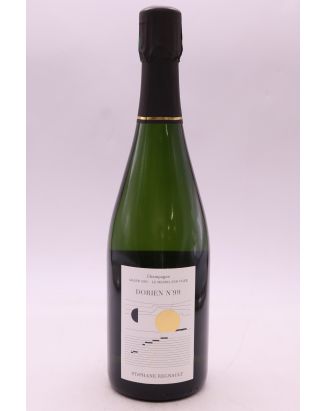
The Dorien cuvée is the most reticent and most complex of Stéphane's cuvées. The wine needs time in the bottle to express its full potential as a powerful, rich, and structured wine. Sourced from the lieu-dit Les Hautes-Mottes in Le Mesnil-sur-Oger, this Grand Cru blanc de blancs grows on veins of pure, compact chalk with a south-facing exposure in a gentle hollow. Floral and structured, with nuanced citrus flavours, this pure chardonnay is one of the most powerful blancs de blancs in all of Champagne.
Coteaux Champenois Blanc
Less well known but equally fascinating, the range of Domaine Stéphane Regnault also extends to Coteaux Champenois, a still white wine with no bubbles, sourced from the same plot of Les Hautes-Mottes. Vinified according to the same non-interventionist principles, this wine reveals another facet of the chalky terroir of Le Mesnil: more austere, even more mineral, stripped of all effervescence to let the soil express itself in its absolute nakedness.
COLLECTION NEAR PARIS & VAT REFUND FOR TOURISTS
Free collection in our warehouse near central Paris (92)