Domaine des Ronces

The wines of the Domaine des Ronces: buy at the best price

Based in Orbagna, in the Sud Revermont, one of the most southerly and most confidential sectors of the Côtes du Jura appellation, the Domaine des Ronces is a beautiful family story. Founded in 1950 by Georges Mazier, it is today run by his grandson Kevin, the third generation, across six to seven hectares certified in organic farming and Demeter biodynamics. The range includes around fifteen cuvées covering the full Jurassian palette: vibrant ouillé whites, finely crafted vins sous voile, vin jaune, sapid reds, crémants, macvin, and vin de paille. 

Read more
See more
Filters

Price

€60.00 - €80.00

Region

Volume

Parker WA rating

No choice available on this group

Burghound rating

No choice available on this group

Revue du Vin de France rating

No choice available on this group

Bettane & Desseauve rating

No choice available on this group

Prices drop

No choice available on this group

Download this list
There are 3 products.
Download this list
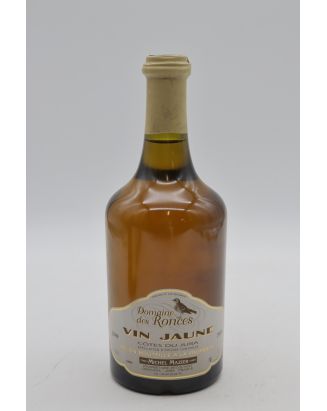
Domaine des Ronces Côtes du Jura Vin Jaune 2009 62cl
18 in stock
131149
White
62cl
Add to cart
Jura | Côtes du Jura

Domaine des Ronces Côtes du Jura Vin Jaune 2009 62cl

€60.00 inc-VAT per bottle
€50.00 ex-VAT
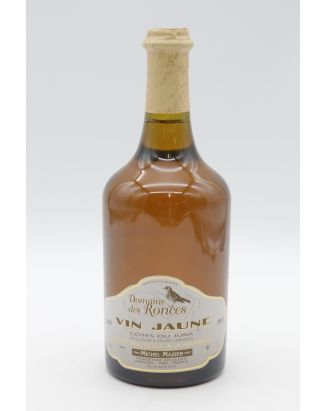
Domaine des Ronces Côtes du Jura Vin Jaune 2007 62cl
11 in stock
131151
White
62cl
Very slightly damaged
Add to cart
Jura | Côtes du Jura

Domaine des Ronces Côtes du Jura Vin Jaune 2007 62cl

€66.00 inc-VAT per bottle
€55.00 ex-VAT
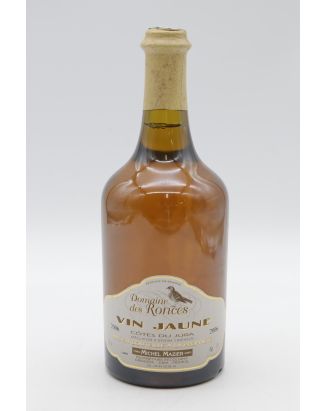
Domaine des Ronces Côtes du Jura Vin Jaune 2006 62cl
21 in stock
131150
White
62cl
Add to cart
Jura | Côtes du Jura

Domaine des Ronces Côtes du Jura Vin Jaune 2006 62cl

€72.00 inc-VAT per bottle
€60.00 ex-VAT

History of Domaine des Ronces

Domaine des Ronces was established in 1950, when Georges Mazier planted his first hectare of vines in the commune of Orbagna, in the south of the Jurassian vineyard. At that time, only chardonnay was worked, later complemented by a little savagnin. After thirty-six years of passionate labour, the operation was taken over in 1986 by his son Michel Mazier. Through patience and perseverance, the latter grew the family estate to six hectares and considerably diversified the grape varieties, with the arrival of the emblematic red varieties of the Jura: trousseau and poulsard first, then pinot noir.

The environmental turning point came in 2010, when Michel Mazier began the conversion to organic farming, certified in 2013. From 2014, the estate moved towards biodynamics. The arrival of Kevin Mazier in 2016, the third generation of the family, coincided with the obtaining of the Demeter certification. Trained in Beaune and then in Australia, the young winemaker brought new precision, finer parcel-by-parcel work and a resolutely natural approach to winemaking, while honouring the inherited legacy. The change in style made itself felt rapidly in recent vintages, welcomed by enthusiasts and peers alike: Michel Mazier, a well-regarded figure in the vineyard, is a friend of Jean-François Ganevat, to whom he even sells a part of his harvest. A member of the Vignerons de Nature collective, the estate nonetheless remains of rare accessibility, with prices that bear no relation to the speculation affecting certain Jurassian addresses.

Terroirs and Vines of Domaine des Ronces

Orbagna is situated in the Sud Revermont, that southern part of the vineyard still too little known to enthusiasts, where limestone slopes alternate with pastures dedicated to the production of milk for comté. Michel Mazier likes to point out that the particular feature of his village is the possession of very fine terroirs for trousseau, a part of which unfortunately remains occupied by grazing land, the dairy sector being sufficiently remunerative to discourage any clearing. This scarcity makes the estate's parcels all the more precious.

Three great terroirs structure the vineyard. For the whites, a first argilo-calcareous ensemble with an east-west exposure brings tension, salinity and aromatic finesse. A second, frankly marly and oriented north-south, yields broader, more textured wines perfectly suited to ageing under veil. For the reds, there is an argilo-calcareous terroir oriented north-south, whose freshness preserves the brilliance of the fruit and the sappiness. Chardonnay and savagnin dominate the grape varieties, complemented by poulsard, trousseau and pinot noir. The estate possesses some fine old vines and a fragmented parcel layout that allows for a multiplication of cuvées despite a limited surface area. Vineyard management is fully biodynamic and certified, with careful soil work and entirely manual harvesting.

Winemaking at Domaine des Ronces

The manual harvest is sorted and then vinified with indigenous yeasts only, without any added yeasts or correction. As Jurassian tradition dictates, the estate pursues two styles in parallel. The ouillé wines see their barrels regularly topped up to prevent any formation of veil, which preserves the brilliance of the fruit and the freshness: they are generally aged around twelve months on lees in barriques. The wines under veil, by contrast, rest for several years in deliberately unfilled barrels, protected by a yeast veil that bestows upon them the aromas of walnut, almond and curry characteristic of the region.

The reds are vinified gently, without excessive extraction, in order to preserve the finesse and drinkability characteristic of Jurassian varieties. Sulphur is used with great restraint, in keeping with the spirit of the Vignerons de Nature collective to which the estate belongs. The crémants follow the traditional method, with a long stay on lees, generally two years, and a malolactic fermentation deliberately not carried out in order to preserve the tension. The result is whites full of energy and indulgence, and reds remarkable for their strong and complex personality.

The cuvées of Domaine des Ronces

The cuvée Florale is the estate's ouillé chardonnay and its finest entry point. Aged twelve months on lees in barriques, it offers a delicate profile of white fruits, flowers and citrus, with a fine balance between roundness and freshness and a saline finish. It is an ideal gastronomic white to accompany fish, poultry or a Jura trout. The cuvée Chalasse showcases savagnin in a perfectly dry register, with that broad texture always structured by a fine acidity that biodynamics further reinforces. The cuvée En Crève-Coeur, also devoted to savagnin, comes from a particular parcel whose name evokes all the difficulty of working these slopes: more concentrated and more profound, it combines tension, notes of candied citrus and spices, and a remarkable mineral length.

The Cuvée Georges pays homage to the founder of the estate and masterfully illustrates the Jurassian art of the veil. It blends around seventy per cent chardonnay aged three years under veil and thirty per cent savagnin aged four years. The result is a fine, saline, delicate and floral wine, with notes of hazelnut and almond, less powerful than a vin jaune but of rare elegance: it is one of the finest quality-to-price ratios in the entire region for discovering oxidative wines. The Vin Jaune, the pinnacle of production, is made from pure savagnin aged six years and three months in barrel without topping up or racking, then bottled in the traditional clavelin. Fresh walnut, curry, baked apple, dried fruits and spices compose a palette of striking intensity, carried by a lively acidity and an endless finish, with an ageing potential measured in decades.

On the red side, the Poulsard expresses this delicate variety in a pale and perfumed version, all red fruits and finesse, of exemplary drinkability, to be served slightly chilled. The Trousseau, from the fine trousseau terroirs that are the pride of Orbagna, is more structured and more spiced, with aromas of black fruits, a firm substance and an ageing potential of seven to ten years. The Pinot Noir, finally, plays an elegant and fruity card: the nose evokes blackcurrant, redcurrant and cherry, the palate is fresh, fine and full of fruit, beautifully balanced, and leaves notes of tobacco in the empty glass.

The sparkling wines are not to be overlooked. The Crémant du Jura Brut Nature, bottled without the slightest dosage, captivates with its fine bubble, its vinosity and its absolute straightness. The Crémant du Jura Cuvée Nany, composed of around seventy per cent pinot noir and thirty per cent chardonnay, aged two years on lees without malolactic fermentation, presents fine substance, very fine bubbles and a remarkable freshness that makes it one of the most accomplished crémants of the area. The Macvin du Jura, a mistelle obtained by mutting grape must with aged marc du Jura, unfolds its aromas of candied fruit, honey and spices, equally at home as an aperitif, with a dessert or with melon. The Vin de Paille, finally, is made from grapes dried for several months on racks before a delicate pressing and a very long barrel ageing: dried apricot, quince, honey and candied fruits combine in a liqueur of extreme concentration, whose freshness preserves it from any heaviness — perfect with foie gras or a dessert of dried fruits.

WHAT THEY SAY ABOUT US

5 good reasons to buy wines on V&M

...

EXPRESS DELIVERY

In a secure polystyrene packaging

...

INTERNATIONAL SHIPPING

Find out more about VAT-EX sale for outside EU deliveries

...

COLLECTION NEAR PARIS & VAT REFUND FOR TOURISTS

Free collection in our warehouse near central Paris (92)

...