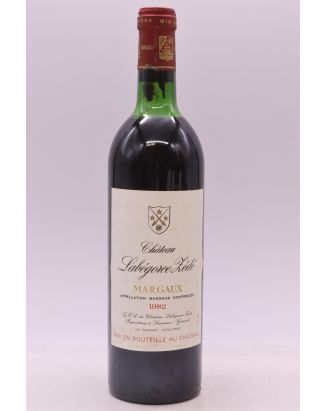
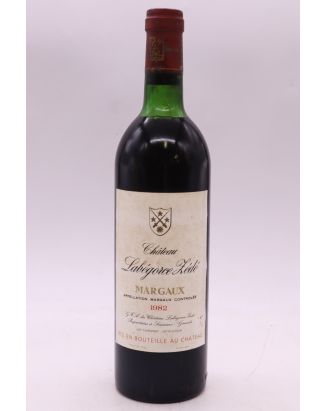
Château Labégorce-Zédé

Cru Bourgeois Supérieur from Margaux

Wines from Château Labégorce-Zédé: buy at the best price

Château Labégorce is a Cru Bourgeois Supérieur from the Margaux appellation, located on the left bank of the Bordeaux wine region. It has belonged to the Perrodo family since 1989 (who also own Marquis d'Alesme and Labegorce Zédé). The vineyard now extends over 70 hectares of vines (sandy-gravelly and sandy-silty soils), as the Perrodo family decided to reunify Labégorce and Labégorce Zédé in 2009, thus returning to the historical dimensions of Château Labégorge 215 years ago. The average age of the vines is close to 25 years, and the entire estate benefits from sustainable farming practices. The vineyard is composed of the 4 main grape varieties used in Bordeaux: 50% Cabernet Sauvignon, 45% Merlot, 3% Cabernet Franc and 2% Petit Verdot.

Read more
See more
Filters

Price

€40.00 - €100.00

Appellation

Color

Volume

Parker WA rating

85 - 89

Burghound rating

No choice available on this group

Revue du Vin de France rating

No choice available on this group

Bettane & Desseauve rating

15 - 15

Prices drop

Download this list
There are 4 products.
Download this list
Labégorce Zédé 1989
2 in stock
76228
Red
75cl
Very High Shoulder
87/100
86/100
Add to cart
Bordeaux | Margaux

Labégorce Zédé 1989

€60.00 inc-VAT per bottle
€50.00 ex-VAT
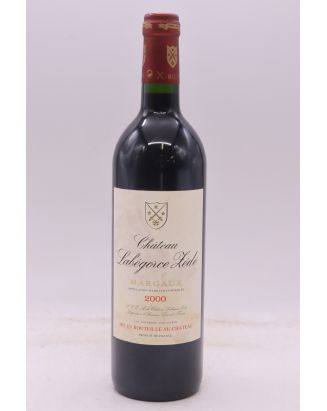
Labégorce Zédé 2000
Last one !
1 in stock
113517
Red
75cl
87/100
15/20
Add to cart
Bordeaux | Margaux

Labégorce Zédé 2000

€48.00 inc-VAT per bottle
€40.00 ex-VAT
Labégorce Zédé 1982 -10% DISCOUNT !
-10%
8 in stock
115645
Red
75cl
High shoulder
Add to cart
Bordeaux | Margaux

Labégorce Zédé 1982 -10% DISCOUNT !

€81.00 inc-VAT per bottle €90.00 inc-VAT -10%
€67.50 ex-VAT
Labegorce Zédé 1982
2 in stock
124182
Red
75cl
Slightly Damaged
Very High Shoulder
Add to cart
Bordeaux | Margaux

Labegorce Zédé 1982

€72.00 inc-VAT per bottle
€60.00 ex-VAT

History of Château Labégorce-Zédé

Several Gorsse families lived for centuries in Margaux and neighboring towns, and an abbot named Gorce likely gave the place its name. The existence of the Maison Noble de La Bégorce is documented as early as 1332; Édouard Féret described it in his 1868 edition as one of the finest and best-situated properties in the commune of Margaux. In August 1795, most of the estate was sold to the Benoist couple, leading to the division of the historic property into three distinct parts: Labégorce, Labégorce-Zédé and L’Abbé Gorsse de Gorsse.

The Zédé name appears with the descendants of the Benoists: engineer Gustave Zédé, director of naval construction and designer of the first French submarine, the famous Gymnote launched in 1888, and his brother, Vice Admiral Émile Zédé. Both developed the estate and improved its quality in the late 19th century. Gustave also commissioned major renovations to the château under architect Georges Minvielle. The property then changed hands several times, including to Jean Battesti in 1961; he replanted part of the vineyard and worked to produce a good-quality wine. In 1979, Battesti sold the estate to an agricultural landholding group, which entrusted its management to Luc Thienpont, a member of the renowned Belgian wine family and owner of Clos des Quatre Vents. The estate then covered 42 hectares, including 29 hectares of vines, and major drainage work was undertaken. Luc Thienpont restored it to its former glory, and it was classified Cru Bourgeois Exceptionnel on June 17, 2003. In 2005, Hubert Perrodo, an industrialist with the Perenco oil group and owner of Château Labégorce since 1989 and L’Abbé Gorsse de Gorsse since 2002, bought Labégorce-Zédé, completing the reunification of the historic vineyard more than two hundred years after its division. Following his death in 2006, his daughter Nathalie Perrodo-Samani brought the project to completion. From the 2009 vintage onward, the properties were combined under the single name Château Labégorce, and Château Labégorce-Zédé ceased to exist.

Terroirs and Vineyards of Château Labégorce-Zédé

The section of the estate corresponding to Labégorce-Zédé, where the original château stood, lies on gravelly soils and the highest rises in the commune of Margaux, surrounded by prestigious vineyards. These deep, well-draining gravels deposited by the Garonne force the vines to root deeply and give fine Margaux wines their characteristic floral fragrance and tannic finesse.

The vineyard long covered between 27 and 35 hectares, with planting densities ranging from 6,600 to 10,000 vines per hectare depending on the parcel, reflecting the care taken to adapt each site. The classic Médoc grape varieties were represented, led by Cabernet Sauvignon and complemented by Merlot, Cabernet Franc and Petit Verdot. Now reunited, Château Labégorce as a whole comprises 62.5 hectares in the Margaux appellation and 4.5 hectares in Haut-Médoc, planted with 50% Cabernet Sauvignon, 45% Merlot, 3% Cabernet Franc and 2% Petit Verdot. The vines average around 30 years of age. The soils are 70% sandy gravel and 30% sandy loam. The vineyard is managed using sustainable practices aligned with the principles of organic and biodynamic farming, with particular attention to soil life through shallow plowing, cover crops and mulching on certain parcels.

Winemaking at Château Labégorce-Zédé

Under the Thienpont family, the house style favored purity and classic proportions over heavy extraction, a philosophy consistent with the family’s work on the Right Bank. The grapes were harvested with rigorous sorting, and each parcel was vinified separately using measured extraction to preserve the fruit and the finesse of the tannins.

The wine was aged in oak barrels for twelve to eighteen months, with the proportion of new oak ranging from 33 to 65% depending on the vintage; a portion was renewed each year. The blend was designed for balance and drinkability as well as aging potential, without ever chasing weight or concentration. Annual production was around 900 hectoliters. This approach explains the wine’s unusual consistency and the excellent value that earned it a reputation among enthusiasts. Since the merger, the Château Labégorce team, led by Marjolaine Maurice de Coninck for the Perrodo family’s wine estates, has continued its precise work parcel by parcel across the reunited property. With aging in around 35% new oak, the wines offer vibrant fruit, a rich, supple texture and delicately integrated tannins.

The Wines of Château Labégorce-Zédé

Château Labégorce-Zédé (Margaux AOC): the estate’s historic fine wine, produced under this name from the 19th century through the 2008 vintage, the last made independently. Dominated by Cabernet Sauvignon and Merlot, the blend was aged in barrels for twelve to eighteen months. It offers an authentic Margaux fragrance, floral and delicate, with violet, raspberry, cherry and sweet spice, followed by notes of undergrowth and cedar that develop with age. The palate favors finesse and precision over power, with fine tannins and an elegant finish. The 1990, 1995, 1996, 2000, 2001, 2005 and 2008 vintages are among its most successful. As production has ended permanently, every bottle now belongs in a collector’s cellar.

Domaine Zédé (Bordeaux Supérieur AOC): the estate’s second wine, first made in the 1988 vintage and accounting for about half its production. It succeeded Château de l’Amiral, a label introduced in 1973 and later discontinued following an objection from Château Beychevelle. Softer, fruitier and ready to enjoy, it offered an introduction to the house style at an approachable price while benefiting from the same winemaking expertise.

Z de Zédé (Bordeaux AOC): the estate’s third wine, first produced in 1990. Made in an even lighter, more approachable style, with crisp red fruit and supple tannins, it was intended for early drinking and rounded out the estate’s range of wines.

Zédé de Labégorce (Margaux AOC): the direct successor to the original wine. Since the 2009 merger, the name has designated Château Labégorce’s second wine, preserving the memory of Labégorce-Zédé and the Zédé brothers. Made from parcels and lots not selected for the fine wine, it accounts for about 40% of total production, which ranges from 150,000 to 180,000 bottles. Supple, fragrant and charming, with fresh red fruit, violet and spice, it is a pleasure to drink after just a few years in bottle and is now the most faithful way to rediscover the spirit of the discontinued wine.

WHAT THEY SAY ABOUT US

5 good reasons to buy wines on V&M

...

EXPRESS DELIVERY

In a secure polystyrene packaging

...

INTERNATIONAL SHIPPING

Find out more about VAT-EX sale for outside EU deliveries

...

COLLECTION NEAR PARIS & VAT REFUND FOR TOURISTS

Free collection in our warehouse near central Paris (92)

...