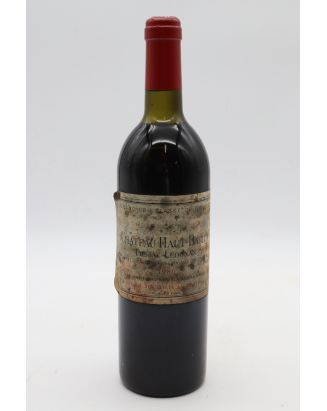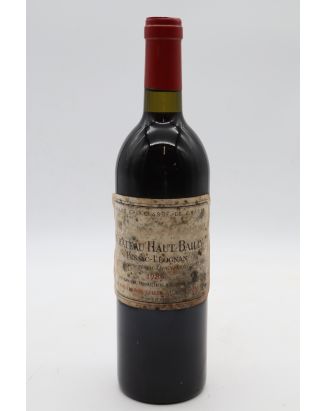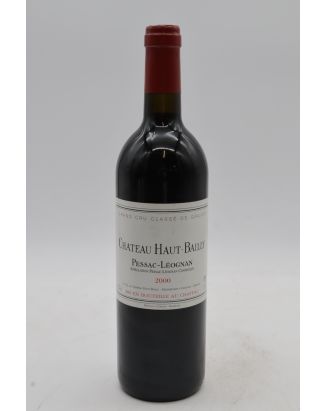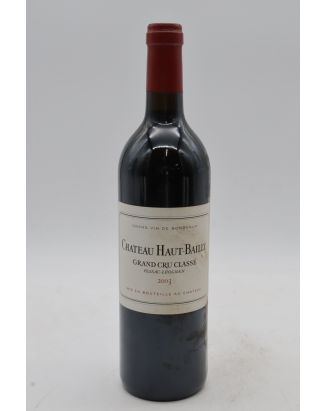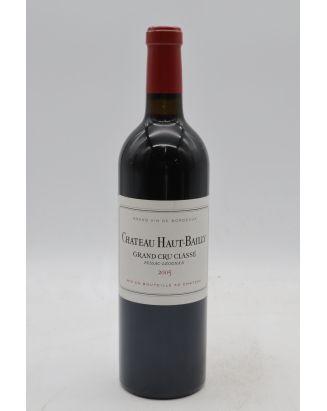
Haut Bailly 2003
Château Haut-Bailly stands out for its rare elegance among the grands crus classés of Pessac-Léognan. Where many Bordeaux wines rely on power, Haut-Bailly cultivates an almost Burgundian finesse, with silky-smooth tannins and a particularly seductive velvety texture. This stylistic signature stems largely from its exceptional terroir — a croupe of deep Günzian gravels — but also from a masterful vinification that favours aromatic precision over muscular weight. The result is a red Bordeaux wine that combines freshness, delicate red fruits and a great capacity for ageing, without ever seeking to impress through excess.
Château Haut-Bailly occupies a singular place in the hierarchy of the grands crus of Pessac-Léognan. Compared to the institutional majesty of Haut-Brion, it plays the card of intimacy and a certain aristocratic discretion, often perceived as more accessible in terms of style. Relative to Smith Haut Lafitte, whose wines are renowned for their fruity brilliance and modernity, Haut-Bailly leans more toward tradition and subtlety. Its absence of a white wine in its production also sets it apart, with the estate devoting all its energy to perfecting its single red. For enthusiasts seeking the quintessence of classic Bordeaux without ostentation, Haut-Bailly is often the most accomplished choice.
A Château Haut-Bailly can technically be enjoyed quite young, from 5 to 7 years after its harvest, but it would be a shame not to allow it the time to fully blossom. For character vintages such as 2000, 2005, or 2009, a patience of 12 to 15 years is ideal for the tannins to mellow and the bouquet to reach its full complexity. For storage, the classic conditions apply: a stable temperature of around 12–14 °C, adequate humidity (70–75%), complete darkness, and the absence of vibrations. Large-format bottles, magnums and above, age even more harmoniously and are to be preferred if you wish to keep your Haut-Bailly for the long term.
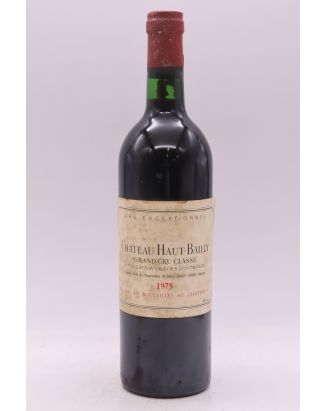
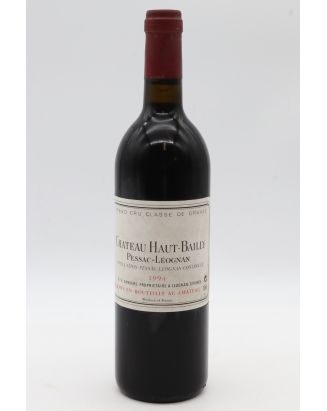
To give a truly memorable bottle, certain vintages of Château Haut-Bailly stand out as absolute references. The 1998 is often cited as one of the greatest of the estate, combining generosity and aromatic complexity. The 1996 captivates with its classic structure and remarkable freshness. Further back, the 1961 and 1975 perfectly illustrate the exceptional longevity of the estate, with bottles still vibrant for lovers of old Bordeaux. The 2005 and 2009 represent the pinnacle of the contemporary period, with remarkable maturity and density. These vintages are safe choices for a prestigious gift.
The blend of Château Haut-Bailly is dominated by Cabernet Sauvignon, which typically represents between 60 and 70% of the blend depending on the vintage, complemented by Merlot and a touch of Cabernet Franc. This predominance of Cabernet Sauvignon gives the wine its elegant structure, its ageing potential, and its characteristic aromas of blackcurrant, graphite, and fine herbs. But what makes the Haut-Bailly blend particularly special is the way in which the Merlot rounds out and envelops these naturally firm tannins, bringing a velvety smoothness that is the true signature of the estate. The resulting balance between power and grace is rarely achieved with such consistency in the appellation.
The wines of Château Haut-Bailly are distinguished by a remarkable gastronomic versatility, directly linked to their balance between structure and finesse. In their youth, they ideally accompany grilled red meats, duck breast with ceps or a rack of lamb with herbs — classics that naturally pair with the wine's aromas of blackcurrant, graphite and blonde tobacco. As they age, their aromatic palette is enriched with notes of undergrowth, truffle and leather that call for more complex pairings: game birds, veal sweetbreads with morels or a platter of aged hard cheeses. The wine's characteristic freshness also allows it to stand up to sauced preparations without ever being overwhelmed, making it a remarkably faithful companion at the table.
The history of Château Haut-Bailly truly begins in the 17th century, in 1630, when the estate was acquired by the Le Bailly family, who would give it its name. However, traces of viticulture on these lands date back to the 15th century. Located in Léognan, in the Graves region, this estate has crossed the ages and overcome challenges, notably the phylloxera epidemic in the 19th century, which devastated a large part of the Bordeaux vineyards.
Under the direction of Alcide Bellot des Minières at the end of the 19th century, Haut-Bailly reached a level of excellence that allowed it to rival the first growths of Bordeaux. Alcide, nicknamed "the king of winemakers", marked the history of the estate by refusing to adopt American rootstocks during the phylloxera epidemic, favouring traditional techniques to preserve the quality of the wine.
The estate's revival took place in 1955, when Daniel Sanders, a Belgian wine merchant, took the reins of the property and undertook a complete renovation. His son, Jean Sanders, and later his granddaughter, Véronique Sanders, continued this work, bringing Château Haut-Bailly to the pinnacle of the Bordeaux elite. Since 1998, the American Wilmers family, first with Robert G. Wilmers and then his son Chris Wilmers, has continued to advance the estate, notably with the addition of modern facilities, such as the new circular winery inaugurated in 2021.
Robert Parker awarded 98/100 to the 2016 vintage of Château Haut-Bailly, while the 2015 and 2009 vintages received 97/100, highlighting the complexity and structure of this emblematic cru from Pessac-Léognan.
The vineyard of Château Haut-Bailly rests on a unique terroir, composed of sands mixed with tertiary clayey gravels, which ensures excellent natural drainage. This soil, particularly well-suited to Bordeaux grape varieties, allows Cabernet Sauvignon, Merlot, Cabernet Franc, Petit Verdot, Malbec and Carménère to flourish fully. The subsoil, rich in faluns (fossilized petrified stones and shells), provides the vines with essential nutrients such as minerals and trace elements, thus contributing to the aromatic richness and freshness of the wines.
The estate now extends over 51 hectares, of which 39 hectares are planted with vines, spread across 52 distinct plots. A major distinguishing feature of Château Haut-Bailly lies in its old vines, some of which are over 120 years old, offering a rare genetic diversity. These century-old vines, planted by Alcide Bellot des Minières in 1905, represent a true treasure for the estate and are at the origin of the complexity and depth of its cuvées.
The vineyard's grape variety composition consists primarily of Cabernet Sauvignon (60%), Merlot (34%), Cabernet Franc (3%) and Petit Verdot (3%). This diversity makes it possible to produce wines that are at once powerful, structured and balanced, while expressing the finesse characteristic of Haut-Bailly's terroir.
Winemaking at Château Haut-Bailly is built on meticulous expertise and a constant pursuit of excellence. Everything begins with manual harvesting, where each grape is carefully sorted in the vineyard, then again on a gentle vibrating sorting table, so as to retain only the finest berries.
The winemaking process is entirely adapted to the structure of each vintage. The grapes are first chilled before fermentation, then distributed into temperature-controlled concrete and stainless steel tanks of varying sizes (from 50 to 110 hectoliters), enabling precise winemaking that respects the characteristics of each plot.
The aging of the wines lasts between 14 and 18 months, in French oak barrels, with a percentage of new wood varying between 50% and 65% for the fine wine, and around 30% for the second wine, Haut-Bailly II. The choice of coopers is rigorous, with barrels sourced from 7 different suppliers, allowing the fruit and the finesse of the tannins to be sublimated.
Château Haut-Bailly - Fine Wine Classé de Graves
The fine wine of Château Haut-Bailly is a model of consistency and finesse. Crafted from the estate's oldest vines, it is distinguished by unrivalled elegance and a structure of great precision. Each vintage is a faithful reflection of Haut-Bailly's exceptional terroir, offering complex aromas of dark fruits and spices, with mineral notes and a velvety texture. This wine is designed for long aging, improving with the years to reveal its full complexity and aromatic richness.
Haut-Bailly II
Formerly known as La Parde de Haut-Bailly, Haut-Bailly II is the estate's second wine. Produced from the same plots as the fine wine, it benefits from the same care during winemaking and aging. Less austere than its elder, it is distinguished by its suppleness and immediate charm, while retaining the imprint of the terroir. Haut-Bailly II is an excellent introduction to the estate's wines, offering immediate pleasure while possessing a noteworthy aging potential.
HB
The estate's third wine, formerly known as Pessac-Léognan, was renamed "HB" from the 2018 vintage onwards. Sourced from the vineyard's youngest vines, it is characterised by great freshness, a fine structure and a suppleness that makes it a wine to enjoy in its youth. HB represents a more accessible expression of Haut-Bailly's wines, without compromising on quality and elegance, offering a fine alternative for those wishing to discover the estate's style at a more affordable price.
The vintages of Graves and Pessac-Léognan, two appellations of Bordeaux, stand out for their consistent quality. The years 1975, 1982, 1983, 1985, 1986, 1988, 1989 and 1990 are particularly appreciated for their finesse and balance. The vintages 1998, 2000, 2005, 2008, 2009 and 2010 are also remarkable for their structure and aging potential. More recently, the vintages 2012, 2014, 2015, 2016, 2017, 2018, 2019 and 2020 confirm the continuation of this excellence, with wines offering both elegance and longevity.
Explore the full range of Grands Crus Classés of Graves, an appellation renowned for the diversity and quality of its wines. At the top of the list, the Premier Grand Cru Classé of 1855, Château Haut-Brion of Pessac-Léognan, is a historic reference. For both red and white wines, estates such as Château Bouscaut, Château Carbonnieux, Château Malartic-Lagravière, Château Olivier, Château Latour-Martillac and Domaine de Chevalier offer interesting cuvées. On the red wine side, you can discover the wines of Château Fieuzal, Château Haut-Bailly, Château Latour Haut-Brion, Château La Mission Haut-Brion, Château Pape-Clément and Château Smith-Haut-Lafitte. White wine lovers can turn to the productions of Château Couhins, Château Couhins Lurton and Château Laville Haut-Brion. These estates offer you a wide range of wines to discover at the heart of the Graves region.
Château Haut-Bailly embodies the excellence of Bordeaux wines, combining tradition and modernity to produce cuvées of rare elegance and great complexity. Thanks to a unique terroir, a meticulously adapted grape variety selection and highly precise winemaking, each vintage of Haut-Bailly reflects the richness and diversity of this exceptional estate. Whether the fine wine, Haut-Bailly II or HB, each cuvée reveals a perfect balance between power and finesse, offering unforgettable tasting experiences.
COLLECTION NEAR PARIS & VAT REFUND FOR TOURISTS
Free collection in our warehouse near central Paris (92)