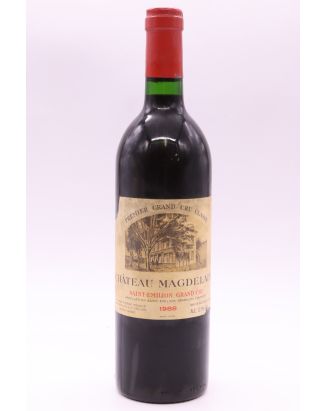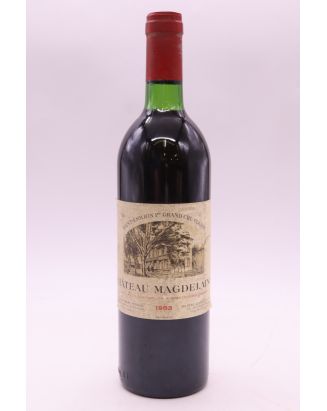
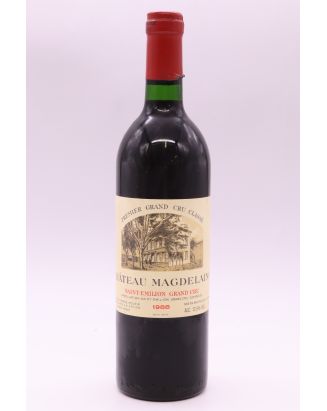
Magdelaine 1988 -5% DISCOUNT !
Personalise your experience
Change your country, language and currency here whenever you wish.
|
|
|
Must-See Châteaux |
|
|
|
|
|
|
A Château merged with Château Bélair-Monange - Former Premier Grand Cru Classé B of Saint-Émilion
Château Magdelaine is an iconic name in the Saint-Émilion appellation, a historic estate that has left its mark on many generations of Bordeaux fine wine enthusiasts. Although it has now merged with Château Bélair-Monange, its wines continue to captivate with their delicacy, finesse, and balance. This traditional cru has captured the essence of the Saint-Émilion terroir, offering refined wines that stand out for their elegance rather than their power.
The history of Château Magdelaine begins in the 18th century, when the property was managed by the Chatonnet family. This estate, situated in the vicinity of Saint-Émilion, enjoys an exceptional terroir that has allowed it to establish itself among the most respected estates of the appellation. However, over time, Château Magdelaine experienced its share of highs and lows, with periods of glory followed by difficulties, particularly at the beginning of the 20th century.
In the 1950s, after decades of neglect that had left the vineyards in poor condition, the property was put up for sale. It was in 1952 that the Établissements Jean-Pierre Moueix acquired it. This Bordeaux négociant house, renowned for the care it brings to several prestigious estates, swiftly undertook the restoration of Château Magdelaine. The vineyards were replanted, the facilities modernised, and efforts were made to restore to this cru the place it deserves among the greatest wines of Saint-Émilion.
Under the management of the Moueix family, Château Magdelaine regained its splendour and was classified Premier Grand Cru as early as 1958, a title it would retain for several decades. Until its merger in 2011 with Château Bélair-Monange, the estate continued to produce wines of great finesse, often praised for their elegance, freshness and aromatic complexity.
The terroir of Château Magdelaine is one of the great riches of this estate. Extending over 11.3 hectares, the vineyard is strategically situated on the limestone plateau of Saint-Martin and on the south-facing slopes, benefiting from an ideal exposure for vine cultivation. The soil, composed primarily of clay-limestone, is renowned for its ability to regulate water, allowing the vines to root deeply and draw essential minerals, thus imparting a remarkable freshness and minerality to the wines.
The vineyard is planted with 90% Merlot and 10% Cabernet Franc. This dominance of Merlot gives the wines of Château Magdelaine a silky texture and a fineness of tannins, while the Cabernet Franc contributes spiced notes and additional structure. The vines average 30 to 35 years of age, with some even reaching 100 years, which contributes to the complexity and depth of the wines. The planting density is 6,000 to 7,000 vines per hectare, encouraging a natural concentration of aromas in the grapes.
The viticultural methods employed at Château Magdelaine are resolutely traditional, yet with a modern attention to detail. The care given to the vines, the precise pruning and the manual harvests are all elements that ensure the quality of the grapes, an essential foundation for the production of great wines. The estate has always placed its trust in environmentally respectful viticulture, which guarantees not only the health of the vines, but also the preservation of the terroir for future generations.
Winemaking at Château Magdelaine is a meticulous process that respects tradition while integrating modern technologies to perfect the elaboration of the wines. Since 2004, fermentations have been carried out in stainless steel vats, offering better temperature control and allowing for a gentle extraction of aromas and tannins. This approach makes it possible to produce precise and well-balanced wines, where each grape variety can best express its potential.
The winemaking process begins with a rigorous selection of grapes, which are sorted by hand on laser sorting tables, a technological addition introduced in 2009 to guarantee the optimal quality of the berries used. Malolactic fermentation takes place in vats, and the decision whether or not to incorporate the press wine is carefully evaluated during ageing to ensure a perfect harmony of the wines.
Château Magdelaine is then aged in French oak barrels, approximately 40% of which are new each year, for an average period of 18 months. This barrel ageing imparts a fine structure to the wines while preserving their freshness and aromatic purity. The choice to use a moderate proportion of new wood ensures that the delicate aromas of the Merlot and Cabernet Franc are not overwhelmed, instead favouring a subtle integration of woody notes.
Château Magdelaine produced approximately 2,500 cases of its principal wine each year, which is today sought after by collectors and lovers of great classic Bordeaux wines. This wine is renowned for its traditional Saint-Émilion style, distinguished by its lightness, refinement and freshness. Unlike other wines from the region, often more powerful and full-bodied, Château Magdelaine offers a more subtle experience, favouring elegance over opulence.
The 2010 vintage is particularly remarkable, often described as a "soft and creamy lacework". It is a brilliant wine, offering delicate aromas of red fruits, spices and a subtle minerality, all underpinned by a fine structure and silky tannins. It is a truly beautiful swan song for this estate, before its merger with Château Bélair-Monange.
The estate also produced a second wine, Les Songes de Magdelaine, which benefits from the same attentive care as the first wine. This more accessible cuvée allowed one to discover the elegant style of Château Magdelaine through a slightly younger wine, but one of equally great finesse.
Saint-Émilion, a jewel of the Bordeaux wine region, has over the years produced vintages of exceptional quality, to the great delight of lovers of fine wines. Among the legendary vintages, one may cite 1947, 1959, and 1961, true icons that have left their mark on the history of Bordeaux wines. The celebrated 1982 remains an undisputed benchmark. The following decades were equally distinguished, with remarkable vintages such as 1990, 1995, 1998, 2000, 2001, 2003, and 2005, all acclaimed for their richness and ageing potential. More recently, the vintages 2008, 2009, 2010, 2012, 2014, 2015, 2016, 2018, 2019, and 2020 have shone for their balance and depth, reaffirming the reputation of Saint-Émilion as one of the most sought-after appellations of Bordeaux, where each new year continues to captivate lovers of great wines with its consistent quality and elegance.
The classification of Premiers Grands Crus Classés B of Saint-Émilion, reviewed every 10 years, brings to light exceptional châteaux from the right bank vineyard. Among those that continue to feature in this prestigious category, one finds iconic names such as Château Beau-Séjour Bécot, Château Beauséjour Héritiers Duffau Lagarrosse, Château Bélair-Monange, Château Canon, Château Pavie-Macquin, Château Troplong-Mondot, Château Trottevieille, and Clos Fourtet. Others, promoted in 2012, such as Château Canon-La-Gaffelière, Château Larcis-Ducasse, Château La Mondotte, and Château Valandraud, also illustrate the ever-rising quality of the crus of the region. By contrast, certain châteaux are no longer classified, such as La Gaffelière (since 2022) and Magdelaine (since 2006). This constant renewal guarantees the excellence and evolution of the Saint-Émilion vineyard, where tradition and innovation blend harmoniously.
Château Magdelaine will forever remain part of the history of the great wines of Saint-Émilion. Although the estate was merged with Château Bélair-Monange, its legacy endures through the wines produced over the decades, marked by a timeless elegance and a subtle complexity. The exceptional terroir and the carefully crafted winemaking methods allowed Château Magdelaine to distinguish itself, not through power, but through the delicacy and harmony of its wines.
COLLECTION NEAR PARIS & VAT REFUND FOR TOURISTS
Free collection in our warehouse near central Paris (92)