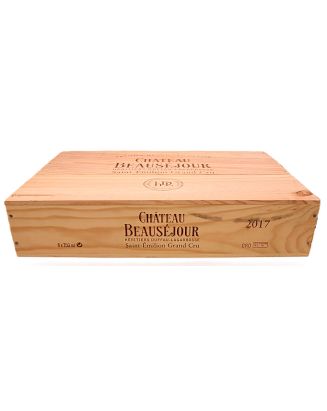
Beauséjour Duffau Lagarosse 1994
Beauséjour Duffau Lagarosse 2003
Personalise your experience
Change your country, language and currency here whenever you wish.
|
|
|
Must-See Châteaux |
|
|
|
|
|
|
A plot-by-plot approach in the service of quality - Premier Grand Cru Classé B de Saint-Émilion
Château Beauséjour, a true gem of the Saint-Émilion vineyard, is an undisputed reference among the Premiers Grands Crus Classés B. Resting on an exceptional terroir and endowed with a rich history, this estate is cherished by wine lovers the world over for the incomparable quality of its vintages. Today, with a new generation at the helm, Château Beauséjour continues to produce elegant and powerful wines, while honouring its centuries-old traditions.
Château Beauséjour dates back to a period of great importance for the Bordeaux vineyard, between the 11th and 12th centuries, a time when the church of Saint-Martin de Mazerat cast its shadow over the estate. However, it was in the 15th century that the first written records of vines on this limestone plateau appeared. For centuries, this estate has benefited from meticulous attention, preserving a unique terroir and producing wines that stand out for their quality and longevity.
The Duffau-Lagarrosse family left their mark on the history of the estate, managing it with care for nearly 170 years. Their work of excellence enabled Château Beauséjour to be recognised as early as 1955 as a Premier Grand Cru Classé B at the creation of the Saint-Émilion classification. One of the most remarkable moments of this dynasty is undoubtedly the 1990 vintage, produced by Joséphine Duffau-Lagarrosse, which received exceptional distinctions.
In 2021, a new chapter began for Beauséjour with the acquisition of the estate by the Courtin family, owners of the Clarins group, in partnership with Joséphine Duffau-Lagarrosse, a member of the ninth generation of the founding family. This partnership makes it possible to perpetuate the family legacy while bringing a modern and sustainable vision to the production of the estate's wines.
Château Beauséjour rests on an exceptional terroir, at the heart of the finest soils of Saint-Émilion. The estate extends over just under 8 hectares, of which nearly 7 are planted with vines. Three distinct soil types characterise this single-block vineyard:
The limestone plateau with astéries: Located at the highest point of the estate, this demanding soil pushes the vine to sink its roots deep, giving the wines an incredible minerality and a robust structure.
The Fronsadais molasse hillsides: These richer, finer and more clay-rich soils are rare in the region and contribute elegance and finesse to the wines produced on these plots.
The ancient colluvial soils: Composed of sands and clays resulting from the degradation of marls, these soils located in the lower areas of the estate add a touch of roundness and suppleness to the wines.
The vineyard's grape variety composition consists primarily of Merlot (75%), which is perfectly suited to the climate and soils of the estate, complemented by Cabernet Franc (25%), whose proportion is increasing to address the challenges of climate change. The average age of the vines is 40 to 50 years, ensuring a root depth that plays a crucial role in water regulation, a characteristic that is widely envied in the world of wine.
At Château Beauséjour, every step of the winemaking process is carried out with particular care to respect the expression of each plot of the estate. It all begins in the vineyards, where the teams make between 35 and 45 passes in front of each vine before the harvest, in order to ensure the perfect ripening of the grapes.
Once harvested, the grapes are meticulously sorted, then destemmed to be vinified according to the specificities of each vintage. The estate now uses a vat room adapted to the individual plots, allowing precise and tailor-made fermentation for each soil type. Malolactic fermentation takes place in oak barrels, bringing roundness and complexity to the wines.
The ageing process, a crucial step in sublimating the wines, takes place in French oak barrels, with 50% of the casks renewed each year. The wine then rests for between 16 and 18 months in these barrels, before continuing its ageing in the château's monolithic cellars, carved directly into the limestone. These natural cellars offer ideal conditions for ageing: total darkness, a constant temperature and perfect humidity levels. This process allows Beauséjour's wines to develop their full depth and complexity.
The estate offers two main cuvées that reflect the excellence and diversity of the terroir:
Château Beauséjour - Premier Grand Cru Classé B
This is the estate's flagship cuvée, produced from the finest plots. It embodies the richness of the terroir and the château's historical expertise. This wine is characterised by its depth, its aromatic intensity and its impressive ageing potential. It reveals aromas of ripe dark fruits, liquorice and truffle, with mineral notes typical of limestone soils. On the palate, it combines power, elegance and freshness, offering a unique gustatory experience.
Croix de Beauséjour - Grand Cru Classé
The second wine of the estate, La Croix de Beauséjour is crafted with the same exacting standards as its elder. This cuvée allows enthusiasts to discover the estate's expertise through a more accessible wine, while retaining the expression of the terroir. The grapes come exclusively from the château's own vineyard, and the same care applied to vinification and ageing is identical. This wine captivates with its finesse, its fruity aromas and its well-balanced structure.
Saint-Émilion, a jewel of the wine-growing region of Bordeaux, has produced over the years vintages of exceptional quality, delighting lovers of great wines. Among the legendary vintages, one can cite 1947, 1959, and 1961, true icons that have marked the history of Bordeaux wines. The celebrated 1982 also remains an undisputed reference. The following decades were no exception, with remarkable vintages such as 1990, 1995, 1998, 2000, 2001, 2003, and 2005, all acclaimed for their richness and their ageing potential. More recently, the vintages 2008, 2009, 2010, 2012, 2014, 2015, 2016, 2018, 2019, and 2020 have stood out for their balance and depth, reaffirming Saint-Émilion's reputation as one of the most sought-after appellations in Bordeaux, where each new year continues to captivate lovers of great wines with its consistent quality and elegance.
The classification of Premiers Grands Crus Classés B of Saint-Émilion, revised every 10 years, shines a light on exceptional châteaux from the right bank vineyard. Among those who continue to feature in this prestigious category, one finds iconic names such as Château Beau-Séjour Bécot, Château Beauséjour Héritiers Duffau Lagarrosse, Château Bélair-Monange, Château Canon, Château Pavie-Macquin, Château Troplong-Mondot, Château Trottevieille, and Clos Fourtet. Others, promoted in 2012, such as Château Canon-La-Gaffelière, Château Larcis-Ducasse, Château La Mondotte, and Château Valandraud, also illustrate the ever-rising quality of the region's crus. On the other hand, some châteaux are no longer classified, such as La Gaffelière (since 2022) and Magdelaine (since 2006). This constant renewal guarantees the excellence and evolution of the Saint-Émilion vineyard, where tradition and innovation blend harmoniously.
Château Beauséjour is one of the jewels of Saint-Émilion, recognised for the exceptional quality of its wines and its unique terroir. For centuries, this estate has been committed to perpetuating a tradition of excellence, while constantly renewing itself to meet the challenges of the future. Thanks to the commitment of Joséphine Duffau-Lagarrosse and the Courtin group, Château Beauséjour continues to shine among the greatest names in Bordeaux. Whether you are a seasoned collector or a lover of wines with character, the cuvées of Beauséjour will offer you an unforgettable tasting experience.
COLLECTION NEAR PARIS & VAT REFUND FOR TOURISTS
Free collection in our warehouse near central Paris (92)