Personalise your experience
Change your country, language and currency here whenever you wish.
|
|
|
Must-See Châteaux |
|
|
|
|
|
|
|
|
A great winemaker from the Southern Rhône with a fruity and indulgent style
After practicing conventional viticulture for several years, Marcel Richaud turned to organic farming under the influence of Beaujolais winemakers such as Marcel Lapierre. Today at the head of more than fifty hectares in the Southern Rhône, he had nonetheless started out modestly. The acquisition of 3 hectares of the L'Ebrescade plot in the late 1980s played a major role in establishing this winemaker's solid reputation. His choice of low vine yields and short aging brings a great deal to the quality of his wines. Les Estambords is his Côtes-du-Rhône prestige cuvée. It is built for aging with its 55% mourvèdre, 30% syrah and 15% grenache. The other flagship cuvée, Cairanne L'Ebrescade, blends one third mourvèdre, one third syrah and one third grenache.
The story begins in 1910, when Marcel Richaud's great-grandfather married Marie Constant and inherited through that union a few vine-growing plots in Cairanne. He established his estate on the eve of the First World War, before leaving for the front, from which he would never return. Marie then carried on the business alone, with great courage, before passing it on to her son Raoul in 1930. For several decades, like virtually all the winemakers in the village, the family delivered their entire harvest to the local cooperative cellar.
The turning point came in 1974. Marcel Richaud took over the reins of the estate at barely seventeen years of age and decided to break free from that system to create his own cuvées. He patiently expanded the property, taking on fifteen hectares on lease and four hectares in ownership upon his father Gaston's departure. In 1987, he acquired three hectares on the Ebrescade terroir, high hillside slopes that would lend their name to his flagship cuvée. Under the influence of Marcel Lapierre and Yann Rohel, he converted to organic farming and became in the 1990s one of the founding members of the Association des Vins Naturels. He also played a decisive role in drafting the specifications for the Cairanne appellation, securing restrictions on the use of machinery, chemical herbicides and sulphur. The estate has been certified organic since 2008. Today, Claire and Thomas Richaud have joined their father and continue to refine the house style vintage after vintage.
The village of Cairanne is perched atop a line of low hills with an ideal exposure, facing east towards the plain stretching between the Aygues and Ouvèze rivers. This altitude ensures temperatures slightly cooler than those of the neighbouring Plan de Dieu, where summer heat is crushing. It is this relative coolness that explains the particularly balanced character of the estate's wines — generous without ever being heavy.
The parcels cover a remarkable diversity of soils. Along the riverbanks, around the lieu-dits Les Granges, Beauchières, Charpier and La Meyeau, one finds silts and fine sands mixed with clay, where proximity to water facilitates dry farming in this arid region. On the mid-slopes, the soils are poor and stony argilo-calcareous. Higher up, between Cairanne and Rasteau, the finest parcels of L'Ebrescade, La Ridel and the Combe d'Henry reach between 250 and 330 metres in altitude, on a blend of red clays and rounded pebbles comparable to that of Châteauneuf-du-Pape. The red grape varieties are Grenache, Syrah, Mourvèdre, Carignan and a little Counoise, which adds tension and length. The whites draw on Grenache Blanc, Clairette, Bourboulenc, Roussanne and Viognier. Some gobelet-trained vines exceed seventy years of age, with yields limited to fifteen or twenty hectolitres per hectare on the prestige cuvées.
Marcel Richaud was one of the very first advocates of low-intervention winemaking in the southern Rhône Valley. All fermentations rely solely on indigenous yeasts, with no added yeasts or other inputs. Sulphur is used with extreme restraint, or even entirely absent in several cuvées, and the wines are neither fined nor filtered. The same level of rigour applies both in the vineyard and in the cellar, and this is immediately perceptible in the purity of fruit found in every bottle.
Ageing methods vary considerably depending on the cuvée. The fruit-driven wines rest in tank to preserve their crunch and immediacy. The terroir wines spend around ten months in demi-muids. The prestige cuvées benefit from twenty-four months in demi-muids and large oak casks, and up to thirty months in large casks for the most ambitious. Over the past few years the estate has equipped itself with an underground winery and ageing cellar, commensurate with the winemaker's ambitions, which has further sharpened the precision of the wines. The result is honest, vibrant and luminous cuvées in which the solar richness of the South always combines with a freshness and drinkability that are the hallmark of the house.
Côtes du Rhône Bulbille: the entry-level wine of the estate, sourced from the youngest vines, currently aged three to seven years, mainly planted at Les Plantiers and complemented by fruit from Les Granges and Les Garrigues. Excellent drinkability, remarkable crunch and aromas of very indulgent small red fruits. The ideal bottle with tapas, grilled meats or a fine charcuterie board.
Côtes du Rhône Terre d'Aigles: labelled Terres d'Aigues until the 2010 vintage, this cuvée comes from young Grenache and Carignan planted on the alluvial soils bordering the Aygues river. It is the fruitiest wine in the range, with a floral, refined and indulgent character, and a perfume that reveals the absence of sulphur during vinification. Beautiful length and complexity for a wine to enjoy in its youth.
Côtes du Rhône Les Garrigues: the new name for the former Terre de Galets cuvée, it blends Grenache and Carignan complemented by a little Mourvèdre and Syrah, from vines aged ten to forty years planted in red clay and rounded pebbles. It carries the lovely scent of garrigue, with small black fruits, notes of black olive tapenade and anise, a silky and generous palate, plenty of freshness and a beautiful length. It can be kept for around five years and is considered one of the best value-for-money wines in the range.
Cairanne Rouge: the archetype of the appellation, rich and structured yet possessed of a finesse that only the finest winemakers manage to coax out. A blend of Grenache, Syrah and Mourvèdre — the latter used in a more generous proportion than average — sourced from poor and stony argilo-calcareous mid-slope parcels. Very peppery, rich and complex, with fruit and spices, liquorice and cherry.
Cairanne Blanc: the estate's white wine, particularly delicious thanks to its high proportion of Bourboulenc, complemented by Clairette, Grenache Blanc, Roussanne and Viognier. A fresh and saline wine, with aromas of white fruits and flowers, equally suited to an aperitif as to Mediterranean cuisine.
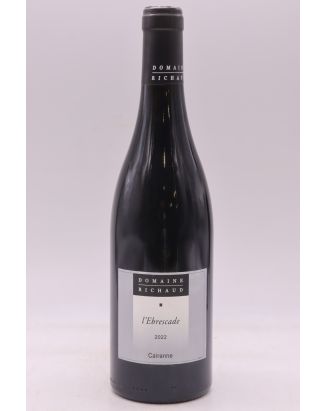
Cairanne L'Ebrescade: the estate's flagship cuvée and the holy grail of the appellation. A parcel-specific selection drawn from the finest old vines in the L'Ebrescade, La Ridel and Combe d'Henry sectors, on hillside slopes culminating at around 320 metres between Cairanne and Rasteau, on rounded pebbles and clay. Mourvèdre, Syrah and Grenache are harvested at derisory yields, then aged twenty-four months in demi-muids and large oak casks. A rich and intense nose of cooked fruits (prunes), very ripe black cherry, cocoa and soft spices (pepper, cinnamon). Richness, complexity, class and freshness: this vibrant Cairanne delivers true emotion and can age ten to twenty years depending on the vintage.
Cairanne Les Estrambords: a historic and exceedingly rare cuvée whose name means "beyond the edges" in Provençal. It is produced only in vintages deemed exceptional, following a ten-year absence between two releases. The grapes come from the mountain terroirs of Cairanne, on the parcels of Les Combes and L'Ebrescade, at an altitude of 330 metres, with Grenache averaging seventy years of age and Mourvèdre of thirty years. Yields of fifteen to twenty hectolitres per hectare and a long ageing of thirty months in large oak casks, yielding a generous, deep and intense wine that unites power with finesse.
COLLECTION NEAR PARIS & VAT REFUND FOR TOURISTS
Free collection in our warehouse near central Paris (92)