Personalise your experience
Change your country, language and currency here whenever you wish.
|
|
|
Must-See Châteaux |
|
|
|
|
|
|
|
|
Facing the Pyrenees, Henri Ramonteu crafts dry and sweet white wines on a domaine de 43 hectares, primarily south-east facing. The soils are composed of a blend of clay, silica, and pebbles. Without being certified, he claims to practice viticulture close to organic farming. He produces wines that reveal themselves from an early age and others more suited to ageing. The dry whites are crafted with gros manseng for its ability to deliver a beautiful freshness. The petit manseng is harvested in successive tries in order to extract only the best of the passerillage of the South-West through the cuvées Noblesse du temps and Quintessence. In years when the climate allows, a cuvée Folie de Janvier is produced.
Records mention the estate as early as 1558 under the name Caussapé, a Béarnais term meaning foot-warmer, with vineyards then spanning four hectares. In the 1980s, Henri Ramonteu, the son of Béarnais farmers, acquired a few acres on the site alongside his family and founded Domaine Cauhapé with just one hectare of vines. In 1988, he permanently left behind the family's mixed farming to dedicate himself entirely to wine. Entirely self-taught, he had no formal enological education, learning through experimentation guided by intuition and an affinity for aromas, looking only to Émile Peynaud and Denis Dubourdieu as mentors.
Every year, he planted half a hectare, sometimes a full hectare, purchasing or leasing new plots until the estate reached around fifty hectares. His extreme sweet cuvées, led by Quintessence du Petit Manseng, joined the ranks of the finest Southwest wines, proving that a Jurançon can rival the world's greatest sweet wines. Then, well before it became fashionable, he sensed the potential of dry whites and gradually shifted his production, which today devotes nearly two-thirds of its output to them. A member of the Académie du Wine de France, supported by an eighteen-person team including an enologist who has worked alongside him for more than twenty years, he passed his passion on to his son David, a consulting enologist in New Zealand who remains involved in the estate.
The vineyard spans the steep slopes surrounding Monein, situated between the Pyrenees and the Atlantic, just a few miles from Pau. The plots are set at varying altitudes, with the highest reaching roughly 400 meters, across clay-siliceous soils strewn with rolled pebbles and facing southeast or due south, like the hillside overlooking the village that yields the Quintessence cuvée. This rugged terrain demands entirely manual labor, but in return provides remarkable sunshine and growing conditions unique in France.
The climate is indeed the signature of Jurançon: a warm, dry wind from Spain sweeps across the slopes in autumn, accelerating the drying of the berries on the vine, while early night frosts shrivel the skins and preserve exceptional acid tension. This rare harmony between sugar concentration and freshness allows harvesting into December or even January without ever becoming heavy. The estate grows only white grape varieties: predominantly Petit Manseng and Gros Manseng, complemented by Courbu and, most notably, Camaralet de Lasseube and Lauzet—two nearly extinct native varieties that Henri Ramonteu replanted, which lend inimitable peppery, aniseed, and floral notes to the dry wines. Vineyard management is extremely rigorous and very close to organic, featuring an extensive soil revitalisation program and the use of herbal preparations since 2021.
Harvesting is done entirely by hand in successive passes, stretching from September 10th until just a few days before Christmas. The grapes arrive in small crates and spend a night in cold storage at around 8 to 10 degrees Celsius to preserve freshness. This is followed by destemming and a cold skin maceration under carbon dioxide for about twelve hours to extract aroma precursors from the skins, before pneumatic pressing with rigorous selection of juices into various quality grades. This technique, adapted from the research of Denis Dubourdieu, accounts for the distinctive aromatic vibrancy of the Cauhapé style.
The cellar houses more than fifty small-capacity vats, enabling separate vinification by parcel, grape variety, and harvest date to ensure each cuvée preserves its unique character. Roughly half the crop is vinified and aged in oak barrels—with the most ambitious cuvées benefiting from new oak for periods ranging from six to thirty months—while the other half matures in stainless steel tanks on total lees to preserve fruit purity. Precise final blending, guided entirely by tasting, fine-tunes each wine's distinct personality.
Chant des Vignes: the entry-level dry Jurançon, crafted in an innovative style born from the pairing of Gros Manseng and Camaralet. Aged for five months in stainless steel tanks on total lees, it reveals a refined, intense bouquet of citrus, exotic fruits, and surprising notes of white pepper, cinnamon, and fennel, delivered on a fresh and generous palate. Ideal as an aperitif or served with shellfish.
Geyser: the estate's flagship cuvée, bringing together the appellation's five grape varieties to express the full scope of its terroir. Twelve hours of skin contact, aged for five months in stainless steel on total lees. The vibrant nose blends citrus and exotic fruit with floral, peppery, and aniseed notes contributed by Camaralet and Lauzet. A dry wine with irresistible freshness.
Quatre Temps: a dry Jurançon built on the synergy of grape varieties and staggered harvest dates. Broader and more structured than the fruit-forward cuvées, it combines roundness, tension, and complexity, with a lovely saline length tailored for refined fish dishes.
Sève d'Automne: a dry Jurançon crafted from late-harvested Petit Manseng and vinified in barrels. A wine of distinct character and refinement, it strikes a rare balance between freshness and power, showcasing notes of yellow fruits, flowers, and sweet spices, supported by precise aging. A high-caliber gastronomic white.
La Canopée: the quintessential expression of Petit Manseng picked at peak ripeness and vinified dry. Its richness is immediately visible in its golden hue. The palate is dense and generous, sustained by a vibrant acidity that endows it with remarkable aging potential.
C de Cauhapé: a connoisseur's wine blending the top selections of the estate's four dry Jurançons, bringing together Petit Manseng, Gros Manseng, Camaralet, Courbu, and Lauzet harvested from September through November. Direct pressing, fermentation in tanks and barrels, aged ten months on lees with stirring. Citrus, yellow-fleshed fruit, spices, and candied fruit define a broad, elegant wine with a signature finish.
Ballet d'Octobre: the introductory sweet wine, made from Gros Manseng harvested in October after early passerillage on the vine. Fresh, inviting nose with hints of pineapple and yellow peach; a supple and lively palate that is never syrupy. Ideal as an aperitif, or paired with foie gras or sheep's milk cheese.
Boléro: a denser sweet wine, crafted from grapes harvested at a higher level of concentration. It reveals aromas of candied yellow fruits, honey, and citrus, with a taut acidity that lengthens the finish and prevents any heaviness.
Symphonie de Novembre: the estate's classic, made from Petit Manseng harvested during the first ten days of November, aged for ten months in its fermentation barrels, followed by six months in tanks, and bottled after two winters. Quince, apricot, ripe pineapple, dried fruit, and delicately toasted notes form a full-bodied, vibrant wine built to age for over fifteen years.
Noblesse du Temps: Petit Manseng harvested at a very high level of ripeness, elevated by meticulous barrel aging. The wine displays the full richness and purity of its aromas, combining candied fruit, orange peel, spices, and toasted nuances, with a luscious texture invariably balanced by freshness.
Quatuor de Cauhapé: a blend of the finest components of each cuvée in the sweet wine range, bringing together harvests from October through late December. It concentrates the estate's entire aromatic spectrum into a single bottle, offering a profile that is complex, harmonious, and remarkably lingering.
Belle des Vignes: a more confidential sweet cuvée, approachable and aromatic, crafted for convivial moments. Ripe yellow fruits, white blossoms, and delicate honey pair with a vibrant acidity that makes it remarkably refreshing and easy to enjoy.
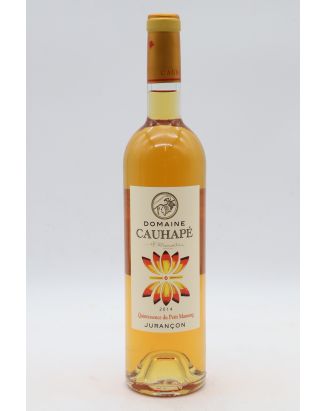
Quintessence du Petit Manseng: the legendary cuvée that transformed the appellation, proving that Monein could produce one of the world's greatest sweet wines. Originating from the south-facing hillside overlooking the village, it is born of grapes dried on the vine to extreme concentration, followed by extensive aging in new oak barrels. Density, complexity, and freshness achieve their pinnacle here.
Folie de Janvier: Henri Ramonteu's ultimate bold creation, crafted from grapes left on the vine until the heart of winter and sometimes harvested after January 1st. The wine achieves spectacular richness, marked by candied fruits, saffron, and spices, anchored by stunning acidity. An absolute rarity, produced only in vintages that allow it.
COLLECTION NEAR PARIS & VAT REFUND FOR TOURISTS
Free collection in our warehouse near central Paris (92)