Personalise your experience
Change your country, language and currency here whenever you wish.
|
|
|
Must-See Châteaux |
|
|
|
|
|
|
A jewel of the South African wine world, Klein Constantia is one of the most prestigious and historic estates in the world, nestled in the Constantia Valley on the slopes of Table Mountain, near Cape Town. Founded on vineyard land dating back to 1685, the estate is world-renowned for its Vin de Constance, a legendary sweet wine beloved by kings, emperors, and writers. Beyond this mythical cuvée, Klein Constantia today produces a comprehensive range of terroir-driven wines of great precision: single-vineyard Sauvignon Blancs, Chardonnay, sparkling wines in the Méthode Cap Classique style, and Bordeaux-style red blends. Carried by the cool breezes of False Bay and soils of decomposed granite, these wines combine centuries-old heritage with modernity.
The history of Klein Constantia begins in 1685, when Simon van der Stel, Governor of the Cape, established the vast Constantia estate between False Bay and Hout Bay and planted the valley's first muscat vines. After his death in 1712, the property was auctioned off and divided into three distinct estates, from which Klein Constantia was born. From the 18th century onwards, Vin de Constance conquered the European courts and became one of the greatest sweet wines in the world, prized above Yquem and Tokay.
Struck by phylloxera at the end of the 19th century, the legendary wine disappeared, before the Jooste family, who acquired the estate in 1980, revived Vin de Constance and restored the entire vineyard. In 2011, the estate passed into the hands of a group of investors, then merged in 2012 with the Anwilka estate in Stellenbosch, bringing in Bordeaux partners Hubert de Boüard, of Château Angélus, and Bruno Prats, formerly of Cos d'Estournel. Cellar master Matthew Day, who joined in 2008, today produces wines acclaimed around the world, and the estate celebrated its 340th anniversary in 2025 with a Vin de Constance 2010 aged fifteen years in barrel.
The terroir of Klein Constantia unfolds at the foot of Table Mountain and the Constantiaberg, in the south-west of South Africa, just a few kilometres from the ocean and False Bay. The cool sea breezes and temperate climate give the grapes a slow ripening and remarkable freshness, ideal for aromatic and taut wines capable of long ageing.
The vines rest on soils of decomposed granite, Table Mountain sandstone and limestone, which contribute minerality and structure. The estate is divided into numerous individual plots, identified according to their microclimates and east and south-facing exposures, with each site harvested and vinified separately. A pioneer of the Biodiversity & Wine Initiative, Klein Constantia practises environmentally responsible viticulture, with certain plots farmed organically and biodynamically.
The estate's philosophy favours simple and precise techniques, designed to let the terroir speak rather than the technique. For the sauvignon blanc wines, the grapes are harvested by hand from four o'clock in the morning to preserve their freshness, then each block is vinified separately, some with spontaneous fermentation using indigenous yeasts, others with hyperoxidation or barrel ageing for structure and depth.
Vin de Constance is produced from Muscat de Frontignan, whose grapes are left to dry on the vine to concentrate the sugars, without systematic reliance on noble rot, then aged for an extended period in barrel. The blends bring together multiple separately vinified batches, in a constant pursuit of balance between sugar, acidity and length, which is the hallmark of the estate's wines' freshness and purity.
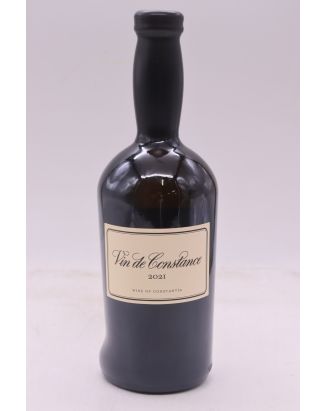
Vin de Constance is the estate's mythical flagship wine, a naturally sweet muscat wine born in 1685 on the slopes of the Constantiaberg. Concentrated and strikingly fresh, it unfolds aromas of apricot, quince, orange zest, marmalade and orange blossom, with a high residual sugar level and a vibrant acidity that ensures exceptional length. Once adored by Napoleon and Frederick the Great, it is today considered one of the greatest sweet wines in the world.
The Estate Sauvignon Blanc is the estate's flagship sauvignon cuvée, a blend of numerous parcels kept separately and then brought together to offer a faithful representation of the Constantia terroir. Vibrant, textured and mineral, it ranks among the finest sauvignon blancs of the Cape.
Perdeblokke is a single-parcel sauvignon blanc sourced from a unique block — the "horse block" in Afrikaans — vinified separately since 2005 to express a singular microclimate. More concentrated and structured, it reveals great depth and a fine capacity for ageing.
Clara is another single-parcel sauvignon blanc, a carefully selected block from the estate. Elegant and precise, it illustrates the diversity of expressions that sauvignon can achieve depending on the soils and exposures of Constantia.
Métis is a sauvignon blanc born from a collaboration with Pascal Jolivet, a winemaker from Sancerre, in a minimalist and holistic approach. Sourced from biodynamically farmed blocks, with no sulphur added at pressing, spontaneous fermentation and twelve months ageing on the lees in stainless steel tanks and neutral barrels, it offers a full, saline and mineral palate, with notes of white pepper and lime.
Rietbos is a premium single-parcel chardonnay from the estate, produced in very small quantities. Taut and complex, it highlights the potential of chardonnay on the cool soils of Constantia, with careful ageing that lends it structure and refinement.
The Estate Chardonnay further completes this expression of the variety in favourable years, in a fresh, fruity and finely oaked style, acclaimed by international critics despite its confidential production.
The Cap Classique Blanc de Blancs is the estate's sparkling wine, produced using the Méthode Cap Classique, the South African equivalent of the traditional method. Fine and elegant, with a delicate bubble and wonderful freshness, it showcases the estate's expertise in sparkling wines.
The Estate Riesling completes the white range in the vintages where it is produced, in an aromatic and fresh style, marked by the coolness of the Constantia climate and a fine, zesty tension.
The Estate Red is the estate's Bordeaux-style red blend, built around cabernet sauvignon and complementary Bordeaux varieties. Elegant and aromatic, it offers dense substance and fine tannins, a fully realised expression of Constantia's red terroirs.
The Estate Shiraz is produced in certain years from syrah, in a spiced and generous profile that broadens the estate's red range according to the vintages.
Vin Annabel is the estate's rosé, a fresh and indulgent cuvée that brings a summery and convivial touch to the range, in the same spirit of precision and respect for the terroir.
Anwilka, finally, is the red wine from the sister estate in Stellenbosch, in a warmer region well suited to Bordeaux-style blends. Produced around syrah, cabernet sauvignon and petit verdot with the involvement of the estate's Bordeaux partners, it extends the Klein Constantia universe with a structured and profound great red wine.
COLLECTION NEAR PARIS & VAT REFUND FOR TOURISTS
Free collection in our warehouse near central Paris (92)