Personalise your experience
Change your country, language and currency here whenever you wish.
|
|
|
Must-See Châteaux |
|
|
|
|
|
|
Domaine de Bonserine is one of the most important and most respected estates in the Côte-Rôtie appellation. Founded in 1961 and modernised in the 1990s under the leadership of Ludovic Richard, this 12-hectare estate is the second largest in the Côte-Rôtie appellation in terms of surface area, and the first in terms of owner-grower. Its defining characteristic is that it is planted predominantly with "serine", an ancient and local variety of Syrah, with small berries that are highly concentrated in aromas, which gives the wines a remarkable depth and purity of fruit. In 2006, Maison Guigal, a world icon of Rhône wines, acquired the estate while preserving its complete operational and team autonomy. Ludovic Richard continues to manage it, with Stéphane Carrel as cellar master, with the same exacting standards of quality. Just four cuvées — three Côte-Rôtie and one Condrieu, aged 24 to 36 months in demi-muids — define an estate of great precision. Complemented by the négociant structure Septentria (Saint-Joseph, Crozes-Hermitage, Côtes du Rhône blanc), the estate covers a complete range of the great appellations of the northern Rhône.
Domaine de Bonserine was founded in 1961, at a pivotal moment for the Côte-Rôtie appellation, which was then in full recession after decades of neglect. Its name is taken directly from the lieu-dit Bonserine, located on the steep hillsides overlooking the right bank of the Rhône between Ampuis and Vienne. In the 1980s, the appellation experienced a spectacular revival, driven in particular by Marcel Guigal and his legendary cuvées. It was in this context that Ludovic Richard took over the direction of the estate and, in the 1990s, embarked on an ambitious modernisation of the cellar infrastructure, enabling a significant elevation in quality. It was during this period that the current iconic cuvées were conceived, notably La Sarrasine (first vintage 1999) and La Garde.
In 2006, Marcel Guigal, captivated by the quality of the vineyard and the personality of Ludovic Richard, acquired Domaine de Bonserine. The transaction was carried out in a spirit of absolute respect for the estate's identity: Ludovic Richard and his team retained full autonomy, their cellar, their vineyard and their winemaking methods. Stéphane Carrel holds the position of cellar master with recognised rigour and precision. The estate produces its own wines under its own label, independently of Guigal's production. In parallel, Bonserine developed the Septentria négociant structure to offer wines from other great northern Rhône appellations (Saint-Joseph, Crozes-Hermitage, Côtes du Rhône) within the same qualitative philosophy.
The vineyard of Domaine de Bonserine spans 12 hectares in total, of which 11 hectares are in the Côte-Rôtie appellation and 1 hectare in Condrieu. In Côte-Rôtie, the plots are spread across a large number of named sites on both historic slopes of the appellation, in Ampuis and on the adjacent communes. La Sarrasine, the main cuvée, is sourced from 10 distinct plots distributed across the entire Côte-Rôtie vineyard. La Viallière is sourced from plots on the Côte Blonde. La Garde, the grand prestige cuvée, comes from only 0.08 hectares of vines aged 60 to 80 years on the Côte Brune, with a slight touch of fruit from the Côte Blonde.
The great singularity of the vineyard lies in the age and nature of the vines: the estate is planted predominantly with "serine", an ancient and local variety of Syrah, whose oldest plants are 60 to 80 years old. This "serine" produces small berries highly concentrated in aromas, with remarkable aromatic density and complexity. All the vines are cultivated on terraces, entirely worked and ploughed, with manual harvesting carried out by a team of 40 passionate vine growers, carefully sorted before vatting. The vineyard is oriented towards organic viticulture with indigenous yeasts as a matter of course.
Vinification at Domaine de Bonserine is precise and classical, faithful to the tradition of the northern Rhône. Harvesting is manual, with rigorous sorting upon reception. For the Côte-Rôtie wines, the grapes are 100% destemmed (except La Garde at 80%). Fermentations begin with indigenous yeasts in temperature-controlled stainless steel vats, with pump-overs during approximately 3 weeks of maceration. Malolactic fermentation takes place under wood. Ageing is one of the estate's distinguishing hallmarks: 24 months in demi-muids for La Sarrasine (60% new, 20% one-wine, 20% two-wine), and up to 36 months in small new French oak barrels for La Garde, the most ambitious cuvée. For the Condrieu, vinification takes place in vats with ageing on lees.
The style of Bonserine's wines is recognisable: an aromatic precision, an energy and a freshness that distinguish these Côte-Rôtie wines from the more opulent versions of other producers. Length, purity of fruit and finesse of tannins are the constants of the range. Stéphane Carrel excels particularly in sunny vintages, where he manages to preserve a remarkable freshness and tension.
Côte-Rôtie La Sarrasine: The estate's flagship cuvée, sourced from 10 different plots of Côte-Rôtie, on the Côte Brune and the Côte Blonde. A blend of 97% Syrah (old serine) and 3% Viognier, 100% destemmed. Aged 24 months in French oak demi-muids, 60% new, 20% one-wine, 20% two-wine. Production of 2,000 to 2,500 cases per year. First vintage 1999. A precise nose of macerated red fruits, dried rose, blond tobacco and soft spices (cardamom, nutmeg). A caressing, pure and long-limbed palate, tight and elegant tannins, a long perfumed finish of cherry stone. One star in the Guide Hachette 2025, "a flattering and complex expression", "a radiant future." The most widely available wine and the most representative of the estate's outstanding quality.
Côte-Rôtie La Viallière: A single-parcel red cuvée sourced from plots on the Côte Blonde of Côte-Rôtie, where the schistous soils, more clayey and lighter in colour than the Côte Brune, produce a Syrah in a more floral and elegant style. Aged in demi-muids. A red wine of finesse and delicacy characteristic of the Côte Blonde, with aromas of violet, raspberry and spices, a silky palate and a schistous mineral tension. A more feminine and approachable expression of the Côte-Rôtie terroir.
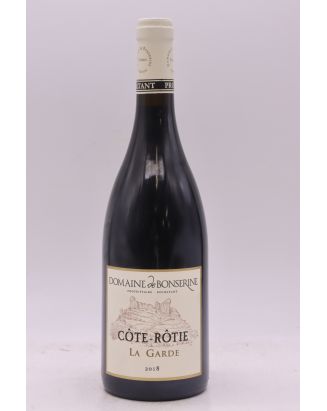
Côte-Rôtie La Garde: The estate's grand prestige cuvée and absolute rarity, sourced from only 0.08 hectares of Syrah (serine) aged 60 to 80 years on the Côte Brune, with a slight touch of Côte Blonde. 80% destemmed. Aged for up to 36 months in small new French oak barrels. Production of only 250 cases per vintage, making it one of the rarest cuvées in the entire Côte-Rôtie appellation. A red wine of exceptional concentration, depth and power, with intense aromas of dark fruits, smoke, liquorice and spices, a dense and voluminous palate, vigorous yet refined tannins, and a finish of incomparable length and persistence. A wine built for long ageing, not to be opened before a minimum of 10 years.
Condrieu Domaine de Bonserine: The estate's only white cuvée, sourced from 1 hectare of Viognier on the granite terraces of Condrieu. A white wine of the aromatic richness typical of the variety: white flowers (acacia, violet), white peach, apricot, light exotic notes. An ample and silky palate, balanced acidity and freshness, long and mineral finish. "The best Condrieu tasted over two days of tasting" according to visitors to the estate. A Condrieu of great distinction, reflecting the granite terroir and the estate's unique expertise.
Septentria (Saint-Joseph, Crozes-Hermitage, Côtes du Rhône Blanc): A négociant range created by Domaine de Bonserine to offer other northern Rhône appellations within the same qualitative philosophy. Saint-Joseph red (Syrah on granite), Crozes-Hermitage red (Syrah on clay and pebbles), and Côtes du Rhône white (Marsanne and/or Viognier) make up this complementary range, vinified and aged at the estate with the same rigour as the estate's own cuvées.
COLLECTION NEAR PARIS & VAT REFUND FOR TOURISTS
Free collection in our warehouse near central Paris (92)