Personalise your experience
Change your country, language and currency here whenever you wish.
|
|
|
Must-See Châteaux |
|
|
|
|
|
|
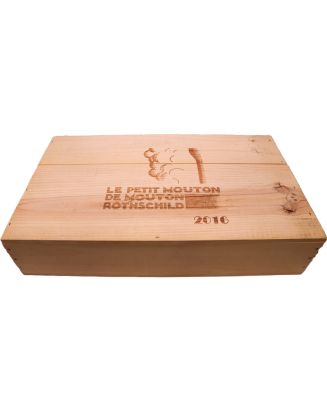
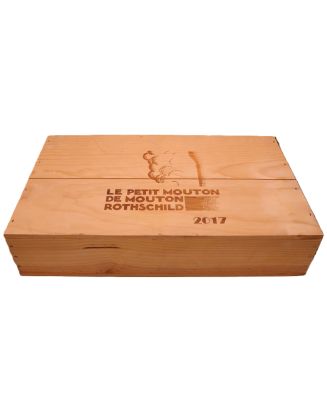
Born in 1993 under the impetus of Baroness Philippine de Rothschild, Le Petit Mouton de Mouton Rothschild is the second wine of the mythical Château Mouton Rothschild, Premier Cru Classé of Pauillac. Sourced from the same 90-hectare vineyard set on the deep gravels of the Plateau de Mouton, it benefits from exactly the same care as its illustrious elder: manual harvesting in crates, sorting on vibrating tables, plot-by-plot vinification in the spectacular gravity-fed vat room with oak vats, and ageing in barrels. Dominated by Cabernet Sauvignon and complemented by Merlot, Cabernet Franc and Petit Verdot, this wine offers a more immediate and more accessible interpretation of the great terroir of Pauillac.
The adventure begins well before the creation of the second wine. In 1720, Joseph de Brane acquired the estate and renamed it Brane-Mouton, developing a vineyard whose reputation quickly rivalled that of the finest crus of the Médoc. In 1853, Baron Nathaniel de Rothschild purchased the property at auction and gave it its definitive name of Château Mouton Rothschild. Classified as a Deuxième Cru in the 1855 classification, the estate adopted the famous motto "Premier ne puis, second ne daigne, Mouton suis." In 1922, Baron Philippe de Rothschild took over the reins at the age of 20 and set in motion a revolution: from 1924, he insisted on integral bottling at the château, then had the Grand Chai constructed in 1926 — a 100-metre building designed by architect Charles Siclis. From the 1945 vintage onwards, each label has been illustrated by a contemporary artist, from Braque to Picasso, from Dalí to Bacon. In 1973, after a battle spanning several decades, Mouton Rothschild finally attained the rank of Premier Cru Classé — the only revision ever made to the 1855 classification — and the motto became "Premier je suis, second je fus, Mouton ne change."
It was Baroness Philippine de Rothschild, daughter of Baron Philippe, who gave birth to the second wine. After launching the dry white Aile d'Argent in 1991, she created in 1993 a cuvée intended to gather the youngest and most supple lots from the estate. This first vintage was marketed under the name "Le Second Vin de Mouton Rothschild" before adopting, from 1994 onwards, its definitive and more intimate name: Le Petit Mouton de Mouton Rothschild, in reference to the Victorian-style residence built in 1885 that the Baroness occupied at the very heart of the property. To create a visual link between this second wine and the Premier Cru, she chose a label inspired by a variation on the theme of the vine created in 1927 by the painter and poster artist Jean Carlu, who designed the label for Château Mouton Rothschild 1924. Since the passing of Baroness Philippine in 2014, her three children — Camille Sereys de Rothschild, Philippe Sereys de Rothschild and Julien de Beaumarchais de Rothschild — have continued to uphold this standard of excellence at the head of the estate.
The vineyard extends over approximately 90 hectares at the lieu-dit Le Pouyalet, on the outskirts of Pauillac, to the north-west of Bordeaux, between the Gironde estuary and the Landes forest. The majority of the plots occupy a ridge known as the Plateau de Mouton, which peaks at 27 metres above sea level. The name of the cru does not, in fact, refer to the animal but to the old French word "mothon", meaning a small hillock. The soils consist of very deep Garonne gravels mixed with sands and clays, resting on a clay-gravel and marl-limestone subsoil. This terroir offers remarkable natural drainage, which forces the vines to root deeply and endows the grapes with a rare concentration and fineness of tannins, while the proximity of the estuary tempers climatic extremes.
The red grape varieties, spread over approximately 84 hectares, combine cabernet sauvignon (around 80%), merlot (approximately 16%), cabernet franc (3%) and petit verdot (1%), with proportions evolving slightly as replanting progresses. Six hectares are dedicated to white varieties destined for Aile d'Argent. The planting density, which is very high, reaches 10,000 vines per hectare, and the average vine age exceeds forty years. Each plot is individually monitored by a dedicated winegrower, in a reasoned approach that prioritises soil work, deshooting, leaf removal and strict yield control. Le Petit Mouton is traditionally sourced from the estate's youngest vines and from lots whose profile — softer and more immediately approachable — does not correspond to the selection of the fine wine.
The harvest is entirely manual, with grapes picked in crates to preserve the integrity of the berries, then sorted on vibrating tables before entering the cellar. Since 2013, the estate has had a high-tech gravity-fed vat room designed by set designer Richard Peduzzi and architect Bernard Mazières. Built on two levels connected by elegant metal pillars, it eliminates any need for pumps and harmoniously combines wood and steel. It houses 44 oak vats, each fitted with transparent staves allowing fermentation to be observed, and 20 temperature-controlled stainless steel vats.
This diversity of vessels, in different sizes, corresponds to the estate's plot structure and allows for precise plot-by-plot vinification — an indispensable condition for the rigorous selection that subsequently distinguishes the fine wine from the second wine. Macerations are conducted gently in order to extract colour and substance without hardening the tannins. The ageing of Le Petit Mouton takes place in French oak barrels, with a moderate proportion of new wood, often around 40% depending on the vintage, compared to 100% for the Premier Cru, so as to preserve the vibrancy of the fruit and drinkability. The classic stages of the great Médoc tradition are respected: regular topping up, successive rackings and fining with egg white to clarify and naturally stabilise the wine before bottling at the château.
Le Petit Mouton de Mouton Rothschild, Pauillac: the second wine of the estate blends predominantly cabernet sauvignon (generally between 60% and 80%) and merlot (from around 20% to 35%), with sometimes a touch of cabernet franc and petit verdot depending on the vintage. Its colour is an intense ruby red with purple highlights. The nose unfolds aromas of blackcurrant, blackberry, black cherry and plum, lifted by notes of cedar, graphite, cocoa, blonde tobacco and soft spices imparted by ageing. The palate is broad, fresh and beautifully structured, with ripe, velvety tannins, a clean acidity and a refined finish centred on black fruit and the chalky minerality characteristic of Pauillac's great gravels. More approachable than the fine wine, it can be enjoyed from five to eight years after the vintage and can be cellared for fifteen to twenty years in the finest years. It pairs wonderfully with roast lamb, grilled red meats, game birds, duck breast and hard pressed cheeses.
COLLECTION NEAR PARIS & VAT REFUND FOR TOURISTS
Free collection in our warehouse near central Paris (92)