Personalise your experience
Change your country, language and currency here whenever you wish.
|
|
|
Must-See Châteaux |
|
|
|
|
|
|
A true gem of the Greek vineyard, the Hatzidakis estate has been showcasing the Assyrtiko grape variety on the volcanic island of Santorini since 1997. Founded by Haridimos Hatzidakis, nicknamed the magician of Santorini, and his wife Konstantina, this cellar carved into the rock was the first on the island to transition to organic farming. Ungrafted vines pruned in a basket shape, indigenous yeasts, unfiltered wines: each cuvée expresses with purity the unique minerality and salinity of the Santorinian terroir.
The story of the Hatzidakis estate begins in 1996, when Konstantina Chryssou showed her husband, Haridimos Hatzidakis, the family vines of Pyrgos Kallistis, left abandoned since the 1956 earthquake. Originally from Crete and at the time head oenologist at the Boutari winery in Santorini, this passionate winemaker discovered a tiny cave there, a kanava, which he transformed into a winery. The first bottles were released in the late 1990s, with a Santorini Assyrtiko and a Mavrotragano, the first wines of an estate destined to become a world reference.
A visionary pioneer, Haridimos Hatzidakis was the first on the island to farm organically, to vinify single-vineyard wines, to allow indigenous yeasts to work freely and to bottle his wines without filtration. He produced the first single-vineyard Assyrtiko from Santorini and one of the first Mavrotragano, saving this rare red variety from oblivion. Having passed away prematurely in 2017, he left the estate in the hands of his family: his wife Konstantina and his children, including eldest daughter Stella, now carry on his philosophy with a team of oenologists faithful to his legacy.
The terroir of the Hatzidakis estate is one of the most singular in the world. On the island of Santorini, in the Cyclades, the vineyard extends over around ten hectares farmed organically, between the villages of Pyrgos Kallistis, Megalochori, Emporio and Akrotiri, at altitudes ranging from 70 to 350 metres. The volcanic soils, made up of ash, pumice, lava and sand, contain almost no clay, which has preserved the island from phylloxera and allows own-rooted vines to be maintained, some of them several centuries old.
To resist the strong winds, the vines are pruned using the ancestral kouloura method, coiled in a basket shape close to the ground. The Meltemi, the north wind that cools the summer nights, preserves the acidity of the grapes and limits disease, allowing viticulture with virtually no treatments. On this mineral and saline land grow the island's native grape varieties: the white varieties Assyrtiko, Aidani and Athiri, as well as the red varieties Mavrotragano, Mandilaria and Voudomato.
At the Hatzidakis estate, vinification extends the work of the vineyard with the utmost respect for the grape. Harvesting is done by hand in August, and the grapes are cooled before a delicate pressing. Fermentations start exclusively with the indigenous yeasts of the site, at controlled temperature, without any chemical additives. The wines are never filtered and receive only a minimal amount of sulphur, allowing time to do its work.
Depending on the cuvée, ageing takes place in stainless steel tanks to preserve freshness and tension, or in oak barrels for the most structured wines, often with an extended period on the lees. The sweet wines follow the tradition of Santorini: the grapes are dried in the sun for around fifteen days before extended ageing in barrel, sometimes over several years, to give birth to the Vinsanto and other nectars of the island.
The white range, dominated by Assyrtiko, has made the estate's reputation. The Santorini Familia, the flagship cuvée aged in stainless steel, expresses the full minerality and salinity of the island; its name pays homage to the partner winemakers considered as family. The Cuvée No 15, an Assyrtiko sourced from the first certified organic plots, captivates with its finesse, while the Skitali, symbol of the torch passed to the Hatzidakis children, combines extended lees ageing with time in barrel, and is also available in a rare Skitali Barrel version. The Rampelia, a single-vineyard wine with a mineral backbone, along with the venerable Assyrtiko de Mylos and Assyrtiko de Louros, sourced from old vines, explore the micro-terroirs of Santorini. The Nykteri, a late-harvest Assyrtiko aged in barrel, and the Aidani, an aromatic white with notes of honeysuckle, complete this ensemble.
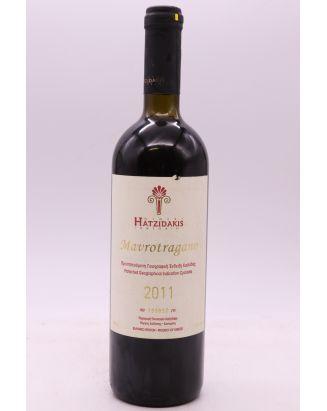
The estate also offers a rosé and a characterful red. La Rosette, crafted from whole-cluster pressed Mandilaria, offers a bright pink hue, cherry and raspberry fruit and a dry finish. The Mavrotragano, a rare red grape variety saved by Haridimos Hatzidakis, yields a concentrated and deep wine, aged eighteen months in barrel, with fine tannins and aromas of dark fruits, often compared to the great reds of Piedmont.
Finally, the sweet wines perpetuate a centuries-old tradition. The Vinsanto, the jewel of the estate produced mainly from sun-dried Assyrtiko and aged for around twenty years in barrel, displays exceptional richness of fig, apricot and candied citrus, balanced by a vibrant acidity. The Voudomato, a rare sweet red from the grape of the same name, and the Liassimo, a nectar of Mandilaria produced in solera from several vintages, complete this collection of Santorinian sweet wines.
COLLECTION NEAR PARIS & VAT REFUND FOR TOURISTS
Free collection in our warehouse near central Paris (92)