Weinbach

Wines from Domaine Weinbach: buy at the best price

Founded in 1612 by Capuchin monks, this highly renowned Alsace estate was acquired by the Faller brothers in 1898. Domaine Weinbach is a "women's" domaine de. Indeed, from 1979 onwards, the estate was taken over by Colette Faller and her two daughters Catherine and Laurence. Since 2015, and following the passing of Laurence Faller, Catherine and her son Théo have been at the helm of the family estate. Domaine Weinbach spans around thirty hectares of vineyards. 

Read more
See more
Filters

Price

€360.00 - €620.00

Parker WA rating

87 - 98

Burghound rating

No choice available on this group

Revue du Vin de France rating

No choice available on this group

Bettane & Desseauve rating

20 - 20

Prices drop

No choice available on this group

Download this list
There are 2 products.
Download this list
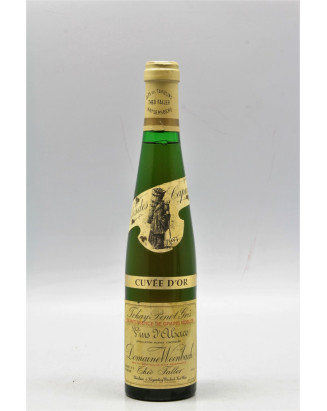
Weinbach Alsace Grand cru Tokay Pinot Gris Altenbourg Quintessence de Grains Nobles Cuvée d'Or 1983 37.5cl
2 in stock
36347
White
37.5cl
Add to cart
Alsace | Alsace Grand cru

Weinbach Alsace Grand cru Tokay Pinot Gris Altenbourg Quintessence de Grains Nobles Cuvée d'Or 1983 37.5cl

€600.00 inc-VAT per bottle
€500.00 ex-VAT
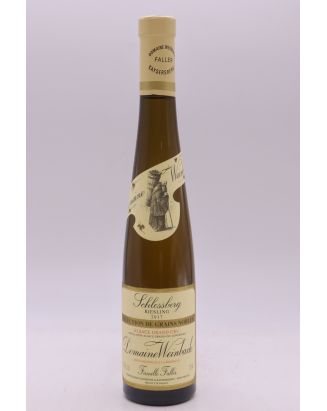
Weinbach Alsace Grand cru Riesling Schlossberg Sélection de Grains Nobles 2017 37.5cl
Last one !
Bio
Les Mieux Notés
Biodynamie
1 in stock
105634
White
37.5cl
98+/100
19/20
Add to cart
Alsace | Alsace Grand cru

Weinbach Alsace Grand cru Riesling Schlossberg Sélection de Grains Nobles 2017 37.5cl

€360.00 inc-VAT per bottle
€300.00 ex-VAT

History of Domaine Weinbach

Vines were cultivated on this land as early as the ninth century, but it was in 1612 that Capuchin monks built their monastery at the foot of Schlossberg and established Clos des Capucins, entirely enclosed by a high stone wall. Sold as national property during the French Revolution, the estate changed hands several times before the Faller brothers acquired it in 1898 and passed it on to their son and nephew Théo. A major figure in the region, Théo Faller was instrumental in establishing Alsace’s appellations d’origine contrôlée and helped raise the region’s wines to their current standing after the war.

After his death in 1979, his wife Colette took the reins, supported by their two daughters: Catherine, who managed the business and sales, and Laurence, an exceptional winemaker whose precision and sensitivity would establish the estate’s modern reputation. Under Laurence’s leadership, the entire vineyard began its conversion to biodynamics in 2005, ultimately earning certification. The estate was then described as a women-run winery, a rarity in French winegrowing. After Laurence’s death in 2014 and then Colette’s, Catherine Faller continued the venture with her sons Eddy and Théo, the fourth generation of Fallers at Clos des Capucins. The new generation is evolving the style toward greater density and purity while exploring new territory: skin-contact wines, pét-nats and original blends.

Terroirs and Vineyards of Domaine Weinbach

All the estate’s plots lie within a few miles of the Clos, on the south-facing slopes that enclose the Weiss Valley. Clos des Capucins itself, held exclusively by the family, sits on sandy, silty and gravelly soils formed by the stream’s alluvial deposits. It produces pure, supple wines with immediate appeal. Just above it rises Grand Cru Schlossberg, a vast terraced granite slope whose reputation was documented as early as the 15th century and which became Alsace’s first vineyard classified as a Grand Cru in 1975. The estate owns around eight hectares there, planted almost exclusively to Riesling, which this warm, well-drained granite gives incomparable focus and salinity.

The Altenbourg vineyard, with its marl, limestone and sandstone soils, is considered by many to have grand cru potential: its capacity to develop noble rot makes it an ideal terroir for Pinot Gris and Gewurztraminer. South-southeast-facing Grand Cru Furstentum, on limestone, brings finesse, subtlety and aromatic power. Grand Cru Mambourg, on very warm limestone marl in Sigolsheim, produces deep, sun-drenched wines, while Grand Cru Marckrain, also on limestone marl, reveals a Pinot Gris with an impressive backbone. Riesling dominates the plantings, accounting for nearly half the vineyard area, followed by Gewurztraminer, Pinot Gris, Pinot Blanc, Sylvaner and Muscat à Petits Grains, with just over one hectare of Pinot Noir. Harvesting is entirely by hand, with successive passes through plots destined for age-worthy wines.

Winemaking at Domaine Weinbach

Work in the soil, vineyard and cellar is tailored to each combination of grape variety, terroir and microclimate. The grapes are pressed slowly and gently to extract the juice without damaging the aromas. Fermentation starts exclusively with the native yeasts present on the berries and takes place in large, old oak casks that impart no oak flavor but allow beneficial micro-oxygenation.

The wines are aged for extended periods on fine lees, without excessive stirring or unnecessary intervention, and fermentations can last several months. This commitment to patience accounts for the estate’s characteristic balance between richness and tension, as well as its wines’ ability to age for decades. Residual sugar, when present, always results from fermentation stopping naturally rather than from a technical decision, and recent vintages show a clear trend toward dry styles.

The cuvées of Domaine Weinbach

Sylvaner Réserve is a remarkably pure dry wine, elegant with white-flower notes, clean and flowing with a touch of salinity, and considered a benchmark for the appellation. Floral and full-bodied, Pinot Blanc Réserve charms with its balance of freshness and richness. Delicately floral Muscat Réserve emphasizes finesse and the crispness of fresh grapes. Les Vignes du Prêcheur is an approachable, easy-drinking blend. Among the experimental wines, Pet’Nat PCC offers lively, appealing bubbles, while Cuvée MVØ, a skin-contact wine from the Vogelgarten vineyard made without any additives, is a textured and deeply original orange wine. Pinot Blanc Les Terres du Prince rounds out the range with greater body and length.

Riesling is the estate’s signature grape. Riesling Cuvée Théo, a tribute to Théo Faller, comes from the finest plots of Clos des Capucins: focused, crystalline and completely dry, it is the estate’s calling card. Riesling Cuvée Colette, made from fifty- to sixty-year-old vines, offers greater complexity, with exotic notes and a delicate hint of citrus zest. Riesling Grand Cru Schlossberg expresses the full verticality of the granite, with penetrating minerality and the potential to age for fifteen to twenty years. Cuvée Sainte Catherine, from very old vines in the heart of the grand cru and harvested late, adds richness, body, and smoky, toasted notes to this mineral structure. It pairs with fish in sauce, lobster and white meats. The single-plot cuvée Sous la Forêt, from the edge of the woods, offers a fresher, more taut expression of Schlossberg, while the exceptionally rare Cuvée L’Inédit represents the pinnacle of the estate’s dry Riesling production. Riesling Grand Cru Furstentum and Grand Cru Mambourg complete the range with greater aromatic depth and sun-ripened character.

Pinot Gris also comes in several styles. Pinot Gris Clos des Capucins is dry and full-bodied, made for veal, risotto or smoked fish. Pinot Gris Les Caracoles, from forty- to fifty-year-old vines, is completely dry, mouthwatering and finely etched, with lemon notes. Pinot Gris Cuvée Sainte Catherine gains density and distinction, while Pinot Gris Altenbourg, historically called Cuvée Laurence, develops an enveloping roundness enhanced by a touch of botrytis. Pinot Gris Grand Cru Marckrain, grown on limestone marl, adds a firmer mineral backbone. On Furstentum, the Pinots Grand Cru cuvée blends the different Pinot varieties in the family for a white wine with a silky texture.

Gewurztraminer reaches remarkable heights here. Gewurztraminer Cuvée Théo, from Clos des Capucins, is the most approachable and freshest of the range, with rose and sweet spice notes. Les Treilles du Loup, from forty- to fifty-year-old vines in the Wolfreben vineyard, impresses with its controlled power and elegance, combining white peach, mirabelle plum, rose petal and grapefruit. Gewurztraminer Altenbourg, formerly Cuvée Laurence, unfolds jasmine, orchid and ripe peach in a broad, golden profile. Gewurztraminer Grand Cru Furstentum brings together finesse, subtlety and power, with spice and candied grapefruit notes encouraged by botrytis. Gewurztraminer Grand Cru Mambourg, even more sun-drenched, offers profound richness and impressive length.

Red wines are taking on a growing role despite the small area planted to them. Pinot Noir Clos des Capucins emphasizes bright red fruit and easy drinkability. Pinot Noir Les Terres du Prince offers more structure, while Pinot Noir Altenbourg, from the marl-limestone terroir below the named vineyard, gains depth and spice. Pinot Noir Le Jardin aux Oiseaux stands out for its refinement and fine tannins. Produced in tiny quantities on the upper slopes of Schlossberg, Pinot Noir La Colline du Château Cuvée S is the pinnacle of the red range, with a texture and tension reminiscent of Burgundy. The most favorable vintages also yield one of Alsace’s finest collections of sweet wines: Vendanges Tardives made from Riesling, Pinot Gris or Gewurztraminer, combining opulence and elegance; Sélections de Grains Nobles produced through meticulous sorting of botrytized berries, with rare concentration and balance; and, in exceptional years, the legendary Quintessences de Grains Nobles, produced in just a few hundred bottles, whose aromatic complexity and freshness defy time.

WHAT THEY SAY ABOUT US

5 good reasons to buy wines on V&M

...

EXPRESS DELIVERY

In a secure polystyrene packaging

...

INTERNATIONAL SHIPPING

Find out more about VAT-EX sale for outside EU deliveries

...

COLLECTION NEAR PARIS & VAT REFUND FOR TOURISTS

Free collection in our warehouse near central Paris (92)

...