Arnoux Lachaux

Wines from Domaine Arnoux-Lachaux: purchase at the best price

Established in Vosne-Romanée since 1858, Domaine Arnoux-Lachaux has established itself within a decade as one of the most sought-after and most talked-about names in all of Burgundy. Under the influence of Charles Lachaux, who joined in 2011, this fourteen-hectare family estate spread across some fifteen appellations in the Côte de Nuits has undergone a complete revolution, both in the vineyard and in the cellar. High planting densities, gobelet pruning, high trellising, the cessation of shoot-trimming, biodynamic farming, whole-cluster harvesting and ageing in sandstone jars have given birth to infused Pinot Noirs of delicate texture and striking aromatic nobility. From the Bourgogne Pinot Fin to the Romanée-Saint-Vivant, everything is exclusively red and produced in infinitesimal quantities.

Read more
See more
Filters

Price

€380.00 - €400.00

Color

Vintage

Volume

Parker WA rating

89 - 96

Burghound rating

90 - 96

Revue du Vin de France rating

No choice available on this group

Bettane & Desseauve rating

15 - 16

Prices drop

No choice available on this group

Download this list
There is 1 product.
Download this list
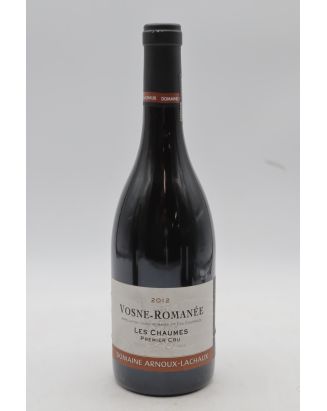
Arnoux Lachaux Vosne Romanée 1er Cru Les Chaumes 2012
New
1 in stock
132019
Red
75cl
Very slightly damaged
90-93/100
Add to cart
Burgundy | Vosne Romanée 1er cru

Arnoux Lachaux Vosne Romanée Premier Cru Les Chaumes 2012

€384.00 inc-VAT per bottle
€320.00 ex-VAT

The History of Domaine Arnoux-Lachaux

The property was founded in 1858 in Vosne-Romanée, in the heart of the Côte de Nuits. It first belonged to Charles Arnoux, then to his son Robert Arnoux, whose name appeared on the labels for nearly 50 years and who patiently built an exceptional collection of vineyards. In 1995, Robert’s daughter Florence and her husband Pascal Lachaux took over. Pascal refined the aging process, brought out the character of each climat and strengthened the estate’s identity throughout the 1990s and 2000s, notably building a new winery in 2005 that enabled gravity-flow transfers.

The real turning point came in 2011 with the arrival of their eldest son, Charles Lachaux, who took charge of winemaking with the 2012 vintage before succeeding his parents in the middle of the decade. With a fresh perspective and remarkable independence of thought, he methodically challenged every local assumption. A great admirer of the wines of Domaine Leroy and inspired by agroecology and biodynamics, he believes that inheriting some of the world’s greatest terroirs brings an obligation to take risks others cannot afford. In just a few vintages, this approach propelled Arnoux-Lachaux among the world’s most coveted estates, alongside the legendary names of Vosne-Romanée.

Terroirs and Vineyards of Domaine Arnoux-Lachaux

The vineyard covers approximately 14 hectares across some 15 appellations, concentrated around Vosne-Romanée, Flagey-Echezeaux, Vougeot, Nuits-Saint-Georges and Chambolle-Musigny, with a holding in Gevrey-Chambertin for Latricières. The clay-limestone soils vary considerably, from the iron-rich ground of Hautes Maizières against the southern wall of Clos de Vougeot to the clay-limestone silts of Les Poisets, the well-drained scree high in Clos de Vougeot and the steep slopes of Aux Reignots, just above La Romanée.

Charles Lachaux treats vineyard management as a laboratory. Everything is done by hand, with a substantial workforce and meticulous care. Bush-vine pruning and very high trellising allow a free-growing canopy to develop; shoot trimming has been abandoned entirely so the vines can find their own balance. Replanted parcels have exceptionally high vine densities. Starting in 2020, plowing was gradually phased out in favor of regenerative farming, supplemented by conservation grazing. The estate is certified organic by Ecocert and farmed biodynamically, with vines often dating from the 1940s and 1950s.

Winemaking at Domaine Arnoux-Lachaux

The guiding principle is simple: there is no magic formula; you just need excellent grapes, and almost everything else is secondary. Since 2012, fermentation has involved whole clusters, with proportions adjusted by cuvée and vintage, from 30% to 50% for the more approachable village wines and premiers crus to 100% for the finest climats. Fermentations begin with indigenous yeasts alone, and time on the skins is deliberately short. Forceful extraction has given way to gentle infusion, with simple daily pump-overs and one or two punch-downs before pressing.

Aging has undergone an equally radical transformation. Through the 2020 vintage, the wines spent 12 to 24 months mainly in barrels, with up to 30% new oak. By 2021, half the volume was already being aged in stoneware jars. From the 2022 harvest onward, oak barrels were eliminated: the wines now rest for 36 months, almost entirely in stoneware amphorae, though a few cuvées still see some oak when space is limited. The result is gently infused wines with delicate textures drawn from succulent grapes, showing remarkable purity and transparency of terroir.

The Cuvées of Domaine Arnoux-Lachaux

Bourgogne Pinot Fin: made from young vines and parcels classified under the regional appellation, this cuvée receives exactly the same attention as the crus. Crisp red fruit, pronounced floral notes and silky tannins make for a Pinot Noir of surprising finesse for its classification, already bearing the estate’s hallmark gentle-infused style.

Chambolle-Musigny: a blend of small parcels high on the Chambolle slope, this village wine expresses all the area’s delicacy. Rose, peony, wild strawberry and a fine mineral thread unfold across an airy palate with integrated tannins and a fragrant finish.

Chambolle-Musigny Clos des Danguerrins: a more recent single-parcel cuvée, aged entirely in stoneware jars from the 2021 vintage onward. It offers remarkable definition, with bright red fruit, sweet spices and chalky minerality in a style of crystalline purity.

Nuits-Saint-Georges: a blend of parcels across the appellation, this village wine is more robust and earthy than the estate’s Vosne wines, with notes of black fruit, licorice and pepper. The texture remains silky and the finish saline, true to the house style.

Nuits-Saint-Georges Les Poisets: 60 ares of vines planted in the 1940s between Premeaux-Prissey and Nuits-Saint-Georges, on silt mixed with clay and limestone. The wine favors freshness and finesse over power, with delicate red fruit and great savory appeal.

Vosne-Romanée: the beating heart of the estate, this village wine brings together everything for which it is renowned: intoxicating aromas of red fruit, violet and spice, a velvety texture, imperceptible tannins and a long saline finish. It easily rivals many neighboring premiers crus.

Vosne-Romanée Les Hautes Maizières: 60 ares planted in the 1950s against the southern wall of Clos de Vougeot, on iron-rich clay-limestone soil. This climat, once classified as a premier cru, produces a dense, deep wine with iron and spice notes and remarkable persistence.

Vosne-Romanée 1er Cru Les Chaumes: located at the foot of the slope south of the village, this climat yields the most approachable wine in the range when young, with a more moderate proportion of whole clusters and a shorter maceration. Ripe, generous fruit, supple tannins and a caressing palate.

Vosne-Romanée 1er Cru Les Suchots: at approximately 75 ares and around 4,500 bottles per vintage, this is arguably the estate’s finest terroir in Vosne, often touted as a candidate for grand cru status. Depth, complexity and energy come together over a mineral backbone of rare elegance.

Vosne-Romanée 1er Cru Aux Reignots: a small premier cru perched on a steep slope just above La Romanée. It stands out for its more lifted aromas and lighter body than Les Suchots, making it the most elegant of the estate’s premiers crus while remaining dense for the appellation.

Nuits-Saint-Georges 1er Cru Les Procès: 60 ares planted in the 1970s in the southern part of the appellation, midway up the slope on clay-limestone soils. Fermented entirely with whole clusters and aged for 36 months in stoneware jars, it reveals pure black fruit, spice and pronounced salinity.

Nuits-Saint-Georges 1er Cru Clos des Corvées Pagets: located in Premeaux, this walled climat produces the most structured of the estate’s Nuits wines, with dense fruit, deep black-fruit notes and firm yet well-rounded tannins. A wine built for aging that improves considerably after eight to ten years.

Clos de Vougeot Grand Cru: some 50 ares in the Quartier de Marei Haut, the uppermost and best-drained part of the clos near the château, planted in the 1950s. Production is limited to around 2,100 bottles. The wine combines restrained power, substantial depth and an elegance rare for the appellation.

Echezeaux Grand Cru: approximately 80 ares of old vines in Flagey-Echezeaux. This grand cru offers noble aromas of black cherry, faded rose, undergrowth and exotic spices, with a silky texture and seemingly endless length.

Latricières-Chambertin Grand Cru: acquired with the 2008 vintage, the estate’s only holding outside the Vosne, Vougeot and Nuits area, comprising just over half a hectare across two parcels. Neighboring Chambertin, it offers pronounced mineral tension, deep black fruit and a noble austerity that calls for patience.

Romanée-Saint-Vivant Grand Cru: the estate’s crowning jewel, from just 34 ares or so a few dozen meters below the legendary Romanée-Conti. The wine unfolds like a carpet of silk, with a dizzyingly complex perfume of rose, spice, candied red fruit and undergrowth. The palate has an almost unreal finesse, the tannins are imperceptible and the finish seems endless. Produced in tiny quantities, it ranks among the most sought-after and hardest-to-find bottles in all Burgundy.

WHAT THEY SAY ABOUT US

5 good reasons to buy wines on V&M

...

EXPRESS DELIVERY

In a secure polystyrene packaging

...

INTERNATIONAL SHIPPING

Find out more about VAT-EX sale for outside EU deliveries

...

COLLECTION NEAR PARIS & VAT REFUND FOR TOURISTS

Free collection in our warehouse near central Paris (92)

...