Domaine du Vieux Télégraphe

The wines of the Domaine du Vieux Télégraphe: buy at the best price

This domaine de Bédarrides has belonged to the BRUNIER family since the end of the 19th century, and the 5th and 6th generations are at the helm of this estate of more than 100 hectares in the Châteauneuf du Pape appellation. The domaine produces the Vieux Télégraphe cuvée (52 Ha of red from a single block, and 6 Ha of white) in the Crau sector, highly renowned for its rounded pebbles resting on a thick layer of clay. This cuvée, based on old vines of around 70 years (65% Grenache, 15% Mourvèdre, 15% Syrah and 5% Cinsault and other grape varieties), represents the estate's flagship cuvée, and it can be said that even though its production is approximately 200,000 bottles per year, it is considered of very high quality.

Read more
See more
Filters

Price

€60.00 - €120.00

Volume

Parker WA rating

86 - 97

Burghound rating

No choice available on this group

Revue du Vin de France rating

No choice available on this group

Bettane & Desseauve rating

15 - 17

Prices drop

Download this list
There are 4 products.
Download this list
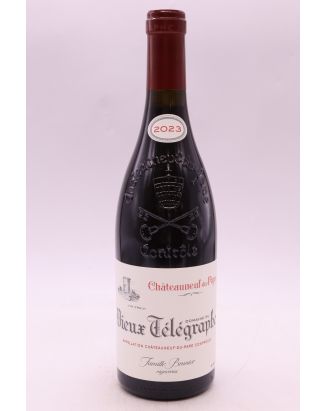
Vieux Télégraphe 2023
18 in stock
126550
Red
75cl
Add to cart
Rhône | Châteauneuf du Pape

Vieux Télégraphe 2023

€78.00 inc-VAT per bottle
€65.00 ex-VAT
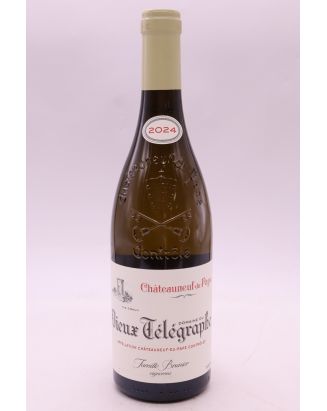
Vieux Télégraphe 2024 blanc
1 in stock
126551
White
75cl
Add to cart
Rhône | Châteauneuf du Pape

Vieux Télégraphe 2024 White

€66.00 inc-VAT per bottle
€55.00 ex-VAT
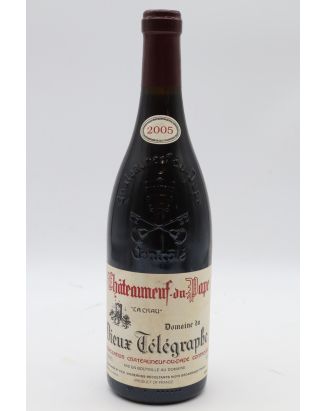
Vieux Télégraphe 2005
6 in stock
129483
Red
75cl
95/100
95/100
18/20
16.5/20
Add to cart
Rhône | Châteauneuf du Pape

Vieux Télégraphe 2005

€108.00 inc-VAT per bottle
€90.00 ex-VAT
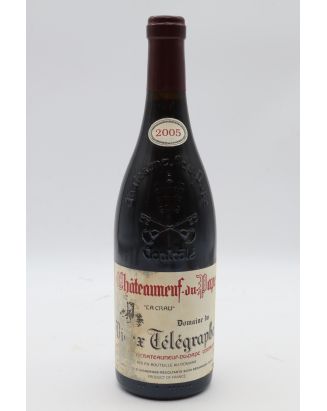
Vieux Télégraphe 2005 - PROMO -5% !
-5%
1 in stock
129484
Red
75cl
Slightly Damaged
95/100
95/100
18/20
16.5/20
Add to cart
Rhône | Châteauneuf du Pape

Vieux Télégraphe 2005 - PROMO -5% !

€102.60 inc-VAT per bottle €108.00 inc-VAT -5%
€85.50 ex-VAT

History of Domaine du Vieux Télégraphe

It all began in 1891, when Henri Brunier passed a few plots on the La Crau plateau to his son Hippolyte. The plateau was then considered almost impossible to cultivate because it was so densely covered in stones. Hippolyte planted his first vines there, on a plateau where vines had nevertheless grown as early as the 14th century and where Claude Chappe had erected one of his optical telegraph towers in 1821. Hippolyte’s son Jules would expand the estate to just under 50 acres and name the wine Vieux Télégraphe in tribute to that relic standing among the vines.

After World War II, fourth-generation Henri Brunier revived the estate, expanded it to roughly 125 contiguous acres and established an unmistakable style that he brought to the world’s leading markets. Since the very early 1980s, his sons Frédéric and Daniel have run the family business together: around 250 acres in Châteauneuf-du-Pape and 50 acres in IGP Vaucluse and AOC Ventoux. Two significant ventures followed in 1998: the purchase of Domaine Les Pallières in Gigondas with their friend, American importer Kermit Lynch, and the founding of Massaya in Lebanon’s Bekaa Valley with Sami and Ramzi Ghosn. In 2015 and 2016, Frédéric’s son Nicolas and Daniel’s son Édouard joined the business in key roles, followed by Frédéric’s daughter Manon in 2018. The sixth generation is in place, faithful to the original philosophy.

Terroirs and Vines of Domaine du Vieux Télégraphe

At the heart of the estate lies the La Crau plateau: roughly 170 contiguous acres rising to about 330 feet, entirely covered by a thick layer of rounded stones deposited by Alpine glaciers before the Rhône Valley formed. Beneath the stones, deep red clay and a subsoil of sand and sandstone allow the roots to reach far down and sustain the vines even through the driest summers. This rare combination, together with the mistral wind that keeps the vineyard healthy and abundant sunshine, produces powerful wines tempered by a distinctive stony minerality.

The family also cultivates other expressions of the appellation: Piedlong’s stony plateau north of the village and the sandier Pignan area, suited to finer, more fragrant wines, as well as Clos la Roquète, a small five-acre plot of sandy soils devoted to white grape varieties. The vines are often more than sixty years old on average, with Grenache predominating alongside Mourvèdre, Syrah, Cinsault and the appellation’s lesser-known varieties. Beyond Châteauneuf-du-Pape, the Bruniers work the foothills of Mont Ventoux for the Mégaphone and Pigeoulet cuvées, and the cool, steep hillsides of Les Pallières in Gigondas, where the limestone of the Dentelles de Montmirail lends tension and freshness. Throughout, vineyard practices are thoughtful and respectful, with plowing, hand-harvesting and controlled yields.

Winemaking at Domaine du Vieux Télégraphe

The cellar, carved into the rock at Bédarrides, embodies the house philosophy: nothing showy, just precision. The grapes are hand-harvested and sorted, then destemmed little or not at all, depending on the vintage, preserving freshness and structure. Fermentation takes place with native yeasts in concrete or wooden vats, with long macerations and gentle extraction, without any pursuit of excessive concentration.

Next comes aging, a hallmark of the estate: the reds spend a year or more in old oak foudres, large vessels that impart no oak flavor but allow slow micro-oxygenation, before a spell in concrete tanks brings the blend into harmony ahead of bottling. The whites are gently pressed and fermented partly in tanks and partly in barrels and 600-liter casks, then aged on fine lees to gain texture without losing their verve. This rejection of showy aging methods explains the wines’ character: rich and dense in their youth, sometimes austere, they need time to release their full energy. They come into their own after five to ten years and can often be cellared for more than two decades.

The cuvées of Domaine du Vieux Télégraphe

Châteauneuf-du-Pape Vieux Télégraphe La Crau rouge: The estate’s fine wine, made from the oldest vines on the La Crau plateau. Predominantly Grenache, complemented by Mourvèdre, Syrah and Cinsault, it is aged in old foudres before being blended in tanks. Deep in color, with aromas of black fruit, garrigue, leather, licorice and spice, it has a dense, structured, saline palate and refined tannins. An undisputed classic of the appellation that improves over twenty to thirty years.

Châteauneuf-du-Pape Vieux Télégraphe La Crau blanc: A blend of Clairette, Grenache Blanc, Bourboulenc and Roussanne, and one of the southern Rhône Valley’s most renowned whites. Full-bodied and textured, it reveals white flowers, stone fruit, fennel and almond, with a lingering mineral finish. Known for its remarkable evolution, it develops greater truffle and honey complexity after around ten years in the cellar.

Châteauneuf-du-Pape Télégramme: The estate’s second wine, made from vines under thirty years old and plots outside the La Crau and Piedlong plateaus. Predominantly Grenache, with Syrah, Mourvèdre and Cinsault, it is aged first in tanks and then in foudres. Supple, round and generous, with ripe red fruit and sweet spice notes, it is a pleasure to drink while young.

Châteauneuf-du-Pape Piedlong: Produced since the 2011 vintage, this cuvée combines old-vine Grenache from Piedlong’s stony plateau with Mourvèdre from the sandy Pignan area. More ethereal and floral than La Crau, it favors finesse, freshness and a velvety texture shot through with appealing minerality. A highly elegant Châteauneuf-du-Pape to open after five years.

Châteauneuf-du-Pape Clos Roquète blanc: From a five-acre plot at Domaine La Roquète, acquired in 1986 and replanted with white grape varieties, this rare cuvée combines Grenache Blanc, Roussanne and Clairette in roughly equal proportions. Sandy soils lend it finesse and freshness, while aging on the lees in barrels and 600-liter casks adds body and complexity. A food-friendly white produced in very small quantities.

Vieux Marc de Châteauneuf-du-Pape: A pomace brandy distilled from the estate’s grape pomace and aged for an extended period in old barrels. Amber-colored and fragrant, with dried fruit and spice notes, it extends the tasting experience at the end of a meal and carries on a Provençal tradition.

Gigondas Les Pallières Terrasse du Diable: From the highest limestone terraces of Domaine des Pallières, acquired in 1998 with Kermit Lynch, this cuvée emphasizes freshness and a sense of lift. Predominantly Grenache, it offers aromas of black cherry, garrigue and pepper, with a taut, mineral palate. A strikingly poised Gigondas, quite different from the appellation’s sun-drenched styles.

Gigondas Les Pallières Les Racines: From the estate’s oldest vines, planted in its deepest soils, this cuvée offers greater density and body. Preserved black fruit, spices, undergrowth notes and supple tannins make for a generous, profound Gigondas built to age for ten to fifteen years.

Les Pallières Au Petit Bonheur: A pale wine made from pressed red grapes, this food-friendly rosé comes from the same steep Gigondas hillsides. Pale in color, with aromas of red berries and citrus and a vinous, saline palate, it is far more than a summer rosé: a wine for the table in its own right.

Ventoux Mégaphone: From plots on the foothills of Mont Ventoux, this cuvée blends mainly Grenache and Syrah grown in cooler soils at higher elevations. Its fruit is vibrant and its palate supple and easy-drinking, with a hint of pepper. Excellent value for discovering the Brunier style.

Le Pigeoulet rouge: Made from plots at the foot of Mont Ventoux and on the Rhône’s left bank, this cuvée blends a large majority of Grenache with Syrah, Carignan and Cinsault, and is aged for around twelve months in foudres. Fruity, spicy and supple, it can be enjoyed slightly chilled right away with Mediterranean cuisine.

Le Pigeoulet blanc: The white counterpart to the cuvée, a blend of fresh, floral southern grape varieties with notes of citrus, white flowers and white-fleshed fruit. Lively, light and refreshing, it pairs beautifully with appetizers, grilled fish and goat cheese.

The wines of Massaya (Lebanon): Founded in 1998 with brothers Sami and Ramzi Ghosn in the Bekaa Valley, this sister winery rounds out the Brunier family’s range. Its wines include Le Colombier, a fruity, spicy red; the more structured, age-worthy Terrasses de Baalbeck and Cap Est; and a Mediterranean white and rosé. There is also Arak el Massaya, a traditional anise-flavored spirit distilled from local grapes.

WHAT THEY SAY ABOUT US

5 good reasons to buy wines on V&M

...

EXPRESS DELIVERY

In a secure polystyrene packaging

...

INTERNATIONAL SHIPPING

Find out more about VAT-EX sale for outside EU deliveries

...

COLLECTION NEAR PARIS & VAT REFUND FOR TOURISTS

Free collection in our warehouse near central Paris (92)

...