Personalise your experience
Change your country, language and currency here whenever you wish.
|
|
|
Must-See Châteaux |
|
|
|
|
|
|
|
|
Domaine Charles Joguet in the Loire: great wines from Chinon
Based in Sazilly on the left bank of the Vienne, Domaine Charles Joguet is one of the great names of the Chinon appellation and the entire Loire Valley. Founded in 1957 by a painter and sculptor who became a winemaker, it pioneered single-vineyard winemaking in Touraine at a time when Cabernet Franc was still sold to négociants. Today, across approximately 35 hectares certified organic, the estate produces a full range of cuvées, from fruit-forward reds to enjoy young to celebrated clos wines made for very long aging, along with rare Chenin whites and a food-friendly rosé.
In 1957, Charles Joguet gave up a promising artistic career to take over his family’s property in Sazilly, where some vines date back to 1830. Inspired by Burgundian practices, he overturned Chinon’s conventions by vinifying each parcel separately, convinced that different terroirs called for different approaches to winemaking. A tireless experimenter, he developed the first stainless steel tanks equipped for punch-downs. Between 1962 and 1976, the vineyards expanded with plantings at La Cure and Les Varennes du Grand Clos on the left bank, followed by the acquisition of Clos du Chêne Vert on the right bank.
In 1985, the Genet family became partners in the estate, adding eleven hectares (Silènes, Clos Monplaisir), before purchasing a large 15th-century tuffeau limestone cellar for aging the wines in 1989. Charles Joguet retired in 1997 to devote himself to painting, leaving Jacques Genet to carry on the work he had begun. In 2006, Kevin Fontaine (vineyard and winemaking) and Anne-Charlotte Genet joined the team and began the conversion to organic farming, culminating in certification in 2016.
The vineyards extend over more than twenty-five kilometers and encompass a cross-section of the appellation’s soils: sandy terraces and Vienne alluvium, gravel over clay, siliceous clay and siliceous limestone, and slopes of flinty clay and tuffeau limestone. Cabernet Franc, locally known as Breton, occupies almost the entire area, complemented by more than three hectares of Chenin planted between 1994 and 1999. In 2006, the estate made a decisive choice in favor of quality, selling six hectares of sandy land to acquire an equal area of clay-limestone soils.
Exposures range from the full-south aspect of Clos Monplaisir to the northeast-facing Clos de la Dioterie, whose cooler orientation extends ripening and preserves the wines’ tension. Farmed organically since 2016, the vines benefit from renewed soil cultivation, the complete abandonment of pesticides, cover crops and hedgerows that support biodiversity. Yields are deliberately low, at 25 to 40 hectoliters per hectare, and grapes are harvested by hand into small crates, with sorting first in the vineyard and then again at the winery.
For the reds, each terroir goes into a separate tank. Around ten days of cold pre-fermentation maceration at approximately 10°C precede four weeks of vatting below 21°C, with pump-overs and punch-downs tailored to each cuvée. Free-run wine and the best press wine are blended as soon as alcoholic fermentation ends. Malolactic fermentation takes place in tanks for Silènes and Les Petites Roches, and in barrels for La Cure, Les Charmes, Les Varennes du Grand Clos, Clos Monplaisir, Clos du Chêne Vert and Clos de la Dioterie.
Aging is long and understated, taking place in the 15th-century tuffeau limestone cellar. Some barrels are replaced each year, with a preference for larger vessels so that oak never dominates the wine. The whites are harvested in several successive passes, pressed in a pneumatic press and then fermented slowly in barrels in a very cool cellar, with lees stirring, before final blending in stainless steel tanks. The rosé, from the first parcel harvested, is direct-pressed and aged for three months in stainless steel, without malolactic fermentation, to preserve its crispness.
Silènes (red Chinon): a blend of parcels on the appellation’s sandy alluvial terraces. Here Cabernet Franc produces an inviting, floral wine bursting with red fruit, supple and easy to enjoy young with charcuterie or grilled food.
Les Petites Roches (red Chinon): formerly Cuvée Jeunes Vignes, renamed to evoke the gravelly terroirs and their limestone bedrock. Clay slopes and plateaus with moderate limestone content, an average yield of 45 hectoliters per hectare, and exclusively free-run wine for purity. Aromas of crushed strawberry and raspberry, a fine mineral structure; enjoy within five years of the vintage.
Cuvée Terroir (red Chinon): a blend from several sites, with vines averaging around thirty years old. This signature cuvée on export markets, served even in Master of Wine tasting exams, is textbook Chinon: violet, rose petal, raspberry, moderate tannins and a lively finish.
La Cure (red Chinon): two hectares planted in 1974 on gravel over clay, corresponding to the Vienne’s upper alluvial terraces, just in front of the church in Sazilly. Five days of cold skin maceration, more than fifteen days of vatting, malolactic fermentation and twelve months of barrel aging. A balanced, saline wine for medium-term cellaring, at its peak between three and six years.
Les Charmes (red Chinon): a parcel selection from the heights of Anché on the left bank of the Vienne, from north-facing clay-limestone soils planted with vines around thirty-five years old. Vinified in wooden vats and then aged for several months in French oak barrels, it is floral, focused and crisp, with silky tannins and a peppery finish. A rarely seductive Chinon for medium-term cellaring.
Les Varennes du Grand Clos (red Chinon): four and a half hectares in Sazilly, planted between 1962 and 1976 at the foot of the gravel terrace on siliceous clay and siliceous limestone soils, yielding forty hectoliters per hectare. Aged for fifteen to sixteen months in barrels, some of which are replaced, then six months in tanks. Black fruit, mineral tension and fine tannins: a wine for long-term cellaring that already charms with its elegance.
Clos du Chêne Vert (red Chinon): two hectares of very steep southwest-facing slopes at the site known as La Haute Olive, in the heart of Chinon’s historic vineyards, on clay-limestone and flinty clay. This classic terroir produces a wine of rare intensity and focus, with refined tannins and even more tension than La Dioterie. An exceptional cru to cellar for several years.
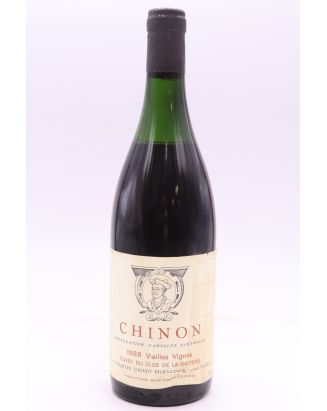
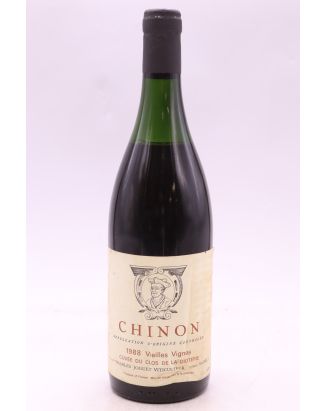
Clos de la Dioterie (red Chinon): the estate’s flagship, a historic enclosed vineyard of just over two hectares beside the winery, planted with seventy- to eighty-year-old vines on highly calcareous clay facing northeast. The last parcel harvested to reach full ripeness, it produces a concentrated, profound wine with an elegant structure and smoky, licorice and menthol notes, destined for very long cellaring.
Clos Monplaisir (red Chinon): a small-production cuvée from a parcel contributed by the Genet family, planted in 1979 and facing due south with sweeping views of the Vienne. Yields are very limited, at around twenty hectoliters per hectare. Malolactic fermentation and barrel aging produce a dense, profound wine that fully reveals itself after around fifteen years in great vintages.
Les Varennes du Grand Clos Franc de Pied (red Chinon): the rarest of the small-production cuvées, made from approximately one hectare of ungrafted vines within Les Varennes, before phylloxera took its toll on them. Distinctive aromatic intensity, mellow tannins and the patina of old vintages: a highly sought-after collector’s bottle.
Rosé (Chinon rosé): from an alluvial parcel dedicated to this cuvée each year and the first on the estate to be harvested. Direct pressing, followed by fermentation and three months of aging in stainless steel tanks, without malolactic fermentation. The result is a crisp, floral and taut Cabernet Franc rosé, equally at home as an aperitif or at the table.
Les Petites Roches Blanc (white Chinon): a finely etched Chenin with aromas of lemon, green apple and pear, accented by chamomile and broom blossom. The palate is brightly fresh, with crisp acidity, vivid minerality and a persistent saline finish. A precise white, perfect with shellfish and river fish.
Les Charmes Blanc (white Chinon): more than two hectares of Chenin on the clay-limestone heights of Anché, yielding thirty-five hectoliters per hectare or less and harvested in successive passes. Pneumatic pressing, vinification in 225-liter barrels (one-third new), very slow fermentation in a cool cellar with lees stirring, then four to six months of aging. Spiced apple, dried pear, white flowers and wet stone over a deep mineral structure.
Clos de la Plante Martin (dry white): the estate’s historic white cuvée, made from Chenin planted between 1994 and 1999, with very low yields. Vinified and fermented in 600-liter barrels, it ages for eight months in barrels and then ten months in stainless steel tanks before bottling. Focused, finely etched and saline, it benefits greatly from a few years in bottle.
Nectar de la Plante Martin (sweet white): made from a second pass through the Chenin vines to pick only botrytized berries, making it rarer still. Produced in tiny quantities and only in favorable vintages, this wine combines rich candied-fruit notes, apricot and honey with acidity that keeps it balanced.
Gourmandise de la Plante Martin (white): another small-production cuvée from the same Chenin parcel, softer and fruitier in style than Nectar. Delicate sweetness, ripe white fruit and Loire freshness make it a wine for the end of a meal or a pairing with foie gras and blue cheeses.
COLLECTION NEAR PARIS & VAT REFUND FOR TOURISTS
Free collection in our warehouse near central Paris (92)