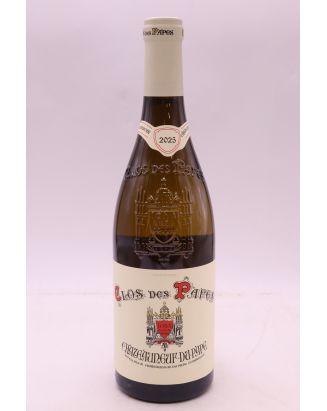
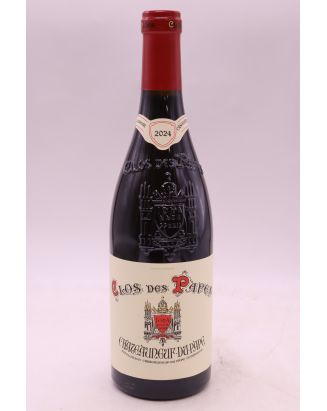
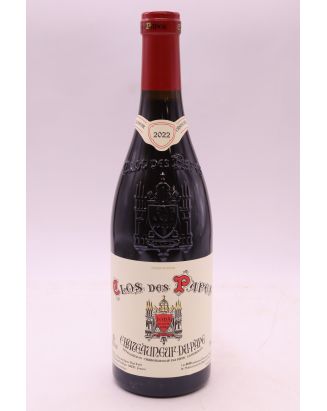
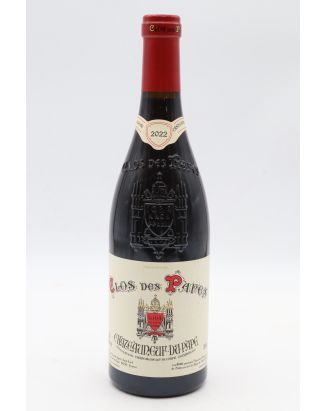
Clos des Papes 2024 blanc
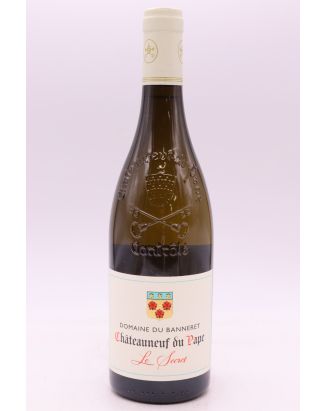
Domaine du Banneret Châteauneuf du Pape Le Secret 2023 blanc
Personalise your experience
Change your country, language and currency here whenever you wish.
|
|
|
Must-See Châteaux |
|
|
|
|
|
|
|
|
Domaine Clos des Papes extends over 32 hectares in the Southern Rhône Valley: 29 hectares in red and 3 hectares in white. The vines are very well distributed across the finest sectors: 7 hectares are located on La Crau, for example. This estate has belonged to the AVRIL family for several generations, even though the original plot of the estate once belonged to the château de Châteauneuf-du-Pape. After the phylloxera crisis, the Avril family developed estate bottling of their wines from the early 20th century onwards, and they played a major role in the creation of the AOC in 1936.
The history of Clos des Papes is closely intertwined with that of the Avril family, who have grown grapes in Châteauneuf-du-Pape since the 17th century. Archives attest to vines on the estate as early as that period, with roots reaching back to the 14th century, when the popes of Avignon had white wines from the region brought to their palace. In the 19th century, the vineyard was devastated by phylloxera in 1865, leading to the temporary planting of fruit trees such as cherry trees before the vines were gradually reestablished through grafting.
In 1896, Paul-Eugène Avril marked a turning point by selling his Mourvèdre wine under the name Clos des Papes. He registered the name in 1902 and pioneered bottling in the 1910s. The family was influential in the community: an Avril even served as the town's first consul in 1756. The family played a key role in the creation of the Châteauneuf-du-Pape appellation in 1935, France's first AOC. In 1954, Régis Avril introduced a white “Mass wine,” which accounted for 10% of the vineyard. Paul Avril took the reins in 1963, following training in Burgundy that inspired a pursuit of elegance in the wines. His son Paul-Vincent joined in 1987 after gaining international experience, from Mouton Rothschild to Australia, and continues the family legacy with 36 vintages to his name. Under his leadership, the estate has expanded into terroirs such as La Crau and Canto while maintaining an unchanged philosophy: just one cuvée of each color, offering a complete expression of the appellation.
Clos des Papes spans a mosaic of 24 to 30 plots covering around 35 hectares, including 3 to 4 hectares devoted to white grape varieties. This fragmentation is a major asset, offering a diversity of terroirs that reflects the full richness of Châteauneuf-du-Pape: stony soils with rounded pebbles that retain welcome warmth, fine sands for finesse, clay for structure and limestone plateaus for minerality. Exposures range from the cool north to sunny southern slopes, allowing precise control over grape ripeness. The original plot, nestled at the foot of the papal castle and enclosed by walls (hence the name “Clos”), offers a living lesson in its terraces planted with every permitted grape variety.
The vines, often described as century-old (up to 80 years old), are organically farmed, with massal selection used to renew 50 ares each year. Yields are sharply limited (18 to 25 hl/ha, versus the permitted 35) through bud thinning, green harvesting and natural ground cover. Grenache (65% of the red blend) thrives on cooler soils that preserve its freshness, Syrah on poor, stony soils, and Mourvèdre on rich clay. For the whites, less free-draining plots prevent water stress, preserving acidity and balance through scorching summers. This exceptional terroir, analyzed every two years and enriched with organic fertilizers (cow and sheep manure and seaweed), produces distinctive, complex wines made with respect for the environment.
Winemaking at Clos des Papes combines Burgundian tradition with Rhône Valley expertise, favoring balance over extraction. Hand harvesting is staggered by plot, with meticulous sorting in the vineyard, in the harvest bins, on the truck and on a sorting conveyor at the winery entrance. Since 1991, the red grapes have been 100% destemmed and moved by gravity into tiled concrete vats. Natural fermentations, started with indigenous yeast cultures, take place at 30–32°C with moderate pump-overs (two a day). Month-long macerations bring out silky tannins without excess.
After the wine is drawn off the skins, it rests through the winter before malolactic fermentation, then ages for 15–18 months in neutral large oak casks (20–55 hl, some a century old). New oak is avoided to prevent any overt oak character; a new cask is first broken in with table wine. There has been no filtration since 1988, though the wines undergo light fining and natural tartrate precipitation. For the whites, the grapes are pressed whole and cold-settled, then fermented in stainless steel at 21°C without malolactic fermentation to preserve freshness and fine lees. They age for 5–6 months without lees stirring. Everything is co-fermented for seamless harmony in a modern underground cellar. This approach, without enzymes or acidification, produces vibrant, appetizing wines with rare longevity.
Clos des Papes eschews the fashion for single-plot cuvées, choosing instead two iconic cuvées that capture the appellation: a red and a white, drawing on all 13 permitted grape varieties between them (12 for the red, 6 for the white). Produced in limited quantities, these wines are pure expressions of the estate.
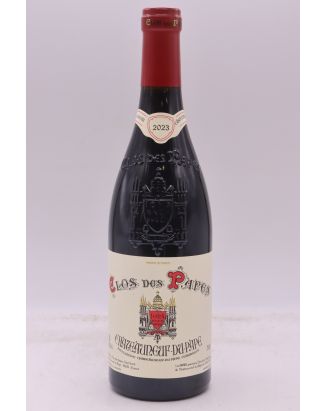
Châteauneuf-du-Pape Rouge: The signature blend is 65% Grenache for ripe fruit and roundness, 20% Mourvèdre for spicy structure and acidity, 10% Syrah for smoky and balsamic notes, and 5% other varieties (Counoise, Vaccarèse, Muscardin, etc.) for complexity. Made from low-yielding old vines, this wine has a powerful yet velvety structure, fine tannins and a saline finish. In its youth, it delights with concentrated fruit (black cherry, raspberry, kirsch) and Asian spices; after 6–7 years, the Grenache develops leather and garrigue notes, reaching its peak at 10–15 years and aging for 20 years or more. Standout vintages such as 2005 (named the world's best red wine by Wine Spectator), 2007 (100/100 from Parker) and 2016 (97–100/100) attest to its consistency. Decant younger vintages and serve at 14–15°C to enjoy their fascinating evolution in the glass.
Châteauneuf-du-Pape Blanc: A balanced blend of six grape varieties (Grenache Blanc, Roussanne, Clairette, Bourboulenc, Picpoul and Picardan, listed at 20% each), co-fermented in two batches (early- and late-ripening) for tension and texture. With neither malolactic fermentation nor oak, it shines with chalky minerality, floral citrus and crushed-stone notes, developing honey and dried flowers after 3–8 years, then toasted nuts in a Meursault-like phase at 10 years. Made in very limited quantities, it combines generous richness with saline freshness and can age for 10–20 years. A precious, food-friendly and underrated Rhône white.
A red table wine, “Le petit vin d'Avril,” made from young or declassified vines, rounds out the range with its easy-drinking fruitiness. It is aged for two years in large oak casks.
Choose these rare cuvées that transcend vintages, offering pleasures that evolve for decades. Order now and become part of the Châteauneuf-du-Pape legend! Explore other estates in the Châteauneuf-du-Pape appellation, such as Beaucastel, Beaurenard, Charvin, Clos du Mont Olivet, Clos Saint Jean, the iconic Henri Bonneau, as well as La Janasse, Jérôme Gradassi, Domaine de Marcoux, Pegau, Tardieu Laurent, Vieux Télégraphe and more at Vins & Millésimes, where you can buy the finest bottles of wine and grands crus online. All our wines are in stock and available for fast delivery! Discover the bottles and magnums of Clos des Papes available to buy!
COLLECTION NEAR PARIS & VAT REFUND FOR TOURISTS
Free collection in our warehouse near central Paris (92)