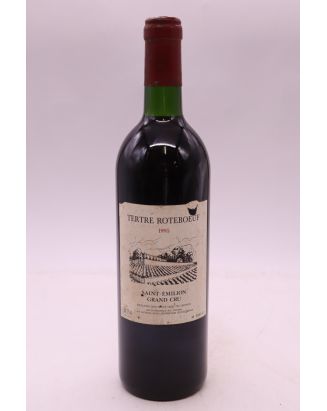
Tertre Roteboeuf 1993
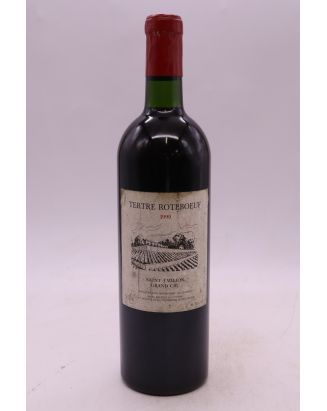
Tertre Roteboeuf 1999 - PROMO -5% !
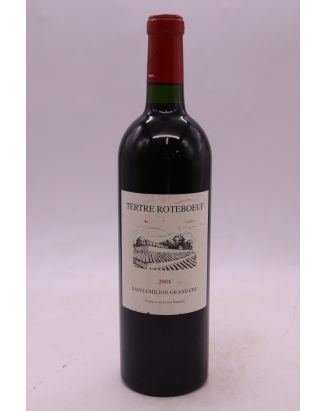
Tertre Roteboeuf 2005
Personalise your experience
Change your country, language and currency here whenever you wish.
|
|
|
Must-See Châteaux |
|
|
|
|
|
|
Appellation d'origine contrôlée and Grand Cru at Saint-Emilion
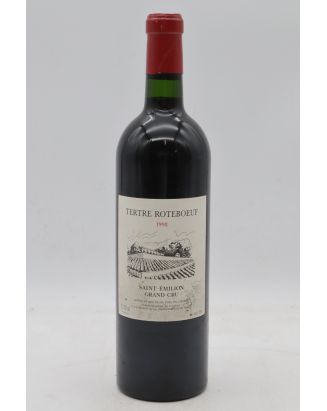
Neighboring the domaine de Larcis Ducasse, Château Tertre Rotebœuf is an unclassified Grand Cru of Saint-Emilion, certainly by conviction of the owner, François Mitjaville, as it would deserve to be counted among the finest of its appellation. Located 35 km east of Bordeaux, the 5.7 hectares of vines are rooted in clay soil typical of the southern slopes of Saint-Emilion, planted at approximately 6,500 vines/ha. With an average age of over 40 years, the vineyard is managed using sustainable practices and is composed of 85% Merlot and 15% Cabernet Franc. The Tertre Rotebœuf domaine de therefore produces no white wines...
The name of the estate already tells the story of its terroir: on this very steep hillside, the oxen that pulled the plough would belch and puff as they climbed the knoll. Long simply called Le Tertre, the property belonged to the family of Miloute, Émilie by first name, who married François Mitjavile. He was not born into the vine: it was in 1975, working alongside Thierry Manoncourt at Château Figeac, that he learned the trade and discovered his calling.
In the late 1970s, the couple took over the family estate and François Mitjavile renamed it Tertre Roteboeuf at the beginning of the following decade. His objective was clear: to produce a wine of very low yields, from grapes harvested at extreme ripeness and elevated by an ambitious aging process. The success was meteoric. Within a few vintages, this tiny estate without any official classification, whose owner refuses to submit to the Saint-Émilion classification, rivalled the Premiers Grands Crus Classés and became a cult wine sought after around the world. The family grew and the expertise was passed on: Nina now runs Château Roc de Cambes and the Domaine de Cambes, while Louis and his wife Caroline acquired Château Cadet in 2007, renamed L'Aurage in 2009, in the Côtes de Castillon.
The vineyard extends over approximately six hectares, of which 5.7 are in production, arranged in an amphitheatre on the clay-limestone slopes of Saint-Laurent-des-Combes, in the Côtes de Saint-Émilion sector, close to Château Pavie. The south-southeast exposure is ideal and the gradient ensures perfect natural drainage. The subsoil combines four types of clay resting on a limestone bedrock, a combination typical of the great hillside terroirs described as cold soil: the clay takes a long time to warm up and the limestone always remains cool and moist.
This particularity explains the entire style of the estate. The grapes can benefit from sunshine very late in the season and reach perfect ripeness well after other properties, what François Mitjavile calls the sumptuous degradation. The grape varieties comprise 80 to 85% Merlot and 15 to 20% Cabernet Franc, with Merlots of around forty years old and even older Cabernet Francs. The vines are trained very low, in double cordon, an obsession of the winemaker intended to capture the heat returned by the soil. Planting density reaches 6,000 to 7,000 vines per hectare, grass cover is maintained and yields are deliberately limited to a maximum of 36 hectolitres per hectare, resulting in a production of approximately 27,000 bottles per year.
The harvest is manual and always very late, the estate often being one of the last in the appellation to pick. Several vintages could, without exaggeration, have carried the mention late harvest. The grapes arrive at the winery at full phenolic ripeness and ferment in temperature-controlled concrete vats, without any added yeasts or refrigeration, in a deliberately minimalist approach. Vatting is long in order to gently extract the full richness of the material.
Then comes the step that defines the estate's signature: an aging of eighteen to twenty-four months in entirely new barrels, specially crafted by the Radoux cooperage with a wood grain and toast level defined for the property. This generous oak influence, very present in the wine's youth, integrates with time and gives Tertre Roteboeuf its intense, smoky and spiced nose, as well as its opulent and velvety texture. There is no second wine, no reserve cuvée: all the harvest worthy of the name goes into the fine wine, which remains extremely rare in Bordeaux.
Château Tertre Roteboeuf, Saint-Émilion Grand Cru: the estate's sole wine, a blend of 80 to 85% Merlot and 15 to 20% Cabernet Franc, aged entirely in new barrels. A deeply sustained purple robe, a flamboyant nose of black raspberry, blackcurrant, flowers, liquorice, smoked tobacco, cedar and spices, an opulent, sensual and deeply layered palate that coats the mouth and extends to an impressive length. Powerful without heaviness thanks to the freshness of the limestone soil, it generally requires a few years of cellaring and can be kept for several decades.
COLLECTION NEAR PARIS & VAT REFUND FOR TOURISTS
Free collection in our warehouse near central Paris (92)