Personalise your experience
Change your country, language and currency here whenever you wish.
|
|
|
Must-See Châteaux |
|
|
|
|
|
|
Constantly evolving in terms of precision and consistency - Fifth Grand Cru Classé
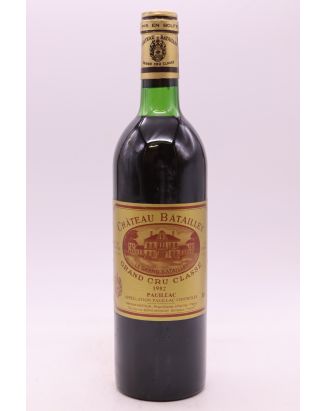
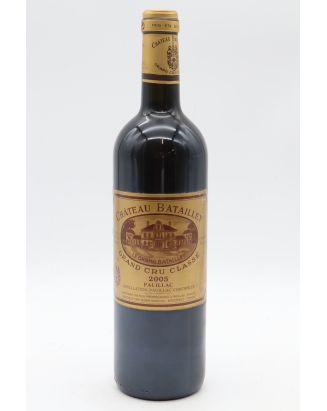
Château Batailley, located in the heart of the Pauillac appellation, is one of the oldest and most prestigious wine estates in the Médoc. Classified as a Fifth Grand Cru in the famous 1855 classification, this historic estate spans 60 hectares and produces wines of exceptional quality, renowned for their elegance and outstanding ageing potential. The richness of its terroir, combined with ancestral expertise, makes Château Batailley an essential destination for lovers of great Bordeaux wines.
The name "Château Batailley" has its origins in a landmark event in French history: the battle that took place in 1453 on the estate's lands, marking the end of the Hundred Years' War and the reconquest of the neighbouring Château Latour by the French. This historical connection lends the estate a particular aura, rooted in collective memory.
The first vines at Château Batailley were planted as early as the 17th century, but it was in the 18th century that the estate truly came into its own, when it was acquired by the Saint-Martin family. In 1791, the two Saint-Martin sisters sold their shares to Guillaume Pécholier, a Bordeaux wine merchant who would play a key role in the development of the vineyard. However, it was Daniel Guestier, a member of the renowned négociant house Barton & Guestier, who truly modernised the estate after acquiring it in 1816. He expanded the vineyard, improved the quality of the wines, and established Château Batailley as a major player in the Médoc.
In 1855, thanks to Daniel Guestier's efforts, Château Batailley was classified as a Cinquième Grand Cru, a distinction that sealed its reputation in the world of wine. Over the generations, the estate passed through the hands of several influential families, including the Halphens and the Bories. Today, Château Batailley belongs to the Castéja family, who, under the leadership of Philippe Castéja, perpetuate the tradition of viticultural excellence.
Robert Parker awarded a score of 95/100 to the 1959 and 1949 vintages of Château Batailley, reflecting the robustness and character of these Pauillac wines.
The vineyard of Château Batailley benefits from an exceptional situation within the Pauillac appellation, on the left bank of the Gironde, at the heart of the Médoc. The proximity to the Gironde estuary provides a particularly favourable oceanic microclimate for vine cultivation, protecting the vines from temperature extremes and frost.
The estate covers 60 hectares, divided into several blocks, which are themselves subdivided into 60 distinct plots. The vineyard soil is primarily composed of deep ancient Günz gravel, with layers of silica and sand, ensuring excellent natural drainage. These characteristics allow Château Batailley to produce rich and powerful wines, marked by aromas of black fruit and spiced notes.
The estate's grape variety composition reflects the typicity of the Pauillac appellation, with a predominance of Cabernet Sauvignon (70%), followed by Merlot (25%), Cabernet Franc (3%) and Petit Verdot (2%). The vines, with an average age of 40 years, are planted at a high density of 8,500 vines per hectare, encouraging low yields per vine and optimal concentration of aromas in the grapes.
Château Batailley applies the principles of sustainable viticulture, aiming to minimise environmental impact while maximising wine quality. The estate is also certified Haute Valeur Environnementale (HVE) at level 3, attesting to its ongoing commitment to sustainable development.
The winemaking at Château Batailley combines tradition and modernity. Each plot is harvested by hand once the grapes have reached full ripeness, ensuring optimal quality. Once harvested, the grapes undergo a double sorting: first in the vineyard, then in the cellar, where they are destemmed and crushed before being placed in temperature-controlled stainless steel vats with a capacity of 100 to 130 hectolitres.
Alcoholic fermentation takes place at low temperature (24 to 26°C), allowing fruity aromas to be preserved and ensuring a gentle extraction of tannins. This is followed by a hot post-fermentation maceration (30 to 32°C) to refine the tannins and add complexity to the wine.
Malolactic fermentation, which transforms malic acid into lactic acid to soften the wine, takes place in both tanks and barrels. The winemaking process lasts between 20 and 25 days, after which the wines are aged in French oak barrels for a minimum of 12 months.
Each year, 60% of the barrels used are new, lending the wine subtle aromas of vanilla and toast. Every 3 to 4 months, a racking is carried out to clarify the wine and refine its profile. Before bottling, the wines are clarified using fresh egg whites, a traditional method that contributes to their brilliance and purity.
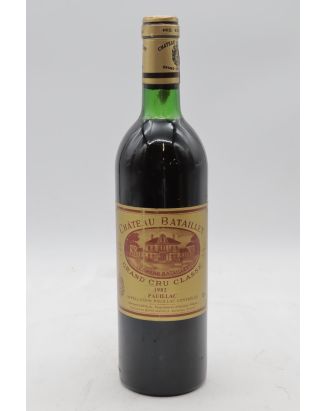
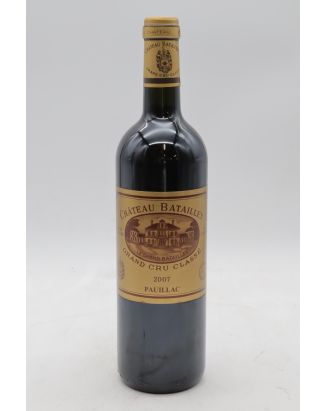
Château Batailley - 1st wine
The first wine of Château Batailley, classified as a Cinquième Grand Cru since 1855, is the pure expression of the Pauillac appellation. It is distinguished by its deep ruby colour, its intense bouquet of black fruit and red fruit aromas, as well as its spiced notes. On the palate, this wine is well-structured, with fine tannins and pronounced flavours of blackcurrant. Its long finish and ageing potential make it a remarkable wine, capable of maturing for several decades.
Lions de Batailley - 2nd wine
The estate's second wine, Lions de Batailley, displays a beautiful garnet colour and an elegant bouquet of ripe fruit and spices. On the palate, it offers a fine structure, with silky tannins and indulgent notes of chocolate and coffee. Although more approachable in its youth than the first wine, it retains a beautiful complexity and a lingering finish.
Pauillac de Batailley - 3rd wine
The estate's third wine, Pauillac de Batailley, completes the range with a seductive profile and great finesse. It is distinguished by aromas of red fruit and graphite, a dense and elegant structure, and a fruit-forward finish. It is a harmonious wine, perfect for more immediate enjoyment, while still retaining a fine ageing potential.
Pauillac, one of the most prestigious appellations in the Médoc, is among the great wines of Bordeaux, with remarkable vintages that have made history. Among the finest vintages are those of 1975, 1982, 1985, 1986, 1989, and 1990, celebrated for their complexity and longevity. The years 1995, 1996, 2000, 2003, 2005 are also distinguished by their richness and power. More recently, the vintages 2008, 2009, 2010, 2012, 2014, 2015, 2016, 2017, 2018, 2019, and 2020 have confirmed the exceptional potential of Pauillac, offering wines that are both elegant and powerful, perfect for extended cellaring.
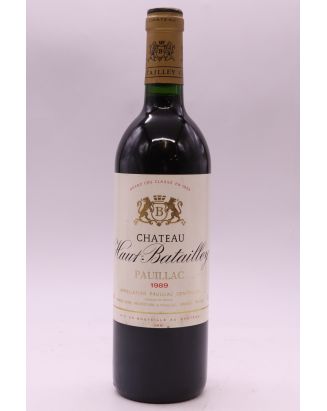
The Fifth Grands Crus Classés offer a fine diversity of estates in the Médoc, bearing witness to Bordeaux's winemaking expertise. In Pauillac, one finds renowned estates such as Château d'Armailhac, Château Batailley, Château Clerc Milon, Château Croizet-Bages, Château Grand-Puy Ducasse, Château Grand-Puy-Lacoste, Château Haut-Bages Libéral, Château Haut-Batailley, Château Lynch-Bages, Château Lynch-Moussas, Château Pedesclaux, and Château Pontet-Canet. In the Haut-Médoc, Château Camensac and Château Cantemerle stand out for their own distinct characteristics. In Margaux, Château Dauzac and Château du Tertre add a touch of elegance, while Château Cos Labory from Saint-Estèphe completes this prestigious selection. Each of these estates reflects a unique facet of the Bordeaux terroir.
Château Batailley is one of the jewels of the Pauillac appellation, and one of the flagship estates of the Castéja family. Thanks to its exceptional terroir, its winemaking methods combining tradition and modernity, and its commitment to sustainable viticulture, this estate produces wines of remarkable consistency, recognised for their finesse and ageing potential.
COLLECTION NEAR PARIS & VAT REFUND FOR TOURISTS
Free collection in our warehouse near central Paris (92)