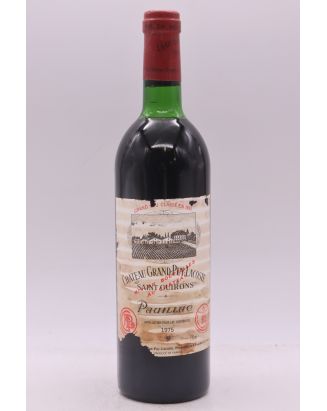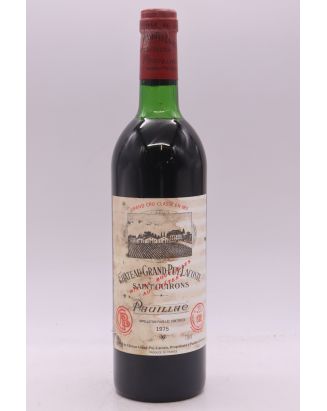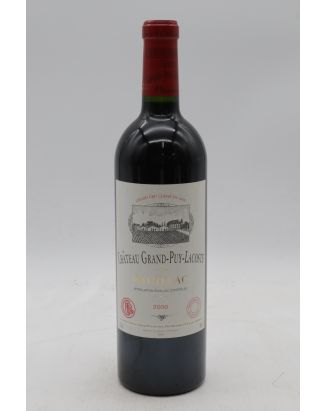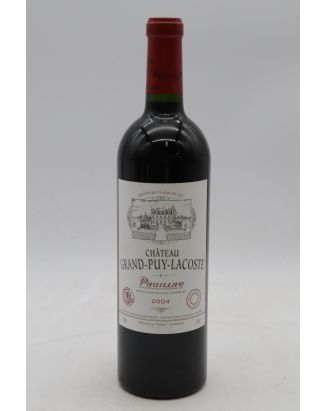
Grand Puy Lacoste 1975 -10% DISCOUNT !
Personalise your experience
Change your country, language and currency here whenever you wish.
|
|
|
Must-See Châteaux |
|
|
|
|
|
|
A château of great consistency - Fifth Grand Cru Classé
Located at the heart of the Pauillac appellation, Château Grand-Puy-Lacoste is an essential reference among the Grand Crus of the Médoc. For centuries, this historic estate has produced wines of exceptional quality, combining elegance, power and longevity. Building on its rich heritage, Château Grand-Puy-Lacoste continues to captivate wine lovers from around the world, thanks to its unique terroir and rigorous expertise.
Château Grand-Puy Lacoste was classified as a 5th Grand Cru Classé in the classification of Médoc wines in 1855, a rank it retains to this day. This status, obtained on the occasion of the Universal Exhibition commissioned by Napoleon III, confirms the estate's historic reputation among the great references of the Pauillac appellation. Many experts indeed consider that the current quality of the wines far surpasses what this classification might suggest.
The Grand-Puy plateau rises to the west of the village of Pauillac, twenty metres above sea level. There one finds a gravelly soil of alluvial pebbles renowned for ensuring excellent water drainage. These alluvial pebbles, two million years old, are geological witnesses of the Quaternary era. This particular soil stores solar heat during the day and releases it to the vine at night, creating ideal conditions for the ripening of Cabernet Sauvignon.
Château Grand-Puy Lacoste is a wine designed for long ageing. These are wines that require at least ten years of ageing to fully reveal their potential. In great vintages, patience is particularly rewarded: as it ages, this wine develops more subtle aromas of undergrowth, leather and truffle, making each tasting a unique experience.
The estate is planted with 75% Cabernet Sauvignon, 20% Merlot and 5% Cabernet Franc. Cabernet Sauvignon is the noble grape variety par excellence, forming the backbone of Grand-Puy Lacoste's wines. The two other varieties allow the blends to be nuanced in order to accentuate the typicity of the cru. This classic Médoc grape composition is perfectly suited to the gravelly soils of Pauillac, which encourage the slow ripening of Cabernet Sauvignon.
Since 1978, the history of the château has been written by the Borie family. It was first Jean-Eugène Borie who ran the estate. Today, François-Xavier Borie manages the estate with his daughter Emeline Borie, ensuring the continuity and stability essential to the consistent quality of the Grand Cru Classé. Under their stewardship, the vineyard has been entirely rethought and the winemaking facilities modernised, elevating Grand-Puy Lacoste among the most reliable names in Pauillac.
Yes, the estate has been committed to a rigorous environmental approach for many years. Grand-Puy Lacoste practises sustainable viticulture with great conviction: over twenty years, treatments have been reduced by half. No insecticides have been used over the past ten years, and wildlife has reclaimed its place. Soil work has always been exclusively mechanical: ploughing, no herbicides, double Guyot pruning. These commitments are officially recognised: viticulture at Château Grand-Puy Lacoste is guided by a deep commitment to sustainability, attested by the Terra Vitis and HVE 3 (Haute Valeur Environnementale Level 3) certifications.
Château Grand-Puy-Lacoste traces its origins to the 16th century, when the de Guiraud family established its first vine plantings on the lands of Pauillac. As early as the 18th century, the estate was already distinguished for the quality of its wines. In 1855, on the occasion of the famous classification commissioned by Napoleon III, Grand-Puy-Lacoste was ranked as a Fifth Grand Cru, a distinction that confirmed its already well-established reputation.
Over the centuries, several families have succeeded one another at the helm of the estate, each contributing their own chapter to its story. The Lacoste family gave its name to the château following the acquisition of the estate by François Lacoste, who is also credited with the construction of the magnificent château that can be admired today.
The Dupin family, who took possession of the estate in 1932, also left a significant mark on the history of Château Grand-Puy-Lacoste. Raymond Dupin, a larger-than-life personality, maintained the prestige of the estate for several decades before ceding the Château in 1978 to the Borie family, already owners of Château Ducru-Beaucaillou.
Since this acquisition, the Borie family, led by François-Xavier Borie, has committed to a complete modernisation of the estate, both in the vineyards and in the facilities. Thanks to these constant investments and the expertise passed down from generation to generation, Château Grand-Puy-Lacoste continues to produce wines that wonderfully embody the greatness of the Pauillac appellation.
The 2005, 1982, 1949 and 2019 vintages of Château Grand-Puy-Lacoste received a score of 96/100 from Robert Parker, confirming the quality and longevity of this great Pauillac.
Château Grand-Puy-Lacoste benefits from an exceptional terroir on the left bank, typical of the Médoc, composed of deep gravel. This gravelly soil, rich in alluvial pebbles, ensures excellent water drainage while retaining the sun's heat and releasing it to the vine during the night. This process reduces thermal variations and promotes homogeneous ripening of the grapes, which is essential for producing wines of great finesse.
The estate's 55 hectares of vines are planted primarily on gravelly mounds, a distinctive relief that characterises the terroir of Pauillac. This type of soil is particularly favourable to Cabernet Sauvignon, the dominant variety on the estate, representing approximately 75% of the plantings. This late-ripening grape variety, well adapted to local conditions, benefits from the heat stored by the gravel to reach perfect maturity. Merlot (20%) and Cabernet Franc (5%) complete the blend, bringing complexity and roundness to the assemblages.
The vines, with an average age of 40 years, are cultivated with particular care. The planting density is high, with 10,000 vines per hectare, which forces each vine to draw deeply from the soil in order to thrive. This deep-rooting effort results in the production of concentrated grapes, balanced between sugar and acidity, yielding structured wines built for long aging.
Winemaking at Château Grand-Puy-Lacoste is built on a skilful blend of tradition and modernity. François-Xavier Borie had temperature-controlled stainless steel vats installed, enabling precise control over the fermentation of the grapes. These vats of varying sizes, adapted to the different plots of the estate, allow each batch to be vinified separately in order to preserve the identity of each terroir.
Malolactic fermentation, a process that softens wines by converting malic acid into lactic acid, takes place in these vats. After fermentation, the wines are aged in French oak barrels, of which approximately 75% are new each year. This crucial stage, lasting between 16 and 18 months depending on the vintage, allows the wine to refine and develop complex aromas while integrating the subtle tannins of the wood.
The care devoted to each stage of the winemaking process reflects the Borie family's commitment to producing wines of the highest quality, which faithfully express the unique terroir of Pauillac.
Château Grand-Puy-Lacoste
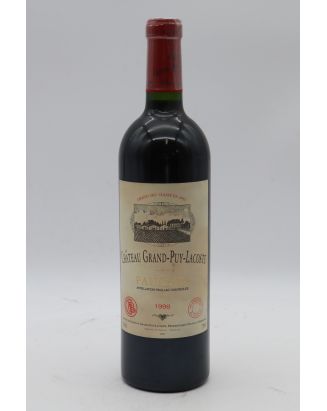
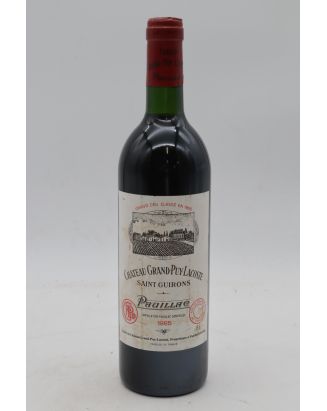
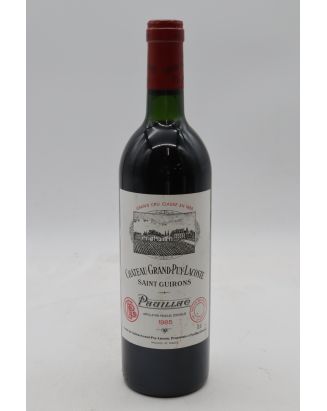
The estate's flagship wine, Château Grand-Puy-Lacoste, is a classic Pauillac, recognised for its solid structure, complex aromas and great aging capacity. Predominantly composed of Cabernet Sauvignon, it displays typical notes of dark fruit, cedar and spice, underpinned by powerful yet well-integrated tannins. As it ages, this wine develops more subtle aromas of undergrowth, leather and truffle, making each tasting a unique experience. In great vintages, Château Grand-Puy-Lacoste can age for several decades, gaining in harmony and depth.
Lacoste-Borie
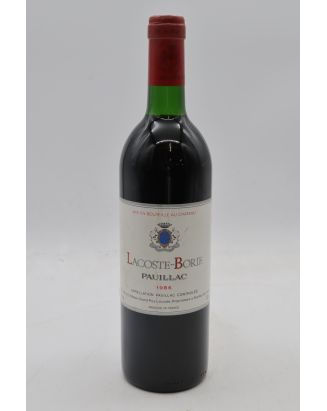
The estate's second wine, Lacoste-Borie, is drawn from the younger vines of the Château. Although more approachable than its elder, Lacoste-Borie remains a wine of great quality, marked by the same attention to detail in its crafting. It is made primarily from Cabernet Sauvignon, which lends it an elegant tannic structure and a beautiful freshness. Lacoste-Borie is a seductive wine, at once supple and fruity, which can be enjoyed younger, while still offering excellent aging potential. It represents a perfect introduction to the wines of Pauillac for enthusiasts in search of a high-quality wine at a more accessible price.
Pauillac, one of the most prestigious appellations of the Médoc, is among the great wines of Bordeaux, with remarkable vintages that have made history. Among the finest vintages are those of 1975, 1982, 1985, 1986, 1989, and 1990, celebrated for their complexity and longevity. The years 1995, 1996, 2000, 2003, 2005 also stand out for their richness and power. More recently, the vintages 2008, 2009, 2010, 2012, 2014, 2015, 2016, 2017, 2018, 2019, and 2020 have confirmed the exceptional potential of Pauillac, offering wines that are both elegant and powerful, perfect for long aging.
The Fifth Grands Crus Classés offer a rich diversity of estates in the Médoc, bearing witness to Bordeaux's winemaking expertise. In Pauillac, one finds renowned estates such as Château d'Armailhac, Château Batailley, Château Clerc Milon, Château Croizet-Bages, Château Grand-Puy Ducasse, Château Grand-Puy-Lacoste, Château Haut-Bages Libéral, Château Haut-Batailley, Château Lynch-Bages, Château Lynch-Moussas, Château Pedesclaux, and Château Pontet-Canet. In the Haut-Médoc, Château Camensac and Château Cantemerle stand out for their distinctive characteristics. In Margaux, Château Dauzac and Château du Tertre bring a touch of elegance, while Château Cos Labory from Saint-Estèphe completes this prestigious selection. Each of these estates reflects a unique facet of the Bordeaux terroir.
Château Grand-Puy-Lacoste wonderfully embodies the excellence of the Grands Crus of the Médoc. For centuries, this family estate has striven to produce refined, elegant and powerful wines that fully express the richness of their exceptional terroir. Thanks to a judicious grape variety selection, precise winemaking methods and constant care of the vines, the wines of Grand-Puy-Lacoste have become essential benchmarks of the Pauillac appellation.
COLLECTION NEAR PARIS & VAT REFUND FOR TOURISTS
Free collection in our warehouse near central Paris (92)