Personalise your experience
Change your country, language and currency here whenever you wish.
|
|
|
Must-See Châteaux |
|
|
|
|
|
|
|
|
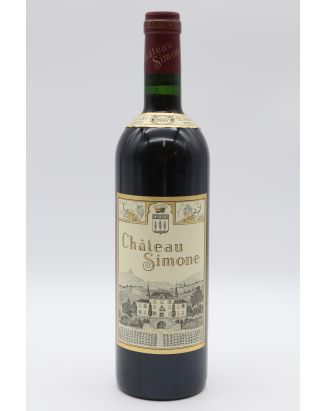
Four kilometers from Aix-en-Provence, in the commune of Meyreuil, Château Simone is the iconic name of the tiny Palette appellation. Owned by the Rougier family since 1830, this domaine de 23 hectares displays a mosaic of north-facing plots on limestone scree, opposite the Sainte-Victoire mountain. Old vines sometimes more than a century old, hand harvesting, indigenous yeasts, long aging exclusively in wood in vaulted cellars carved into the rock by the Grands Carmes monks: everything here reflects an unwavering fidelity to tradition. The red, white, and rosé wines of Château Simone rank among the greatest wines of Provence, with an exceptional aging potential.
Vines have been cultivated on this hillside since ancient times, but the earliest written records date to 1552, when the estate belonged to the monks of the Grands Carmes of Aix. They had the tiered, vaulted cellars carved into the rock; the cellars are still used to age the wines today. The property subsequently passed through the hands of several Provençal families and owes its name to a former owner, Madame de Simon. In 1830, Nicolas Toussaint Rougier acquired the country house and a few hectares of north-facing vines, beginning an unbroken line of winemakers that continues to this day.
At the end of the 19th century, phylloxera destroyed the entire vineyard. Albert Rougier patiently set about rebuilding it, planting clairette extensively—the grape that would become the signature of the house’s white wine. The next generation marked a decisive turning point: convinced of the uniqueness of this forest-enclosed terroir, Jean Rougier submitted an application for official recognition in 1946, leading to the creation of the Palette AOC in 1948. The estate also obtained organic farming certification in 2021. René and then Jean François Rougier, the sixth and seventh generations, continue to uphold this instantly recognizable style today, under an original label that has remained virtually unchanged for decades.
Château Simone’s terroir owes much to a geographical setting rare in Provence. The plots lie at different elevations on the northern slopes of the Montaiguet massif, around 200 meters above sea level, in a natural amphitheater sheltered from the winds and crossed by the Arc River. This microclimate combines moisture from the river, the coolness of a biodiverse woodland setting, and a northerly exposure that protects the grapes from the scorching Mediterranean sun and the force of the mistral. This coolness accounts for the estate’s wines’ tension, length, and exceptional ability to age.
The soil consists of limestone scree from lakebed formations dating to the Tertiary period, mixed with clay, stones, and gravel. The vineyard forms a mosaic of plots in a wooded setting, with vines of an exceptionally high average age: some are more than 125 years old, and missing vines have always been systematically replaced. The grape varieties reflect a deep commitment to Provençal heritage: predominantly clairette for the whites, complemented by grenache blanc, bourboulenc, ugni blanc, and muscat blanc; grenache and mourvèdre lead the reds and rosés, alongside cinsaut, syrah, carignan, various muscat varieties, and now exceedingly rare varieties such as castet and manosquin. The vines are bush-pruned and supported by stakes, and the soils are worked mechanically, without herbicides or chemical fertilizers.
Harvesting is exclusively by hand at full ripeness, with an initial sorting in the vineyard. The grapes are brought to the cellar in small 40-kilogram bins to prevent crushing, then sorted again before being lightly crushed. Fermentation follows traditional methods, using only indigenous yeasts and careful temperature control. The red grapes are lightly crushed and partially destemmed, then fermented in small vats with simple pump-overs, for macerations lasting fifteen to twenty-one days. The white grapes are drained and pressed in vertical hydraulic presses, with manual turning of the press cake and light settling of the juice. The rosé is made by blending directly pressed juice with a proportion of free-run juice drawn off from the red wine vats, accounting for its deep color and unusual body.
Aging takes place entirely in oak, in cellars carved into the rock by the Carmelite monks, where constant humidity and temperature provide ideal conditions. The reds spend eight months in small oak casks, then a year in barrels of different ages, before blending and bottling without filtration. The whites spend eighteen months in small casks, including six months on fine lees, followed by a year in barrels. The rosés are also aged in small casks, kept on fine lees, and clarified by natural settling during successive rackings. There is no pursuit of effect, no showy technology: winemaking aims above all to preserve the integrity of the fruit.
Château Simone Blanc (AOC Palette) is arguably the estate’s best-known wine and one of the great Mediterranean whites. It blends approximately 80% clairette, 10% grenache blanc, 5% bourboulenc, 3% ugni blanc, and 2% muscat blanc, from vines over fifty years old, some of them a century old. In its youth, its golden color accompanies floral and fruity aromas with subtle oak notes. Over time, it takes on an antique-gold hue and develops a bouquet both delicate and powerful, with remarkable depth. Its aging potential is measured in decades, and it reveals its full character after several years in the cellar. Serve with fine fish, poultry in cream sauce, truffles, or aged cheeses.
Château Simone Rosé (AOC Palette) is a food-friendly rosé unlike the pale, light rosés of Provence. Made from grenache (45%), mourvèdre (30%), cinsaut (5%), and a selection of other grape varieties (20%), it has a deep light-ruby color with amber highlights. Lively and structured, with rare body and finesse, it owes its vinous character to aging in oak on fine lees. It can be kept for several years, gaining complexity and making it a rosé for the table that can accompany bouillabaisse, grilled lamb, or spicy dishes.
Château Simone Rouge (AOC Palette) has the same grape varieties as the rosé, with grenache and mourvèdre at its core, complemented by cinsaut, syrah, carignan, and unusual Provençal varieties such as castet and manosquin. Beneath its deep ruby color, it reveals subtle aromas and a highly complex bouquet, combining dark fruit, garrigue, spices, leather, and, with age, balsamic notes. Full-bodied and rich in refined tannins, it rewards patience, coming into its own after five to ten years in the cellar, with aging potential well beyond twenty years. An ideal companion to red meat, game, and slow-cooked Provençal dishes.
Les Grands Carmes de Simone Blanc is the house’s more approachable white, made from younger vines and plots outside the Palette appellation, on the vineyards once tended by Carmelite monks. Vinified and aged with the same care, it offers a more accessible expression of the Simone style, with generous texture, refined bitter notes, and floral freshness. An excellent introduction to the estate’s wines.
Les Grands Carmes de Simone Rosé uses a blend of grenache and mourvèdre complemented by cinsaut, with partial destemming, spontaneous fermentation in large oak casks, and aging on fine lees followed by time in neutral barrels. It is then bottled without filtration. Its deep color and vinous texture set it far apart from easy-drinking rosés, while making it approachable in its youth.
Les Grands Carmes de Simone Rouge combines the house style with a softer approach. With grenache and mourvèdre predominating, traditional maceration in small vats, and aging first in large casks and then in barrels, the wine retains the fine wine’s refined tannic structure and complex bouquet, but offers more expressive fruit and develops more quickly—ideal for discovering Palette without waiting a decade.
COLLECTION NEAR PARIS & VAT REFUND FOR TOURISTS
Free collection in our warehouse near central Paris (92)