Personalise your experience
Change your country, language and currency here whenever you wish.
|
|
|
Must-See Châteaux |
|
|
|
|
|
|
|
|
The wines of Château de Pibarnon in Bandol: an iconic Provence estate
Henri de Saint Victor founded Château de PIBARNON in 1978, and within a few decades established it as one of Bandol’s iconic properties, alongside Tempier and Pradeaux. His son Éric has run Domaine Pibarnon since 2000 and cultivates 52 hectares of vines (47 hectares of red Provence wine + 5 hectares of white Provence wine) on the limestone terroirs of La Cadière d’Azur.
The story begins with love at first sight. In 1977, after exploring several French wine regions, Catherine and Henri de Saint Victor had lunch at a small restaurant in the port of Bandol and discovered Château de Pibarnon’s 1975 red. Captivated, they immediately went up to visit the property, then run by the successor to a winemaker from Piedmont who had made these wines from barely three and a half hectares. The winery and house still relied on wells, with no running water; the terroir was rocky and the surroundings harsh. Yet the couple, then in their fifties, bought the property without hesitation and took possession in 1978.
Henri de Saint Victor undertook extensive work: building restanques, clearing land, replanting, creating a winery and establishing a production framework for both reds and whites. The vineyard grew from sixteen hectares in 1977 to around fifty today. Recognition came quickly, with several consecutive gold medals at the Concours Général Agricole in Paris in the 1980s, followed by praise from international critics. Éric de Saint Victor, who grew up among the large oak casks, officially joined the estate in 1989 and took charge in 2000. He continues the family’s work with a stronger emphasis on environmental stewardship, earning official organic certification in 2019, while constantly refining the expression of its terroirs.
The vineyard forms a southeast-facing amphitheater stepped into restanques—hand-built dry-stone terraces that limit erosion and retain water in a hot, dry climate. The soil is a genuine geological anomaly: although the vines are planted on Triassic bedrock, substantial seams of blue marl and fossil-rich limestone run through it, with material markedly older than that found elsewhere in the appellation. This combination, sometimes compared with Pomerol’s blue clays, gives the wines a rare balance of power and finesse, with a freshness and salinity not found lower down the slope.
Altitude plays a decisive role: summer nights remain cool, the mistral clears the morning sea mist, and the vines benefit from additional moisture that allows mourvèdre to reach full ripeness slowly. This late-ripening, demanding variety reigns here, joined by grenache and cinsault in the reds and rosés, while clairette, bourboulenc, marsanne and rolle occupy a north-facing amphitheater dedicated to the whites. The estate has more than two hundred individually managed plots, with green harvesting to regulate crop load, yields kept around 30 to 35 hectoliters per hectare, and an entirely manual harvest followed by selective sorting.
The winery carries the vineyard’s philosophy forward: revealing mourvèdre’s charming, velvety side rather than its roughness. Depending on the vintage, a significant share of the harvest is fermented as whole clusters. Because the grapes arrive at good ripeness, extraction is exceptionally gentle: the fruit is allowed to infuse rather than being pressed hard. Maceration is long, often two to three weeks, but never excessive, producing ripe, silky tannins without harshness. The rosés blend saignée mourvèdre with directly pressed cinsault, with temperature-controlled fermentation and full malolactic fermentation.
Aging takes place mainly in large oak casks, for approximately eighteen months in the case of Château de Pibarnon’s red. The collection of casks is gradually renewed, with a deliberate mix of coopers and wood ages, to tailor the aging to each terroir without ever imparting a noticeable oak flavor. For its most ambitious cuvées, the estate is also experimenting with stoneware vessels, a fine, low-porosity material that brings brightness, tension and purity while remaining completely neutral. The result is a hedonistic, sensual style that grows more elegant with time.
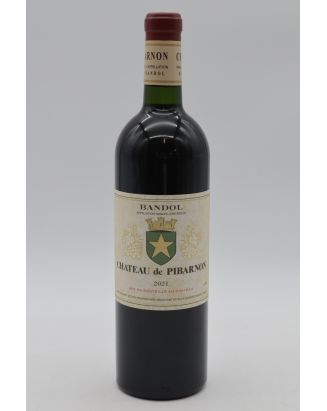
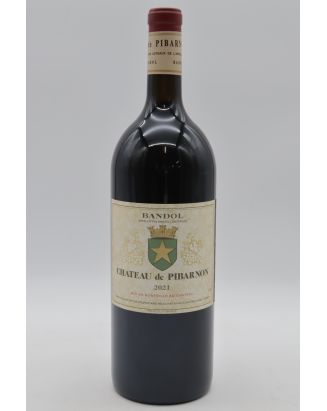
Château de Pibarnon Bandol red: the estate’s flagship cuvée, made from approximately 92% mourvèdre and 8% grenache, sourced from its finest terraces and aged for eighteen months in large oak casks. Extended maceration, gentle extraction, and silky, concentrated tannins: the wine combines velvety richness with a remarkably refined expression of fruit, showing blackberry, truffle, bay leaf and garrigue. A fine wine for aging that often needs around ten years to reveal its full depth, and is readily compared with great Barolos for the elegance it develops over time.
Les Restanques de Pibarnon red: created in the early 2000s, this cuvée blends approximately 70% mourvèdre and 30% grenache, primarily from the youngest vines. More approachable than its older sibling, it offers a generous texture, juicy tannins and great freshness, with a bright, precise and hedonistic character. Black fruit, sweet spices and an airy note make for a Bandol that can be enjoyed young without sacrificing the complexity that defines the estate’s wines.
Château de Pibarnon Bandol rosé: far from a casual patio rosé, it combines saignée mourvèdre with directly pressed cinsault, in proportions close to half of each variety depending on the vintage. It balances power and delicacy, a rich texture and lively freshness, with mourvèdre’s characteristic orange hue and a hint of licorice. Salinity lends lift to its fleshy palate: a rosé made for food, superb with sea bass in cream sauce and capable of aging for several years.
Nuances: the estate’s great age-worthy rosé, born of the idea of deliberately allowing a rosé to mature in the cellar through an entire spring and summer before its release the following fall. Made from 95% mourvèdre from a late-ripening, high-altitude plot harvested early one morning with the mistral blowing, it is vinified and aged partly in a 30-hectoliter large oak cask and partly in a stoneware vessel. A delicately iridescent color, elegant aromas of candied fruit, honey, quince paste and spices, and a distinguished finish: a rosé designed for white meats and fall dishes.
Château de Pibarnon Bandol white: made from clairette, bourboulenc, marsanne and rolle planted in a north-facing amphitheater, it benefits from both the sea’s influence to the south and the cool conditions to the north. Cold settling, a long, slow fermentation and full malolactic fermentation yield a wine with a sea-scented nose and a deep, floral, complex palate of white flowers, almond and citrus, with appealing salinity. An outstanding white for the table, especially with fish and shellfish.
Henri-Cath: a rare and deeply symbolic cuvée honoring Henri and Catherine de Saint Victor, the estate’s founders. From the Bel Air terroir, it stands out for its enveloping texture and exceptional refinement—a tribute to southern French finesse. Produced in very small quantities, it represents Éric de Saint Victor’s most accomplished expression of mourvèdre.
Le Vieux Marc de Bandol: distilled from the estate’s grape pomace and then aged for an extended period in wood, it is a natural extension of the range. Warm and aromatic, with dried fruit, vanilla and sweet spices, it is enjoyed as an after-dinner spirit and reflects the house’s attachment to Provençal traditions.
COLLECTION NEAR PARIS & VAT REFUND FOR TOURISTS
Free collection in our warehouse near central Paris (92)