Pradeaux

Château Pradeaux in Bandol: great wines from Provence

Château Pradeaux wines: buy at the best price

Located in Saint-Cyr-sur-Mer, just a stone's throw from the Mediterranean, Château Pradeaux is one of the landmarks of the Bandol appellation and its most uncompromising guardian of tradition. Owned by the Portalis family since 1752, the estate cultivates around twenty hectares in a single block on clay-limestone soils, where mourvèdre reigns supreme. Whole-cluster harvests, long macerations, four-year aging in old large oak casks: here, shortcuts are refused and the art of waiting is embraced. The result is red wines that are austere in their youth and sumptuous after fifteen or twenty years of cellaring, as well as full-bodied, food-friendly rosés.

Read more
See more
Filters

Price

€20.00 - €40.00

Appellation

Vintage

Volume

Parker WA rating

88 - 95

Burghound rating

No choice available on this group

Revue du Vin de France rating

No choice available on this group

Bettane & Desseauve rating

16 - 17

Prices drop

No choice available on this group

Download this list
There is 1 product.
Download this list
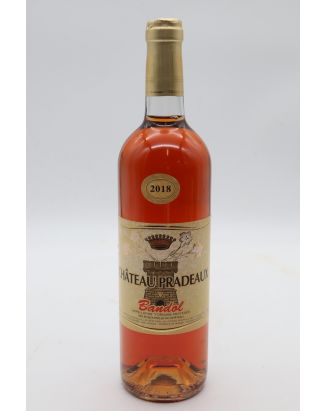
Pradeaux Bandol 2018 rosé
1 in stock
129660
Rosé
75cl
Add to cart
Provence | Bandol

Pradeaux Bandol 2018 Rosé

€26.40 inc-VAT per bottle
€22.00 ex-VAT

History of Château Pradeaux

Château Pradeaux entered the Portalis family in 1752 through an inheritance received by Jean-Marie-Étienne Portalis, a future minister under Napoleon I, co-author of the 1804 Civil Code and author of the Concordat. A great wine lover, he never missed an opportunity to leave Paris for his Provençal vineyards. The property then endured difficult times: ransacked during the Revolution, it was struck hard by phylloxera in the 19th century before being replanted. Later generations visited only occasionally, and the house gradually became little more than a vacation home.

Everything changed in 1939. Fleeing the advancing German troops, Suzanne Portalis and her daughter Arlette left Paris to take refuge at Château Pradeaux. They stayed. Becoming a winemaker through force of circumstance, Arlette rebuilt the estate after occupying troops ravaged the vines and made the decisive choice to produce a red wine containing more than 80% mourvèdre. In 1941, she helped establish the Bandol appellation alongside Pierre Le Roy de Boiseaumarié, one of the founders of the INAO. In 1983, her nephew and adopted son Cyrille, trained at the Beaune wine school, took over with his wife Magali. Since 2010, their sons Étienne, an agricultural engineer specializing in viticulture, and Édouard have represented the ninth generation, guiding the wines toward greater finesse and tension without ever abandoning the house style.

Terroirs and Vineyards of Château Pradeaux

The estate covers approximately 26 hectares, around twenty of them planted within the Bandol appellation, all in one contiguous holding—a rarity in this fragmented appellation. The vineyard stretches across clay-limestone soils dominated by limestone, with red earth and exposed rock, just a few hundred yards from the sea. This maritime proximity, together with the mistral and cool nights, tempers the summer heat and allows mourvèdre, a late-ripening and demanding variety, to mature slowly. Harvest often begins in the first days of October, well after that of most neighboring estates.

Mourvèdre accounts for nearly all the red grape plantings, supplemented by a few old grenache and cinsault vines. Yields are deliberately low, around 25 hectoliters per hectare, and only plots more than twenty-five years old go into the reds; the average vine age is well over thirty-five years. Vineyard work is entirely manual or mechanical, including plowing and moving soil around the vine bases, with no herbicides. For many years, sheep grazed between the rows in spring, providing natural fertilizer and eliminating any need for chemical weed control. The vines are cultivated using organic methods, with scrupulous respect for the site.

Winemaking at Château Pradeaux

The Pradeaux signature begins with a practice that has become extremely rare in Bandol: the grapes are never destemmed. They are lightly crushed and fermented as whole clusters, giving the wines a formidable tannic structure in their youth but an extraordinary ability to age. Maceration is long, fermentation proceeds without added yeast, and Étienne Portalis now punches down the cap less often than in the past, seeking gentler extraction and greater suppleness and tension.

Aging follows, the longest in the appellation and among the longest in France: up to four years, or forty-eight months, in old large oak casks aged forty to eighty years. There is no new oak and no barriques: the large vessels provide the necessary oxygen without ever imparting a noticeable oak flavor. The reds are bottled without fining or filtration. For the rosés, the grapes are pressed directly, the juice is settled cold, fermentation begins with indigenous yeasts in egg-shaped tanks, and malolactic fermentation is deliberately avoided to preserve acidity, before extended aging on the lees.

The Cuvées of Château Pradeaux

Château Pradeaux Bandol red: the flagship cuvée, made from at least 95% mourvèdre from the oldest vines, supplemented by a little grenache that adds a hint of spice and softens the structure. Whole-cluster fermentation, extended maceration, four years in old large oak casks, then bottling without fining or filtration. The nose mingles honey, white flowers, leather and animal notes; the full palate has ripe, powdery tannins and a finish of fresh pepper, violet and licorice. Unyielding in its youth, it becomes splendid and distinguished after fifteen to twenty years of aging.

Cuvée Longue Garde: produced only in exceptional vintages and in tiny quantities—often just a few hundred bottles—it comes exclusively from the estate’s oldest mourvèdre vines, which are more than forty-five years old. Extraordinarily dense and almost black in color, it offers powerful aromas of Provençal herbs and smoked meat, flavors of macerated plum and blackcurrant, and remarkable length. The quintessence of the Pradeaux style, reserved for the most patient wine lovers.

Le Lys red: the estate’s second wine, made from its youngest vines, with approximately 85% mourvèdre supplemented by grenache and cinsault. Half the harvest is destemmed, not to make the wine more immediately flattering but to preserve the balance of a less flavorful fruit, and aging is limited to two years in large oak casks. Blackberry, chocolate, eucalyptus and dark tobacco make for a Bandol that can be enjoyed younger without losing any of the house’s identity, and that can readily be kept for around ten years.

Château Pradeaux Bandol rosé: made from old mourvèdre vines supplemented by cinsault, this is no casual patio rosé. Vinous, full-bodied and structured, it offers red fruit, dried herbs and an appealing, refined bitterness, with acidity preserved by the absence of malolactic fermentation. A true rosé for the table, equally at home with bouillabaisse or white meat, and one that benefits from a few years’ patience.

Le Lys rosé: the rosé counterpart to the second wine, more immediately approachable and fruit-forward, made from young mourvèdre and cinsault vines. A delicate color, aromas of strawberry and citrus, and a fresh, mouthwatering palate: a rosé made for pleasure that nevertheless retains the vinous character and poise typical of the estate.

Vesprée: the house’s great age-worthy rosé, whose name evokes the pink hue of the sky at dusk. Selected by plot at harvest and made almost entirely from mourvèdre, it is vinified and aged for ten to twelve months on fine lees in an egg-shaped concrete tank, without malolactic fermentation, and released a year after the classic rosé. Quince paste, white pepper, spices and citrus zest are supported by a dense texture and remarkable tension. Rejected three times by the appellation authorities, this cuvée—profoundly Bandol in character nonetheless—is sold as Vin de France.

The young-vine rosé: completing the estate’s range of four rosés, this lighter cuvée comes from its newest plots, is vinified in tank and bottled early. It offers a crisp, thirst-quenching profile of small red berries and a saline finish, while retaining the limestone character and restraint that distinguish all the property’s wines.

WHAT THEY SAY ABOUT US

5 good reasons to buy wines on V&M

...

EXPRESS DELIVERY

In a secure polystyrene packaging

...

INTERNATIONAL SHIPPING

Find out more about VAT-EX sale for outside EU deliveries

...

COLLECTION NEAR PARIS & VAT REFUND FOR TOURISTS

Free collection in our warehouse near central Paris (92)

...