Personalise your experience
Change your country, language and currency here whenever you wish.
|
|
|
Must-See Châteaux |
|
|
|
|
|
|
Bernard Magrez's expertise in Saint-Émilion - Grand Cru Classé de Saint-Émilion
Nestled in the heart of the prestigious Saint-Émilion appellation, Château Fombrauge stands out for its rich history, exceptional terroirs, and commitment to precision winemaking. Grand Cru Classé since 2012, this emblematic estate combines tradition and innovation to produce wines of remarkable quality, appreciated throughout the world.
The history of Château Fombrauge dates back to 1466, when Jacques de Canolle, a visionary squire, acquired the property and became the first Lord of Fombrauge. The name "Fombrauge" has its roots in the Occitan expression "fons brogiera", meaning "a spring surrounded by heather and bushes", a reference to the rich and verdant lands of the estate.
Over the centuries, three great families have shaped the history of Fombrauge: the Canolle, the Dumas, and the Taffard. In 1758, Jacques François Dumas inherited the estate and introduced avant-garde agricultural practices. His passion for the vine was expressed in the meticulous care devoted to cultivating the grape varieties and developing the wines, to the point of paying for his artistic commissions in barrels.
Under the direction of Ferdinand de Taffard in the 19th century, Château Fombrauge distinguished itself by its excellence. In 1867, its wines won a gold medal at the Universal Exhibition in Paris, a sign of international recognition.
In 1999, Bernard Magrez, a visionary entrepreneur, acquired the property. Under his leadership, Fombrauge underwent a spectacular revival: renovation of the cellars, reorganization of the gardens, and modernization of viticultural techniques. This tireless work was rewarded in 2012, when Château Fombrauge was elevated to the rank of Grand Cru Classé, restoring all the prestige of this exceptional estate.
The vineyard of Château Fombrauge is the largest of the Grands Crus Classés of Saint-Émilion, spanning 58.6 hectares. Located across three communes — Saint-Christophe-des-Bardes, Saint-Étienne-de-Lisse, and Saint-Hippolyte — it benefits from an exceptional diversity of terroirs. The soils are composed of white clays, astéries limestone, and calcareous molasse, lending the wines a complexity and a unique identity.
The varied exposure of the plots and the richness of the soils allow for precision viticulture. Using modern techniques such as drones and detailed mapping, each plot receives tailored care. These technological tools are combined with traditional methods such as animal-drawn plowing and manual harvesting, ensuring optimal grape quality while respecting the environment.
The vineyard is primarily planted with red grape varieties: 77% Merlot, 14% Cabernet Franc, and 9% Cabernet Sauvignon. The average age of the vines is 30 years, and their planting density reaches 6,600 vines per hectare, promoting the production of concentrated and well-balanced wines.
Winemaking at Château Fombrauge is a meticulous process, blending tradition and innovation to bring out the best in each harvest. After a manual harvest in small crates, a rigorous sorting is carried out before and after destemming. The grapes are then gravity-fed into a variety of vessels — wooden vats, concrete vats, stainless steel vats, and terracotta jars — in order to capture all the aromatic nuances of the grape varieties.
A cold pre-fermentation maceration, lasting between 4 and 8 days at a temperature of 8°C, gently extracts aromas and colors. The maceration duration varies according to the grape variety: 28 to 32 days for Merlot and 26 to 28 days for the Cabernets. Malolactic fermentations take place in new or one-wine barrels, under the supervision of Michel Rolland, an internationally renowned oenologist.
Aging lasts on average 16 to 18 months, with a perfect balance between new barrels (40%) and one-wine barrels (60%). This approach ensures structured, rich, and highly elegant wines capable of aging harmoniously.
Château Fombrauge offers a range of wines that reflects the richness of its terroir and the excellence of its winemaking. Each cuvée is the fruit of a unique expertise, combining power and finesse.
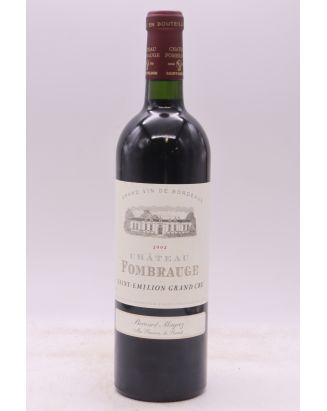
Château Fombrauge Rouge
85% Merlot, 15% Cabernet Franc
A deep and intense color, aromas of red fruits (black cherry, blackberry), and a smooth palate with enveloping tannins. This wine, both indulgent and elegant, offers a beautiful aromatic depth.
Prélude de Fombrauge
The second wine of the estate, Prélude de Fombrauge, stands out for its freshness and suppleness. Crafted with the same care as the fine wine, it offers a more accessible approach, ideal for drinking young.
Château Magrez-Fombrauge Blanc
Although the production of white wine under the Château Fombrauge name has ceased, the estate offers Château Magrez-Fombrauge Blanc, a refined blend of Sémillon, Sauvignon Blanc, and Sauvignon Gris, from limestone soils. This charming wine seduces with its power and floral notes.
Saint-Émilion, a jewel of the Bordeaux wine region, has over the years produced vintages of exceptional quality, delighting lovers of great wines. Among the legendary vintages, one can cite 1947, 1959, and 1961, true icons that have marked the history of Bordeaux wines. The celebrated 1982 vintage also remains an undisputed benchmark. The following decades were equally impressive, with remarkable vintages such as 1990, 1995, 1998, 2000, 2001, 2003, and 2005, all acclaimed for their richness and aging potential. More recently, the vintages 2008, 2009, 2010, 2012, 2014, 2015, 2016, 2018, 2019, and 2020 have shone for their balance and depth, reaffirming Saint-Émilion's reputation as one of Bordeaux's most sought-after appellations, where each new year continues to captivate lovers of great wines with its consistent quality and elegance.
The classification of Premiers Grands Crus Classés B of Saint-Émilion, revised every 10 years, highlights exceptional châteaux from the Right Bank vineyard. Among those that continue to feature in this prestigious category, one finds iconic names such as Château Beau-Séjour Bécot, Château Beauséjour Héritiers Duffau Lagarrosse, Château Bélair-Monange, Château Canon, Château Pavie-Macquin, Château Troplong-Mondot, Château Trottevieille, and Clos Fourtet. Others, promoted in 2012, such as Château Canon-La-Gaffelière, Château Larcis-Ducasse, Château La Mondotte, and Château Valandraud, also illustrate the ever-rising quality of the region's wines. Conversely, some châteaux are no longer classified, such as La Gaffelière (since 2022) and Magdelaine (since 2006). This constant renewal guarantees the excellence and evolution of the Saint-Émilion vineyard, where tradition and innovation blend harmoniously.
Château Fombrauge embodies the perfect alliance between tradition and innovation. Backed by a centuries-old heritage, an exceptional terroir, and precision winemaking, this Grand Cru Classé of Saint-Émilion offers remarkable wines, appreciated by enthusiasts and experts alike.
COLLECTION NEAR PARIS & VAT REFUND FOR TOURISTS
Free collection in our warehouse near central Paris (92)