Personalise your experience

Change your country, language and currency here whenever you wish.
|
|
|
Must-See Châteaux |
|
|
|
|
|
|
Nestled in the heart of the Sarthe, on the borders of Maine, Anjou and Touraine, Domaine de la Bellivière has established itself as the absolute reference for the Jasnières and Coteaux du Loir appellations. Across 18 hectares divided into more than 60 plots and 5 communes, the Nicolas family crafts wines of striking purity and tension, produced from vineyards managed entirely through biodynamic farming. Here, Chenin Blanc and Pineau d'Aunis find their most authentic expression: age-worthy wines with an enchanting minerality, shaped by tuffeau and flint-clay soils that no other region could hope to replicate.
The story of Domaine de la Bellivière begins in the late 1980s, when Éric Nicolas, seized by a consuming passion for wine, began studying oenology in Montpellier. After an initial experience at Château Pibarnon in Provence, he discovered the Loir valley and fell under the spell of its abandoned vineyards, forgotten since the catastrophic frost of 1956 that had decimated virtually all of the plantings.
In 1994, Éric and Christine Nicolas settled in the Jasnières area, leasing 3.5 hectares. The first harvest was entirely lost to frost. The following year, the landowner reclaimed his land. This double setback could have spelled the end of the venture. It was thanks to the generosity of their neighbour Louis Derré, who ceded plots to them, that Domaine de la Bellivière was officially established in 1995, on 5.5 hectares under the Coteaux du Loir appellation.
Driven by unwavering determination, Éric and Christine gradually expanded their vineyard by purchasing plots in Jasnières and the surrounding area. In 2005, the entire estate converted to organic farming. In 2008, biodynamics became the rule, certified Demeter and then Biodyvin from 2011 onwards. In 2015, a new state-of-the-art gravity-flow winery was built, allowing work to be carried out without any mechanical pumping, in complete respect of the grape.
That same year, their son Clément Nicolas joined the estate, soon accompanied by his wife Laure-Anne in 2020. In 2021, the handover was made official: Clément and Laure-Anne took the reins of the estate, carrying on the family's work with the same exacting standards and the same sensitivity. Today, Domaine de la Bellivière is cited as one of the greatest references in the Loire Valley, a flagship of the viticultural renaissance of the Sarthe.
The vineyard of Domaine de la Bellivière extends over 18 hectares dispersed across more than 60 plots in five communes: Lhomme, Ruillé-sur-Loir, Chahaignes, Marçon and Dissay-sous-Courcillon. This mosaic of terroirs is the beating heart of the diversity of the estate's cuvées.
The dominant subsoil is tuffeau, the soft Turonian chalk so characteristic of the Val de Loire, which gives the wines their incomparable saline tension and their ageing potential. On this calcareous bedrock, clay-with-flint deposits accumulate in varying proportions depending on the plot: predominantly clayey in the sectors devoted to the red Pineau d'Aunis wines, more siliceous and stony for the Chenins on the Jasnières hillsides.
The Jasnières appellation covers a strip of vines barely 6 kilometres long and 1 kilometre wide, facing due south on a steep hillside. It is one of the most northerly vineyards in western France; only Chablis, Champagne and Alsace lie further north in terms of French viticulture. This extreme latitude imposes late ripening (harvests take place in October) and constant risks of frost, downy mildew and powdery mildew. Crop losses can reach 50% in a difficult year. But when nature delivers a great vintage, the Jasnières wines from Bellivière reach heights of rare depth.
The Coteaux du Loir appellation has a slightly more south-westerly orientation and soils dominated by clay-with-flint on tuffeau. The vineyard benefits from the protection of the Bercé forest to the north and a temperate microclimate conducive to expressive ripening.
The vines are managed under certified biodynamics, without herbicides or chemical fertilisers, with regular ploughing, mounding and scraping. Plantings are carried out using massal selection (since 2010 in partnership with nurseryman Lilian Bérillon), at deliberately high densities: 7,000 to 10,000 vines per hectare, sometimes up to 11,200, in order to encourage competition between the plants and draw the best from the terroirs. The vineyard is composed of 75% Chenin Blanc and 25% Pineau d'Aunis.
The winemaking philosophy of Domaine de la Bellivière rests on a founding principle: allowing nature to express itself without artifice. The objective is to preserve the integrity of the fruit, the purity of the aromas and the singular character of each terroir.
The harvests are entirely manual, carried out in small crates, with deliberately very low yields (25 hl/ha maximum for reds, sometimes 20 hl/ha for old vines).
The gravity-flow winery inaugurated in 2015 is at the heart of this minimalist approach: the grapes are pressed at height, and the juices flow down by gravity into the cellars carved into the tuffeau, without ever being pumped. This absence of mechanical stress preserves the fine structure and texture of the wines.
For the white Chenin wines, the grapes are pressed directly, then the musts ferment using indigenous yeasts in 350-litre barrels (previously used, oak), over months of ageing on fine lees in the tuffeau cellars. Malolactic fermentation is permitted depending on the cuvée and the vintage. Sulphuring is kept to a strict minimum (between 30 and 40 mg/L of total SO₂ depending on the cuvée), or even none at all for certain experimental versions.
For the red Pineau d'Aunis wines, vinification takes place in open vats with hand punching-down, over a maceration period of approximately one month. Free-run and press wines are systematically blended, then malolactic fermentation occurs naturally in new barrels. Ageing lasts from 12 to 18 months on fine lees. Bottling is carried out without filtration for the top-of-the-range cuvées, with a very light sulphuring.
This winemaking approach — as natural as possible, yet scrupulous, to borrow the very words of the RVF Guide — gives birth to wines of remarkable straightforwardness and salinity, which evolve magnificently in the cellar over 10, 15 or even 20 years.
Jasnières Prémices
A first introduction to the Jasnières world of Bellivière, Prémices is crafted from young Chenin vines (5 to 20 years old) planted on clay-with-flint soils on slopes oriented due south. The barrels used are exclusively old casks, ensuring a pure expression of the fruit without any influence from the wood. It is the most open and accessible cuvée in the Jasnières range: aromas of orchard fruit (pear, ripe apple), beautiful mineral freshness and a characteristic saline finish. Often vinified as a demi-sec depending on the vintage, its sugar-acidity balance is naturally perfect.
Jasnières Les Rosiers
Les Rosiers represents the intermediate level and the core of the range at Domaine de la Bellivière in Jasnières. It comes from the same plots as Prémices, but from a selection of the finest barrels, those most suited to ageing. The vines are less than 50 years old, and ageing takes place in old casks with around one quarter new wood, adding an extra layer of depth and density. The palate is more structured, with marked mineral tension, notes of ripe citrus, quince and white flowers. A remarkable wine for ageing, which blossoms after 5 to 7 years in the cellar.
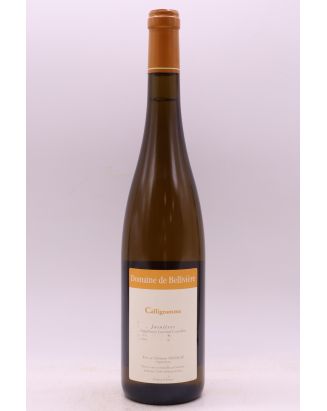
Jasnières Calligramme
An emblematic and monumental cuvée of the estate, Calligramme takes its name from the visual poems of Apollinaire, in which the shape of the text mirrors the meaning of the words. Sourced from old vines of more than 70 years selected by massal selection, planted at very high density (11,200 vines per hectare), it yields naturally low quantities (20 hl/ha in a good year). The terroir is identical to the other Jasnières cuvées — clay-with-flint on tuffeau — but the age of the vines confers an exceptional depth of material and concentration. Ageing is carried out with a small proportion of new barrels to accompany this richness.
Coteaux du Loir L'Effraie
L'Effraie (the barn owl, a nocturnal presence around the cellars) is the estate's dry white wine under the Coteaux du Loir appellation. Crafted in the same spirit as Les Rosiers on the Jasnières side, it expresses a different facet of Chenin: the Loir terroirs bring a rounder texture, notes of honeyed white fruits, candied orange and a saline mineral edge on the finish. An approachable, pure wine of delicate balance, to be enjoyed young or after a few years of ageing.
Coteaux du Loir Vieilles Vignes Éparses
The Coteaux du Loir counterpart to Calligramme, Vieilles Vignes Éparses comes from nine plots of 80-year-old old vines spread across the estate, with a slightly more south-westerly orientation than the Jasnières. The soils here are clay-with-flint on limestone, with a more pronounced clay presence. These octogenarian vines yield no more than 20 hl/ha in good years. The massal selection at 11,200 vines per hectare drives the plants to reach deep into the tuffeau, yielding a concentrated material of extraordinary minerality. The wine opens on honeyed white fruits, notes of candied orange and dried fruits, with a finish of staggering length, elegantly austere. A
COLLECTION NEAR PARIS & VAT REFUND FOR TOURISTS
Free collection in our warehouse near central Paris (92)