Personalise your experience
Change your country, language and currency here whenever you wish.
|
|
|
Must-See Châteaux |
|
|
|
|
|
|
|
|
Located in Cramans, about fifteen kilometers north of Arbois, on the banks of the Loue river which marks the border between the Jura and the Doubs, the domaine des Cavarodes has become, in less than twenty years, one of the most sought-after addresses in French natural wine. Étienne Thiébaud cultivates four and a half hectares of vines using organic farming, some of which are over a century old, and produces a multitude of single-parcel cuvées in minuscule quantities. Chiseled Chardonnays from the Lumachelles, vibrant trousseaux, delicate poulsards and blends of forgotten Jurassian grape varieties: wines of rare purity, brilliance and sincerity.
domaine des Cavarodes was founded in 2007, on the initiative of a young winegrower who was then only twenty-two years old. Étienne Thiébaud had previously spent several years alongside Pascal and Évelyne Clairet, of the domaine de la Tournelle, in Arbois. Deeply inspired by the emblematic figures of Jurassian natural wine — Pierre Overnoy, Jean-François Ganevat, and Stéphane and Bénédicte Tissot — he committed from the outset to an artisanal approach, respectful of living things and without the slightest compromise on quality. From the very beginning, he had the good fortune to acquire a few very old plots that nobody wanted to work any longer.
His progression toward natural winemaking was rapid and deliberate. As early as 2008, he drastically reduced the use of sulfur, henceforth limited to bottling alone. Two years later, in 2010, he went a step further by eliminating it entirely on certain cuvées, and in the same breath released his first pétillant naturel, a wine that captures all the energy and spontaneity of the estate. Discreet to the point of shyness, Étienne Thiébaud has become, despite himself, a genuine star of the international natural wine scene, his bottles both adored by critics and virtually impossible to find. His most persistent dream remains the preservation of forgotten Jurassian grape varieties, which he carefully maintains even though the specifications of the local appellations do not permit their replanting.
The vineyard stretches on both sides of the Loue, straddling the Jura and Franche-Comté, and is divided among three appellations: Arbois, Côtes du Jura, and IGP Franche-Comté. The soils combine hard limestone, limestone scree on marl, and deep marl, a mosaic that accounts for the multiplicity of cuvées produced over a nonetheless very small area. The age of the vines ranges from a few years to over one hundred and fifteen years, with some plots even being ungrafted, franc de pied, survivors of phylloxera.
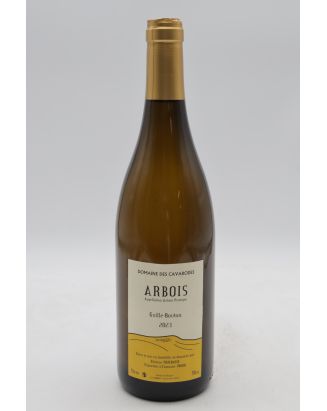
Three named plots structure the range. Les Lumachelles, on the communes of Marnoz and Mouchard just north of Arbois, takes its name from lumachelle, that limestone rock packed with small fossil shells: the grey and brown marls there are saturated with Jurassic shell debris and yield wines of a striking salinity and tension, from chardonnay, poulsard, pinot noir, and trousseau. Guille Bouton, in Arbois, produces a chardonnay of great finesse. Les Messagelins, also in Arbois, is the birthplace of the estate's finest trousseaux, complemented by poulsard and chardonnay. To these terroirs is added the climat of Chemenot. The grape variety selection is exceptionally rich: chardonnay, savagnin, savagnin jaune, savagnin rose, poulsard, trousseau, trousseau à la dame, pinot noir, sauvignonasse, as well as virtually extinct Jurassian varieties such as enfariné noir, mézy, geuche, argant, pinot meunier, and mondeuse. All work is entirely organic and certified since the very beginning, with ploughing sometimes by horse, herbal teas, treatments limited to Bordeaux mixture and sulfur at reduced doses, and pruning aligned with the lunar calendar.
The cellar philosophy is one of attentive listening and minimal intervention. Harvesting is done by hand, with rigorous sorting. The reds are meticulously destemmed by hand and then vinified by semi-carbonic maceration, in open vats or fibreglass tanks, with short macerations and no aggressive pump-overs. Fermentations start spontaneously thanks solely to indigenous yeasts, with no additions whatsoever. Aging then continues for several months, generally around ten, in old barrels, demi-muids, or neutral foudres that impart no oak character.
The whites ferment and age in old barrels over long periods that confer richness, spice, and sometimes a slight oxidative touch that is typically Jurassian, without ever losing their brilliance. No sulfur is added during vinification, and bottling is carried out either entirely without sulfites or with two grams per hectoliter at the absolute maximum when the wine requires it. No fining, no filtration. Volumes are tiny, which explains the rarity of these bottles.
Le Chardonnay Les Lumachelles is one of the estate's emblematic cuvées. Born from the fossiliferous marls of Marnoz, it combines an ample and supple palate with a taut, long, and brioche-laced finish, with that shell-derived minerality that is the signature of the site. Le Chardonnay Guille Bouton, on the hillsides of Arbois, shows greater finesse and more verticality, of a crystalline elegance, while Le Chardonnay Les Messagelins plays a broader and more sun-drenched card. The cuvée Ostrea Virgula takes its name from a Jurassic oyster fossil found in abundance in the plot's soil: it is a white of remarkable depth and complexity, rich, spiced, and expressive, with an interminable saline finish. The Savagnin, depending on the vintage and the aging, is offered either in an ouillé version — taut and citrusy — or with that slight veil character that recalls the Jurassian heritage. Le Pétillant Naturel, born in 2010, bottled before the end of fermentation and with no additions whatsoever, embodies the estate's energy all on its own, with its spontaneous bubble and crunchy fruit.
Le Trousseau Les Lumachelles is probably the most sought-after bottle from the estate. Sourced from the eponymous plot on grey and brown marls rich in small fossil shells, vinified as whole clusters with a short maceration then aged for several months in old barrels, it is bottled without fining, without filtration, and without the slightest added sulfite. The wine combines structure, delicacy, and elegance, on a foundation of black cherry, blackberry, and a spiced edge, with fine tannins and a vibrant acidity. It pairs wonderfully with a guinea fowl supreme with mushrooms, a slow-cooked veal fillet with rosemary jus, or a red tuna tataki. Le Trousseau de Messagelin, on the terroirs of Arbois, offers a firmer and wilder reading of the variety, with superior aging potential.
The Poulsard de Chemenot seduces with its pale, luminous color, its aromas of blackberry, strawberry, and raspberry, and that touch of pomegranate on the finish that brings a noble and refreshing bitterness. Endowed with beautiful minerality and a vibrant energy inherited from the work of the soils, it is a delicate wine that never overpowers refined dishes and is best served slightly chilled. Le Poulsard Les Lumachelles declines the same variety on the shell-rich terroir, with greater salinity. Le Pinot Noir Les Lumachelles, even rarer, reveals an almost Burgundian finesse, with brilliant red fruit and a mineral backbone.
The cuvée that best embodies Étienne Thiébaud's heritage-driven approach is, however, his red IGP Franche-Comté. Sourced from his very first plot — his pride, an old vine over a century old planted en foule — it blends around ten grape varieties: pinot noir and trousseau in the majority, complemented by approximately ten percent of virtually extinct Jurassian varieties — enfariné noir, mézy, geuche, argant, pinot meunier, and mondeuse. This unique wine, impossible to reproduce elsewhere, offers a bewildering and fascinating aromatic profile, between wild red fruits, spices, and noble vegetal notes, carried by a remarkable freshness. Alive, vibrant, and marked by a rare sincerity, it captures with striking precision the singularity of this forgotten corner of the Jurassian vineyard and, on its own, sums up why this still-confidential address has already become a cult destination among lovers of free-spirited wines.
COLLECTION NEAR PARIS & VAT REFUND FOR TOURISTS
Free collection in our warehouse near central Paris (92)