Personalise your experience
Change your country, language and currency here whenever you wish.
|
|
|
Must-See Châteaux |
|
|
|
|
|
|
|
|
Founded in the 17th century, La Maison Drappier is one of the Champagne houses renowned for its dynamism and its Champagne wines characterized by pinot noirs. The Drappier family moved to Urville, in the Aube, in 1805. The vineyards extend between the Côte des Bar, the Montagne de Reims and the Côte des Blancs. The vineyard covers 50 hectares with a majority of pinot noir (70%) but also chardonnay and pinot meunier. Partnerships and quality purchases (chardonnay from Cramant and pinot noir from the Montagne de Reims and Côtes des Bars) complement the estate acreage of this Champagne house, which produces more than one million bottles per year.
Urville’s winemaking history began long before the house was established. The Gallo-Romans planted vines there, but it was Saint Bernard, founder of Clairvaux Abbey, who made the village a center of winemaking by establishing a Cistercian outpost with extensive cellars around 1152. Those cellars are still used today to age the cuvées. The monks introduced morillon noir, an ancestor of Pinot Noir from Burgundy, and developed a substantial wine trade. The family line itself goes back to Rémy Drappier, born in 1604, a cloth merchant in Reims whose surname recalls his original trade. In 1805, François Drappier settled in Urville and began cultivating its vineyards three years later, in 1808: the estate was born.
The 20th century marked a decisive turning point. In the 1930s, Georges Collot, Michel Drappier’s maternal grandfather, replanted extensively with Pinot Noir against local convention, establishing the variety that would define the house’s identity. In 1952, André and Micheline Drappier created Carte d’Or and its now-iconic yellow label. General de Gaulle, a neighbor in Colombey-les-Deux-Églises, became a loyal customer and later inspired a tribute cuvée launched in 1990. Michel Drappier took charge of winemaking in 1979, continuing the work begun by his father André, who died in 2025 after some 60 harvests. In 1988, the house acquired deep chalk cellars excavated in Reims under Napoleon III, complementing the Cistercian cellars in Urville. Today, the eighth generation helps guide an estate that remains resolutely family-run and human in scale, and a pioneer of carbon neutrality in Champagne.
The heart of Drappier’s vineyards extends over some 60 hectares around Urville, on the Jurassic Kimmeridgian limestone of the Côte des Bar—the same limestone-marl subsoil found in Chablis, a few dozen kilometers farther south. Rich in fossils and exceptionally well drained, this terroir, together with abundant sunshine, gives the wines sun-ripened fruit, pronounced vinous character and a recognizable saline minerality. Additional grape sources broaden the palette: powerful Pinot Noirs from the Montagne de Reims, notably Bouzy and Ambonnay, and finely etched Chardonnays from the Côte des Blancs, in Avize, Cramant and Chouilly, bringing the total vineyard area worked to around 100 hectares.
Pinot Noir takes pride of place in the vineyards, accounting for around 70% of the planted area, alongside Chardonnay and Meunier. True to its role as a custodian of heritage, the house also grows Champagne grape varieties that have nearly disappeared: Arbane, Petit Meslier, Blanc Vrai (Pinot Blanc) and Fromenteau (Pinot Gris), living records of the region’s vineyards. Vineyard practices prioritize respect for living ecosystems: a large proportion of the estate is certified organic by Ecocert, some plots are plowed by draft horse, and cover crops and biodiversity are encouraged. This environmental commitment made Drappier the first Champagne house accredited as carbon neutral, a status achieved through sustained work on energy, packaging and logistics.
The winemaking philosophy comes down to one word: naturalness. Only first-press juice, known as the cuvée, is retained, extracted with low-pressure mechanical presses. The must moves by gravity to limit pumping and the risk of oxidation, then settles naturally by simple decantation. Alcoholic fermentation relies heavily on native yeasts from the estate, and malolactic fermentation is generally completed to bring roundness, depth and stability. Some reserve wines are aged in large oak casks and barrels, adding texture without ever imparting a pronounced oak aroma.
Because Michel Drappier himself is intolerant to sulfur, the house has made reducing sulfites a central part of its expertise: the wines contain extremely little added sulfite (often around 20 mg/L), are unfiltered and are not decolorized. This approach culminates in Brut Nature Sans Soufre, made without any sulfur addition. Dosage is deliberately low and uses a liqueur made from organic cane sugar aged for several years—sometimes fifteen—in oak barrels. Aging takes place in the 12th-century Cistercian cellars at a constant temperature of around 10°C, with long periods on racks. Unusually, secondary fermentation takes place in the original bottle for every format, from half-bottles to very large sizes such as the Primat (27 liters) and Melchisédech (30 liters). Grande Sendrée is still riddled entirely by hand.
Carte d’Or Brut: created in 1952, it is the house’s defining wine. Predominantly Pinot Noir, it comes close to a blanc de noirs and shows a golden hue with copper highlights. The nose evokes ripe fruit and the famous quince jelly that is the estate’s aromatic signature. The palate is generous, vinous, fresh and inviting, ideal as an aperitif or with a meal.
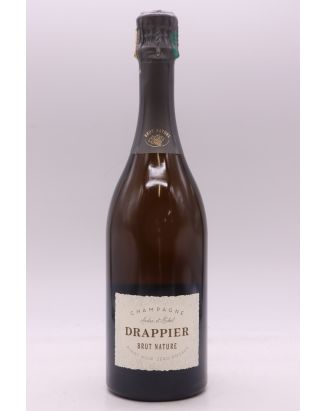
Brut Nature Zéro Dosage: a Champagne made entirely from Pinot Noir, exclusively from the first pressing, with no dosage at all. Purity, tension and directness define this unembellished cuvée, in which the Kimmeridgian terroir speaks without a filter. A food-friendly Champagne for those who appreciate bold, direct flavors.
Brut Nature Sans Soufre: the culmination of the house’s natural approach, this zero-dosage cuvée made entirely from Pinot Noir is produced without any added sulfur. The wine gains brightness of fruit, energy and texture, with vibrant aromatics and a saline finish. A global benchmark for Champagne with no added sulfites.
Clarevallis: conceived by Hugo Drappier, this organic cuvée takes its name from the Latin name for Clairvaux Abbey. It blends approximately 75% Pinot Noir, 10% Meunier, 10% Chardonnay and 5% Blanc Vrai, all from the Urville hillside, part of which is plowed by horse. With an Extra Brut dosage of 4 g/L, it is unfiltered and contains very little added sulfite. It offers a gray-gold hue, aromas of violet, elderflower and dried fruit, and a focused, silky palate with appealing bitter notes.
Rosé de Saignée: Drappier is one of the few houses to make its rosé by macerating Pinot Noir and then drawing off the juice, a demanding technique that yields natural color and aromatic intensity. The nose reveals strawberry, red currant, black currant and spice; the palate is structured, fresh and elegant. A rosé with character that pairs beautifully throughout a meal.
Brut Nature Rosé: an undosed version of the rosé made by the saignée method, also 100% Pinot Noir. Pale orange-pink in color, with an intense nose combining red berries, flowers and spices, and a palate marked by finesse and precision. A limited-production single-plot cuvée made for the table.
Blanc de Blancs Signature: made from around 95% Chardonnay with a touch of Blanc Vrai (Pinot Blanc), it combines floral finesse with roundness. Luminous pale gold in color, with aromas of pear, white peach, apricot and pastries; the palate is mineral, creamy and slightly biscuity. An original blanc de blancs with very little added sulfite, perfect as an aperitif before a fine meal.
Blanc de Blancs Grand Cru: a vintage cuvée made entirely from Chardonnay grown in the Grand Cru villages of Avize, Cramant and Chouilly in the Côte des Blancs. Fermented and aged in stainless steel tanks to preserve its tension, with an Extra Brut dosage of around 5.5 to 6 g/L, it spends about five years aging on racks. White flowers, ripe white fruit with a hint of honey, and finely defined chalkiness create a Champagne of great purity.
Quattuor: a unique blanc de quatre blancs in Champagne, blending equal parts Arbane, Petit Meslier, Blanc Vrai and Chardonnay. Certified organic, this rarity celebrates the nearly forgotten grape varieties of the Champagne vineyards. The wine is mineral, finely etched and highly aromatic, with a persistent finish and vibrant acidity. A cuvée of discovery for curious wine lovers.
Charles de Gaulle: created in 1990 to mark the 50th anniversary of his Appeal of June 18, this cuvée pays tribute to the general, a loyal customer from his home in Colombey-les-Deux-Églises. The blend follows the one he favored: around 80% Pinot Noir and 20% Chardonnay from the Kimmeridgian soils of Urville. The nose combines apple, citrus, almond and nutmeg; the palate is dense, slightly candied, long and refined.
Millésime Exception: presented in a molded bottle as a record of a particular year, this Champagne is produced only when the vintage’s weather conditions warrant it. The blend most often combines a majority of Pinot Noir with a substantial proportion of Chardonnay, using only first-press juice. A complex nose of white fruit, almond, hazelnut and fresh ginger, a creamy, focused palate with brioche notes, and a candied citrus finish.
Grande Sendrée: the prestige cuvée, named for a plot covered in ash after the fire that devastated Urville in 1838; its spelling was altered when the land registry was copied. Made only in outstanding vintages from the oldest vines in the best plots, it blends around 55% Pinot Noir and 45% Chardonnay, with a significant portion aged in oak barrels. After a long rest on racks and entirely manual riddling, it reveals citrus, white flowers, brioche and gingerbread, with a chalky texture of remarkable depth. It is presented in a reproduction of an 18th-century bottle found in the cellars of Urville.
Grande Sendrée Rosé: the rosé counterpart to the prestige cuvée, made by the saignée method from Pinot Noir (around 90%) with a touch of Chardonnay for elegance. Reserved for exceptional years and aged for several years on racks, it combines ripe red fruit, citrus and gentle spices such as cinnamon on a smooth, generous and perfectly balanced palate. A rare food-friendly rosé, superb with a red-fruit dessert or a prepared fish dish.
Les Éphémères and the Œnothèque cuvées: beyond its permanent range, the house offers limited-production series and older bottles disgorged after extended aging, such as Père Pinot, a family wine aged in oak without added sulfur. Produced in very small quantities, these cuvées offer a chance to taste single-plot experiments, rare grape varieties or old vintages patiently preserved in Urville’s Cistercian cellars.
COLLECTION NEAR PARIS & VAT REFUND FOR TOURISTS
Free collection in our warehouse near central Paris (92)