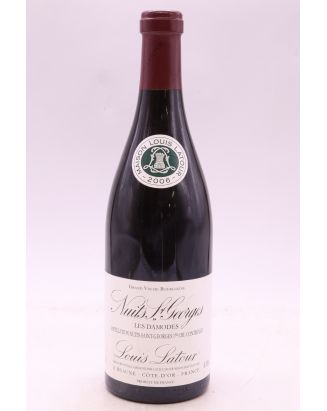
Louis Latour Nuits Saint Georges 1er Cru Aux Damodes 2006
Personalise your experience
Change your country, language and currency here whenever you wish.
|
|
|
Must-See Châteaux |
|
|
|
|
|
|
|
|
A Burgundy family wine house with over 200 years of history
Founded in 1797 and based in Beaune, this family wine house has particularly close ties to the Côte de Beaune, home to 95% of its 50 hectares of vineyards (including 10 hectares of vines for white Burgundy wines), notably its many plots around Aloxe Corton. The eleventh generation is now represented by Louis Fabrice Latour, who chairs Domaine Latour’s management board.
The Latours were coopers first. In 1731, the family acquired its first vines in the Côte de Beaune, marking the beginning of its journey. In 1768, Jean Latour settled in Aloxe-Corton, founded his own cooperage and began building a substantial estate by purchasing plots such as Les Chaillots, Corton Grèves and Corton Bressandes. The French Revolution accelerated this expansion by liberalizing access to vineyard ownership. Maison Louis Latour was officially founded in 1797, and by 1815 it was exporting its first barrels. Between 1830 and 1834, the family built the Corton Grancey winery in Aloxe-Corton, at the time the only building of its kind constructed specifically for winemaking. In 1867, the house became a wine merchant and moved to rue des Tonneliers in Beaune, where it remains today.
Phylloxera, which devastated French vineyards from 1870 to 1931, paradoxically gave the house its most iconic wine. In 1891, at the height of the crisis, Louis Latour purchased Château Corton Grancey—built in 1749 by Gabriel Lebault, president of the Parliament of Burgundy—from the Comtes de Grancey, along with 33 hectares of vines in Aloxe-Corton. Finding that the aligoté planted at the top of the hill had been wiped out, Louis Latour made the visionary decision to plant chardonnay there, on limestone-rich soils that had previously been overlooked. Corton-Charlemagne was born, and his signature still appears on the label today. In 1900, the house purchased grand cru vineyards in the Côte de Nuits, in Romanée-Saint-Vivant and Chambertin, as well as an oak forest to supply its cooperage. A plot of Chevalier-Montrachet Les Demoiselles followed in 1913. In 1943, the Hospices de Beaune presented Louis-Noël Latour with the Cross of Charlemagne, which still overlooks the vineyard.
The 20th century brought international expansion and diversification: Ardèche in 1979, with the Grand Ardèche cuvée created in 1985; the U.S. subsidiary Louis Latour Inc in 1986; Domaine de Valmoissine in the Var in 1989; and a British subsidiary in 1990. In 1997, its bicentennial year, the house was admitted to the highly exclusive Hénokiens, an association of 200-year-old family businesses that still bear their founders’ names. A commitment to sustainable viticulture followed in 1998, ISO 14001 environmental certification in 2003, investment in Chablis that same year, then in Beaujolais in 2008 and the Pierres Dorées in 2015. Louis-Fabrice Latour took the helm in 1999, before Florent Latour succeeded him in 2023.
The heart of the estate lies in Aloxe-Corton, where the family owns 33 of its 48 hectares of vineyards. The hill of Corton, whose name is thought to be a contraction of Curtis Othonis, meaning Othon’s estate, is renowned for the quality of its soils and the diversity of its exposures. At the summit, limestone marl and southern exposure allow chardonnay to reach perfect ripeness: this is Corton-Charlemagne territory, where the house farms an exceptional 10.5 hectares. Farther down the slope, red clays and iron-rich marls give rise to red Corton wines from the climats Clos de la Vigne au Saint, Bressandes, Les Chaumes, Les Pougets, Les Perrières, Clos du Roi and Les Grèves.
Beyond Corton, the estate owns prestigious plots in the Côte de Nuits, in Chambertin and Romanée-Saint-Vivant Les Quatre Journaux, as well as in Chevalier-Montrachet Les Demoiselles on the Côte de Beaune, not to mention several premier crus, particularly in Beaune. In Burgundy, the house works exclusively with single-varietal wines: pinot noir for reds and chardonnay for whites, allowing each plot to express its own aromatic character. The estate has practiced sustainable viticulture for nearly thirty years and is ISO 14001 certified. Under the direction of Christophe Deola, an oenologist and agricultural engineer who joined in 2011 and was appointed estate director in 2017, soil care is paramount: cover crops, compost made on-site, biological pest control, and the planting of trees and hedges. Since 1996, weather stations managed in partnership with the University of Dijon have helped refine decisions about vineyard protection. Paysage de Corton, an association launched at the house’s initiative in 2009, brings Aloxe-Corton producers together to combat erosion and promote biodiversity.
The grapes are harvested entirely by hand, generally from mid-September onward, depending on ripeness and their health. The pinot noir is sorted with care and completely destemmed before fermentation, while the chardonnay is pressed directly after sorting, without destemming. The house’s philosophy is clear: in making a fine wine, 90% of the work takes place in the vineyard, but the remaining 10% is crucial and delicate. The estate’s wines are vinified each year in the magnificent Corton Grancey winery, renovated in 2011 and 2012, with a deliberate commitment to manual, traditional methods.
Aging is another hallmark of the house, which has had its own cooperage since the 18th century, historically supplied by its oak forest. Barrels are made to measure for each cru, with the toast tailored to the wine, and aging generally lasts twelve to eighteen months depending on the appellation. The Louis Latour style favors aromatic clarity, oak that is always well integrated, and balanced structure over displays of power, producing well-built wines capable of developing gracefully for many years.
Corton-Charlemagne Grand Cru is the house’s signature wine, born when the top of the hill was replanted with chardonnay after phylloxera. From 10.5 south-facing hectares comes a white wine of impeccable clarity, with notes of citrus, linden blossom, rose and spice, and oak that is perfectly integrated after eighteen months of aging. Rich rather than bulky, balanced and structured, it has considerable aging potential.
Château Corton Grancey Grand Cru is the house’s legendary cuvée, produced only in the finest vintages. It blends five Corton climats—Les Bressandes, Les Perrières, Les Grèves, Les Chaumes and Le Clos du Roi—vinified and aged separately before the finest barrels are selected. Unique to Maison Latour, this wine captures the essence of a vintage from the family’s historic home ground.
Corton Grand Cru Clos de la Vigne au Saint comes from a very old vineyard, mentioned as early as 1375 in the archives of the Chapter of Saulieu and linked to the Latour family since 1731. With a perfect southern exposure on a rocky outcrop at the foot of the slope, it grows in rust-red soil rich in marl, which gives it highly distinctive aromas and refined elegance.
Corton Grand Cru Clos du Roi comes from one of the hill’s most renowned climats. Powerful and structured, it reveals aromas of black fruit, spice and forest floor, with a refined tannic framework built for long aging.
Corton Grand Cru Perrières takes its name from the old stone quarries. On these stony soils, the wine develops greater minerality and an upright profile, with a more taut, finely etched character.
Corton Grand Cru Domaine Latour blends several southeast-facing plots on the hill, where strict pruning allows for a late harvest and excellent ripeness. This selection ensures consistent quality vintage after vintage and very good aging potential.
Chambertin Grand Cru Cuvée Héritiers Latour, acquired in 1900, represents the pinnacle of Gevrey-Chambertin: an imposing structure, aromatic complexity spanning black fruit, spice, leather and forest floor, a silky texture and legendary longevity. Production is necessarily very limited.
Romanée-Saint-Vivant Grand Cru Les Quatre Journaux is the other historic Côte de Nuits grand cru, acquired by the estate in 1900. It combines the sensuality of Vosne-Romanée with a velvety texture, spicy floral notes and an exceptional mineral finish.
Chevalier-Montrachet Grand Cru Les Demoiselles, acquired in 1913, is the pinnacle of the white wine range. Crystal-pure, it combines vibrant tension, a silky texture and breathtaking length that unfolds over decades.
The house also offers a remarkable collection of grands crus made from carefully selected grapes: among the whites, Montrachet Grand Cru, Bâtard-Montrachet Grand Cru, Bienvenues-Bâtard-Montrachet Grand Cru, Criots-Bâtard-Montrachet Grand Cru and Chablis Grand Cru Les Clos; among the reds, Clos Vougeot Grand Cru, Bonnes-Mares Grand Cru, Clos de la Roche Grand Cru, Échézeaux Grand Cru, Grands Échézeaux Grand Cru, Charmes-Chambertin Grand Cru, Latricières-Chambertin Grand Cru and Mazis-Chambertin Grand Cru. Each is vinified and aged separately, with respect for its individual character.
Among the premier crus produced by the estate and the house are Beaune 1er Cru Aux Cras, Aloxe-Corton 1er Cru Les Chaillots, from the enclosed vineyard surrounding Château Corton Grancey, and Clos Chameroy, a plot acquired in the late 1970s. These are joined by a wide range of premier crus from both Côtes—in Beaune, Pommard, Volnay, Meursault, Puligny-Montrachet, Chassagne-Montrachet, Nuits-Saint-Georges, Gevrey-Chambertin and Chambolle-Musigny—all bearing the house’s hallmark finesse and balance.
Village and regional appellations round out the range with classics such as Bourgogne Chardonnay, Bourgogne Pinot Noir, Bourgogne Aligoté, Marsannay, Meursault, Puligny-Montrachet, Chassagne-Montrachet, Pommard, Volnay, Nuits-Saint-Georges, Vosne-Romanée, Gevrey-Chambertin, Chablis and Pouilly-Fuissé, as well as the Duet cuvée, created in 2002.
Outside Burgundy, the house has built a reputation with its Chardonnay Ardèche and Grand Ardèche. The latter, created in 1985 and aged in oak barrels, helped introduce southern chardonnay to the world. Domaine de Valmoissine Pinot Noir, planted in the Var in 1989 on the foothills of the Verdon Gorges, offers a fresh, fruity pinot noir grown at altitude. The house has also been present in Chablis since 2003 through Simonnet-Febvre, and in Beaujolais since 2008, notably in the Pierres Dorées area since 2015.
COLLECTION NEAR PARIS & VAT REFUND FOR TOURISTS
Free collection in our warehouse near central Paris (92)