Personalise your experience

Change your country, language and currency here whenever you wish.
|
|
|
Must-See Châteaux |
|
|
|
|
|
|
|
|
A leading estate in Saint Aubin: Jean Claude Bachelet
Domaine Jean Claude Bachelet is located in the village of Saint Aubin in Burgundy and covers a vineyard of 10 hectares. Since the passing of their father Jean Claude in February 2020, his two sons Jean Baptiste and Benoît have been running Domaine Jean Claude Bachelet, maintaining continuity as they had joined the estate back in the early 2000s. Domaine Jean Claude Bachelet stands at the very top of the Saint Aubin appellation, but also in Chassagne Montrachet and Puligny Montrachet, where exceptionally fine Villages and Premiers Crus are produced, as well as a prodigious Bienvenues Batard Montrachet Grand Cru.
The earliest traces of the family in the vineyards date back to the early 17th century. As early as 1648, a Pierre Bachelet was growing vines in Chassagne-Montrachet, where the family’s holdings remained concentrated for many years. It was not until around 1900 that the Bachelets settled in Saint-Aubin, in the hamlet of Gamay, nestled at the bottom of the valley behind the Montrachet hill. The estate gradually took root there, in an appellation then considered secondary.
In 1965, following his father’s death, Jean-Claude Bachelet took over a seven-to-eight-hectare estate, more than half of which was still planted with Pinot Noir. A respected winegrower, he built a strong reputation and began moving away from the high-yield, chemical-intensive methods then prevalent at an early stage. His sons joined him around the turn of the millennium—Benoît in 2000 and Jean-Baptiste a few years later—and set about patiently taking the steps from quality to excellence. They began vinifying often tiny parcels separately, converted the entire vineyard to biodynamics beginning in 2016, and gradually refined their aging methods. Still little known in the early 2000s, the estate went from one to watch to an essential reference, then to a cult estate. Jean-Claude Bachelet died in 2020, leaving his sons a legacy they have taken to the highest level, not only in Saint-Aubin, an appellation they have done much to bring to prominence, but also in Chassagne-Montrachet and Puligny-Montrachet. The two brothers see themselves first and foremost as winegrowers rather than business owners, working among the vines from morning to night.
The vineyard covers around 10 hectares, 6 of them planted with Chardonnay, spread across numerous parcels that are often small. The heart of the estate lies in Saint-Aubin, an appellation long overshadowed by its prestigious neighbors and the source of much of its production. Here, the Bachelet brothers produce wines from no fewer than seven premier cru climats. En Remilly, with its very stony soil, and Les Murgers des Dents de Chien, on an east-southeast-facing terrace overlooking the vines of Puligny-Montrachet, rank among the Côte de Beaune’s finest terroirs for white wine. Le Charmois and Les Combes au Sud face east and border Chassagne-Montrachet at the mouth of the valley, while Les Frionnes, Les Champlots, and En Montceau lie farther north in the Saint-Aubin valley around the hamlet of Gamay.
In Chassagne-Montrachet, the estate owns the Les Encégnières lieu-dit, just below the Bâtard-Montrachet and Bienvenues-Bâtard-Montrachet grands crus, as well as the Les Macherelles, La Boudriotte, and, above all, Blanchot-Dessus premier crus. The last is a tiny climat adjoining Montrachet that some call “little Montrachet.” In Puligny-Montrachet, the village-level Les Aubues and premier cru Sous le Puits complete the mosaic, crowned by a parcel of Bienvenues-Bâtard-Montrachet Grand Cru. All the vines are cultivated according to organic and biodynamic principles, with intensive soil work, no pesticides, deliberately low yields, and harvesting entirely by hand. The estate has been certified organic since the 2023 vintage, although the Bachelets had rigorously followed organic practices for much longer.
Winemaking aims to express the identity of each site purely and faithfully, without artifice or embellishment. Harvest dates are chosen parcel by parcel: earlier-ripening sites such as En Remilly in Saint-Aubin and Les Macherelles in Chassagne are picked first, followed a few days later by later-ripening climats such as Blanchot-Dessus. The grapes are pressed slowly, then the musts ferment with indigenous yeasts alone, in deliberately slow fermentations that can last several weeks.
Aging takes place in French oak barrels, historically for eighteen months, but the two brothers have gradually shortened that period to preserve the fruit’s vibrancy and the wines’ mineral tension. The proportion of new oak remains restrained and varies according to the standing of each cru, with the aim of ensuring the oak never shows. The wines rest on fine lees with limited stirring before being bottled with minimal intervention. The result is remarkably luminous white wines, marked by lively acidity, pronounced mineral intensity, and the aromatic purity for which the estate has become known. The Saint-Aubin wines stand out for their energy, while the Chassagne wines bring greater density and notes of mint and toast.
The Bourgogne Chardonnay opens the range and is a benchmark in its category. Lively and crystalline, with unexpected salinity and length for this appellation level, it is one of the best values in the entire Côte de Beaune and the best introduction to the estate’s style.
The Saint-Aubin 1er Cru Les Frionnes, from the valley around the hamlet of Gamay, offers a taut, floral Chardonnay with citrus and hawthorn notes and lovely freshness. The Saint-Aubin 1er Cru Les Champlots strikes a similar note but is broader on the palate, with ripe white-fruit notes and a chalky finish. The Saint-Aubin 1er Cru En Montceau, a less widely available cuvée, stands out for its precision and incisive minerality.
The Saint-Aubin 1er Cru Les Combes au Sud, facing east at the mouth of the valley beside the Chassagne vineyards, develops greater substance and roundness while retaining the high acidity characteristic of the appellation. The Saint-Aubin 1er Cru Le Charmois is one of the estate’s great successes: a delicate, superbly elegant nose, an energetic palate, subtle buttery and minty notes, and a mouthwatering, airy finish. Its aging potential is remarkable, with some older vintages retaining their full brilliance after fifteen years.
The Saint-Aubin 1er Cru En Remilly, planted on very stony soil, reveals this terroir at its finest: both ripe and exceptionally fresh, it combines striking mineral intensity with richly flavorful fruit in a refined balance. The Saint-Aubin 1er Cru Les Murgers des Dents de Chien comes from the appellation’s star climat, one that has nothing to envy in the most prestigious crus of Puligny and Chassagne. The wine is deep and balanced, with extraordinary mineral intensity and power.
In Chassagne-Montrachet, the Chassagne-Montrachet Les Encégnières, a direct neighbor of Bâtard-Montrachet, far exceeds its village-level status, combining minerality, freshness, citron and grapefruit notes, and restrained power. The Chassagne-Montrachet 1er Cru Les Macherelles is generous and bright, with white-fruit and almond notes. The Chassagne-Montrachet 1er Cru La Boudriotte impresses with its wet-stone minerality, power, and intensity, with a long finish carried by fine citrus-zest bitterness.
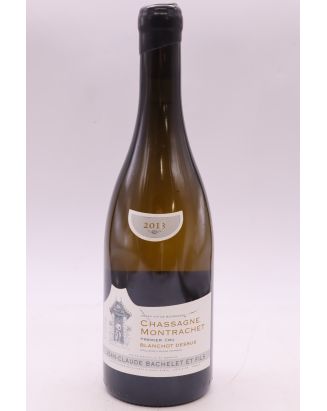
The Chassagne-Montrachet 1er Cru Blanchot-Dessus is one of the estate’s two jewels. This tiny climat adjoining Montrachet, which some call “little Montrachet,” shares its exceptional terroir. In the hands of the Bachelet brothers, it yields a wine with all the hallmarks of a grand cru: density, complexity, a crystalline texture, and spectacular saline length.
The Puligny-Montrachet Les Aubues is a substantial wine: fleshy, savory, pure, and concentrated, with delicate brioche flavors. It is an excellent introduction to this prestigious appellation. The Puligny-Montrachet 1er Cru Sous le Puits, planted at altitude on the edge of Saint-Aubin, gains in verticality and tension, with chalky minerality and excellent aging potential. The Bienvenues-Bâtard-Montrachet Grand Cru crowns the collection: produced in just a few hundred bottles, it offers floral elegance, vibrant preserved lemon, exceptional mineral depth, and a finish that continues to develop for more than fifteen years.
Among the less widely available reds, the Bourgogne Pinot Noir is a lively, easy-drinking wine with cherry and raspberry notes and fine tannins. The Saint-Aubin 1er Cru Derrière la Tour Vieilles Vignes offers a taut, spicy Pinot Noir shaped by high-altitude freshness and a clear limestone character. The Chassagne-Montrachet Vieilles Vignes Rouge brings more substance and depth, with dark fruit and woodland-floor notes. Finally, the Chassagne-Montrachet 1er Cru La Boudriotte Rouge, from the same climat as its white counterpart, stands out for its fine, elegant tannic structure, intense fruit, and a finish that calls for several years in the cellar.
COLLECTION NEAR PARIS & VAT REFUND FOR TOURISTS
Free collection in our warehouse near central Paris (92)