Personalise your experience
Change your country, language and currency here whenever you wish.
|
|
|
Must-See Châteaux |
|
|
|
|
|
|
|
|
Jean-Marc Burgaud established his estate in 1989 in Villiers-Morgon, after training as a winemaker in Burgundy. In 1992, he took over the vines in the Côte de Py sector, previously farmed by his father-in-law. Treatments are predominantly based on copper and sulfur, but organic certification is not claimed. Indeed, Jean-Marc Burgaud prefers to retain some flexibility in the event of high disease pressure, as in 2012 and 2013.
From a family of winegrowers and holding a BTS in viticulture and oenology from Beaune, Jean-Marc Burgaud established his estate in 1989 with three hectares of leased vines — one hectare in Beaujolais-Villages, one in Régnié and one in Morgon. He vinified at the time in the cellars of the Château de Thulon, in Lantignié, a twelfth-century residence belonging to his aunt. The first harvests were sold to négociants, while he built up a clientele and a reputation.
The decisive turning point came in 1992, with the takeover of the Côte du Py vines previously farmed by his father-in-law. Married to Christine, herself the daughter of local winegrowers, Jean-Marc Burgaud gradually acquired new parcels in Morgon between 1998 and 2002, then those of his own father in 2006. The estate thus reached nineteen hectares, thirteen of which are in the Morgon appellation, five in Beaujolais-Villages and one in Régnié — a significant size for the region. The operation remains deeply family-run, however, managed by Jean-Marc, his wife and two employees. A formative stint in Burgundy gave him a taste for parcel-by-parcel work, for destemming adapted to each vintage and for extended ageing, sometimes over two winters. This exacting approach has earned him unanimous critical recognition today and the status of an essential winemaker, respected by his peers.
The Côte du Py, a hill of volcanic origin that dominates Villié-Morgon, forms the heart of the estate with seven to eight hectares, including 4.8 hectares on the upper slope, all around the cross of the Veuve Sauzet, with a south and south-east exposure. On this plateau, soil is almost non-existent: the degraded bedrock, a metamorphosed diorite akin to that of the Côte de Brouilly, is covered by only a few centimetres of sand and blue gravel. The vine struggles here and never yields large quantities, which accounts for the density and depth of the wines. At the foot of the slope, the terroir becomes more clayey: it is here that the Javernières climat is born, whose 0.5-hectare parcel planted in 1967 offers a striking finesse and elegance. The La Pente parcel, exposed to the south facing Mont Brouilly, receives special treatment, with its shoots tied to rattan to shade the bunches and prevent sunburn.
The Grands Cras climat, farmed since 2006 over four hectares, rests on markedly more clayey soils with a significant calcite content: it yields rounded and structured wines, sometimes austere in their youth. Les Charmes is situated to the north-west of the appellation, on a late-ripening and cool plateau at 350 metres of altitude: thin soils over granite and vines exceeding eighty years of age — some planted in 1932 and grafted onto riparia — produce barely forty hectolitres per hectare, with a harvest gathered nearly a week after the others. The Vallières climat, in Régnié, features a granitic subsoil and a sandy surface, very light and well-draining, on vines of forty to fifty years. Finally, the granitic slopes of Lantignié, around the Château de Thulon, carry vines of fifty to sixty years. Vineyard management is thoughtful, with deliberately shallow soil work, very few treatments and no green harvesting, with natural yields sitting between forty and forty-five hectolitres per hectare.
The harvest is entirely manual, as Beaujolais tradition demands. The grapes, in whole bunches or partially destemmed depending on the vintage profile, are vinified by semi-carbonic maceration in concrete tanks, without any added yeasts, with a simple daily pump-over. The maceration period varies according to the cuvée, from a minimum of six days for the Beaujolais-Villages to fifteen days for the Côte du Py. At the end of maceration, free-run wine and press wine are systematically blended together.
The more accessible cuvées are aged in tank until April or May, while the single-parcel cuvées benefit from longer barrel ageing in traditional barriques, 350-litre barrels or demi-muids, selected with the utmost care and almost always from several wines. Sulphiting is reduced to a minimum, around one gram per hectolitre, and degassing is carried out with nitrogen just before bottling. Only the cuvées bottled before summer receive a light filtration at two microns for clarity of colour: the wines aged in barrel clarify naturally and are not filtered.
The Beaujolais-Villages Château de Thulon, also marketed under the name Les Vignes de Thulon, is born on the granitic slopes of Lantignié, very close to the Régnié appellation. Vinified and aged in the cellars of the family château, it captivates with its light purple colour, its nose of blackcurrant bud and its round, suave palate with rounded tannins and a very fine balance. The cuvée Les Vignes de Lantignié offers a similar reading — fruity and immediate, perfect with charcuterie or white meat. The Beaujolais-Villages blanc is a true rarity of the estate: from half a hectare of chardonnay planted on clayey soil in place of a hundred-year-old vine that was uprooted, vinified entirely in tank, without malolactic fermentation and bottled as early as the end of February, it is produced in only around thirteen hundred bottles, on a taut and floral register.
The Régnié Vallières comes from the eponymous lieu-dit, on one hectare of fifty-year-old vines planted on sand and gravel over a granitic subsoil. Supple, rounded and fruity, described by the winemaker himself as joyful and feminine, it offers a lovely colour, a delicate nose of red fruits and a light, fresh and indulgent palate, to be enjoyed within three to five years. It is one of the finest entry points into the world of the estate.
Morgon Les Charmes is born on the eponymous climat, with its octogenarian vines and its cold high-altitude plateau. The colour is violet-ruby, the nose is delicate with cherry and strawberry and a spiced touch, the palate is fruity and fresh, with rounded tannins and remarkable length: it is the most charming and earliest-ready Morgon of the estate, while still possessing depth. Morgon Grands Cras, on calcitic clays, is rounder and more structured, sometimes austere in its youth, but gains greatly with three or four years of bottle age. Morgon Corcelette, on the light granitic sands of the northern part of the appellation, brings a more airy and floral interpretation of the cru. In recent years the estate has also isolated other Morgon climates, such as La Roche, Chollet, Ruyère and the Héritage cuvée, as well as a Vieilles Vignes cuvée — so many variations that reflect the fine parcel-by-parcel approach that is the hallmark of the house.
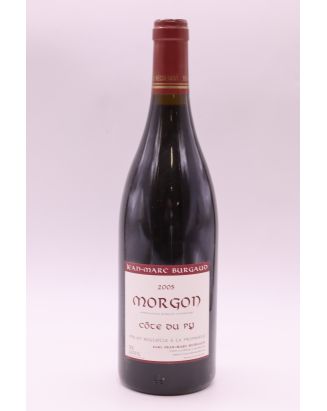
At the summit reign the Côte du Py wines. The Morgon Côte du Py, from the plateau parcels, displays a full-bodied and serious profile, with delicate aromas of peony and Burlat cherry, heightened minerality inherited from the blue rock and an ageing potential of six to ten years. The Morgon Côte du Py Javernières, isolated as a separate cuvée since 2007 and aged in barrel, is the most delicate and most elegant of the series: it possesses no less depth than its elders but is more approachable, with a silky texture and a salivating finish. The Morgon Côte du Py Réserve, also aged in wood, brings together batches of very fine quality from the best parcels and offers an excellent pleasure-to-price ratio at the top of the range. The Morgon Côte du Py James, drawn from the Croix parcel whose rare rootstocks encourage millerandage, is the archetype of a deep, powerful and structured wine: a very deep violet colour, an indulgent nose blending fruit, spice and fine oak, an ample and long body, to be waited five years in lesser vintages and ten in the great ones. Finally, the cuvée 357, offered in magnum, completes this Côte du Py series with a concentrated and distinguished expression of Morgon's greatest terroir.
COLLECTION NEAR PARIS & VAT REFUND FOR TOURISTS
Free collection in our warehouse near central Paris (92)