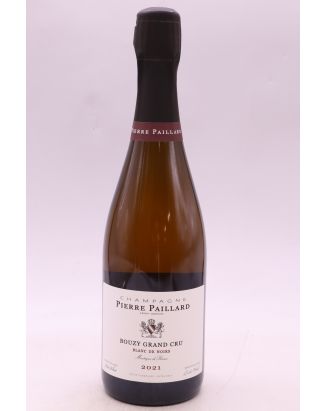
Pierre Paillard Bouzy Grand Cru Extra Brut Blanc de Noirs 2021
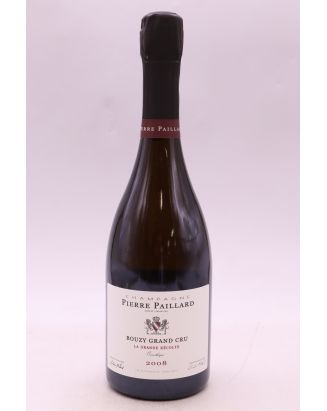
Pierre Paillard Bouzy Grand Cru Extra Brut La Grande Récolte 2008
Personalise your experience
Change your country, language and currency here whenever you wish.
|
|
|
Must-See Châteaux |
|
|
|
|
|
|
The Pierre Paillard estate: grower Champagne wines from Bouzy
Established in Bouzy for more than two centuries, the Pierre Paillard estate is today led by Antoine and Quentin Paillard, two brothers of the eighth generation. Across eleven hectares entirely classified Grand Cru, this family domaine cultivates a simple yet demanding philosophy: produce less but better, respect the soils to achieve high ripeness levels, and give each plot the unhurried time of barrel fermentation. Conversion to organic farming undertaken from 2016, parcel-by-parcel winemaking, long ageing in 19th-century chalk cellars: the cuvées Les Parcelles, Terres Roses, Les Maillerettes, Les Mottelettes and La Grande Récolte are among the most sought-after wines of the Montagne de Reims.
The Paillard family settled in Bouzy as early as the beginning of the 18th century. The family first worked in other trades: shepherds, then innkeeper-carter and schoolmaster. The turning point came around 1768, when an ancestor named Antoine Paillard acquired a few acres of vines in the village and became a winegrower. From generation to generation, the estate grew parcel by parcel, until it formed a family vineyard of eleven hectares located entirely on the legendary Grand Cru terroir of Bouzy — a true rarity in Champagne.
Benoît Paillard, father of the current winemakers, steered the house towards a demanding pursuit of quality, founded on respect for the soils, controlled yields and parcel-by-parcel vinification. His sons Antoine, trained in Avize and responsible for production, and Quentin, in charge of development, officially took over the reins in 2016 after experience in France and abroad. They immediately began converting the vineyard to organic farming and defined a shared signature. In 2018, driven by a love of wine and true to this spirit of excellence, they opened up to the finest neighbouring terroirs of the Montagne de Reims, an approach that gave rise, from 2023, to new old-vine cuvées.
Bouzy occupies the south-facing slope of the Montagne de Reims, a privileged position where full southern exposure and a chalk subsoil give Pinot Noir a unique breed and identity. Ripeness is consistently high here, producing wines that are ample and generous, somewhat rounder and less tense than those of neighbouring Ambonnay, yet endowed with remarkable longevity and complexity. The chalk provides the structure and finesse that carry the opulence of red fruit, and the village has always been as renowned for its still wines as for its champagnes.
The vineyard comprises 10.70 hectares in Bouzy, around identified lieux-dits that are vinified separately: Les Maillerettes planted in 1970, Les Mignottes in 1979 and Les Mottelettes in 1961. Since 2018, these have been supplemented by 0.61 hectare in Ambonnay Grand Cru (Les Aigremonts, La Guillotte, Le Village), 0.60 hectare in Verzy Grand Cru (La Voie Creuse and Les Champs-Mahaut planted in 1930, Les Courtisols), 0.67 hectare in Verzenay Grand Cru (Les Corettes, Les Champs Saint-Martin), 0.60 hectare in Ludes Premier Cru and 0.80 hectare in Taissy Premier Cru. The encépagement is split between approximately 60% Pinot Noir and 40% Chardonnay, the latter being planted where the clay layer is thinnest so that the roots reach the chalk quickly. The brothers use their own compost, ban herbicides and insecticides, and favour mass selection to enrich the genetic diversity of the vineyard.
Each parcel is vinified separately, using indigenous yeasts and natural malolactic fermentation, without rushing anything. The wines then rest for nine to ten months on lees, in tank and barrel, before a deliberately late bottling in June or July, in order to allow the wood to express its influence fully and to respect the slow pace of fermentations. The long ageing ensures a natural clarification that renders fining and filtration unnecessary.
Then comes the moment of truth: each parcel is tasted, scored and commented upon by Benoît, Antoine and Quentin, until the profile of the year is perfectly defined, after which successive blind tastings lead to the definitive composition of each cuvée. The bottles then descend sixteen metres underground, into the family's 19th-century chalk cellars where the ancestors carved their names into the walls. They rest there for three to ten years depending on the cuvée, with a minimum of five years on laths for the single-parcel wines, corked with natural cork, while Les Parcelles and Terres Roses age under crown cap. This extended time allows the carbon dioxide to dissolve completely and the bubble to refine — the hallmark of the vinous and identity-driven champagnes of the house. Dosages remain low, in extra-brut style.
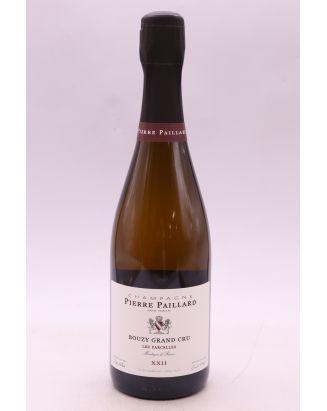
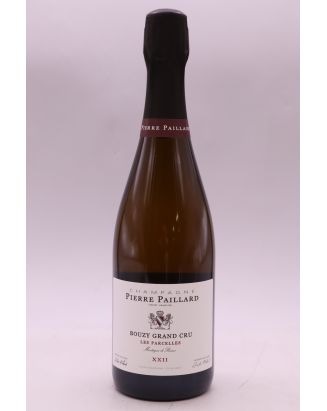
Les Parcelles: the true flagship of the estate, this Extra-Brut cuvée blends a mosaic of twenty-two to thirty distinct parcels located exclusively on the Bouzy terroir, with a strong dominance of Pinot Noir complemented by Chardonnay. It combines the brilliance of ripe fruit with the chalky sap of the Grand Cru, in a precise balance between richness and finesse. Each edition bears a Roman series number — XX, XXI, and onwards.
Les Terres Roses: the house's sole rosé cuvée, Extra-Brut like its siblings and equally marked by the Pinot Noir of Bouzy. A delicate colour, a fresh nose of red fruits and woodland berries, a fine, taut and perfectly savoury palate. Far from demonstrative rosés, this is a true gastronomic wine that pairs as well with shellfish as with poultry and lightly sweetened desserts.
Les Maillerettes: a vintaged blanc de noirs from a parcel of Pinot Noir planted in 1970, considered the mother vine of all others on the estate, so closely intertwined is its history with that of the family. It yields a champagne of great aromatic richness, evoking sun-ripened dark fruits and white flowers, with the freshness, precision and saline touch typical of the finest Bouzy wines.
Les Mottelettes: an Extra-Brut blanc de blancs from a parcel of Chardonnay planted in 1961, where the thin clay layer allows the roots to plunge quickly into the chalk. Old vines, low yields and partial ageing in seasoned barrels produce a wine that is chiselled, floral and deeply mineral, with a persistent saline backbone. A rare interpretation of Chardonnay on a Pinot Noir terroir.
La Grande Récolte: the estate's prestige cuvée, vintaged and produced only in the greatest years. It brings together the fifty-year-old vines of Les Maillerettes and the finest Chardonnays from Bouzy, with ten months on lees followed by nearly a decade of ageing in chalk cellars before disgorgement. Complex, pure and refined, it offers considerable ageing potential and minimal dosage.
Ambonnay Grand Cru: the first expression outside Bouzy, sourced from the lieux-dits Les Aigremonts, La Guillotte and Le Village, planted between 1966 and 1969. Ambonnay brings a more marked tension and verticality than its neighbour, with a floral and spicy aromatic profile and an elongated chalky finish. A fascinating counterpoint to the house's sunny style.
Verzenay Grand Cru: a blanc de noirs from old vines sourced from Les Corettes and Les Champs Saint-Martin, planted in 1967 and 1979 on the north-facing slope of the Montagne de Reims. The cooler exposure yields a strict, saline and vibrant Pinot Noir, with notes of tart red fruits, citrus and flint, endowed with a superb capacity for ageing.
Verzy Grand Cru: a cuvée announced for 2027, sourced from exceptional parcels including La Voie Creuse and Les Champs-Mahaut, planted as early as 1930, complemented by Les Courtisols. These nearly century-old vines promise a champagne of rare density and depth, in the taut and mineral register that has made this forested Grand Cru's reputation.
Ludes Premier Cru: born from the lieux-dits Les Hautes-Pertes and Les Vigneulles-de-Devant planted in 1970, this old-vine cuvée explores a more discreet terroir of the Montagne de Reims. It captivates with its fruity generosity, supple texture and freshness, while retaining the precision and extended ageing typical of the estate.
Taissy Premier Cru: sourced from the parcel Au Dessus des Monthouzons planted in 1963, at the gates of Reims, this cuvée offers a more airy and immediately appealing expression. White fruits, flowers and chalky notes compose an elegant and easy-drinking champagne, often presented as the most accessible entry point in the Montagne de Reims range.
Coteaux Champenois Bouzy Rouge: a still red wine made from Pinot Noir from the lieu-dit Les Mignottes, planted in 1979, in a village historically celebrated for its reds. Aged with the same patience as the champagnes, it unfolds cherry, raspberry and soft spice over fine tannins and a chalky freshness, produced in very limited quantities depending on the vintage.
COLLECTION NEAR PARIS & VAT REFUND FOR TOURISTS
Free collection in our warehouse near central Paris (92)